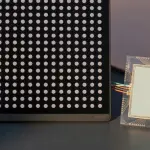
Researchers at PASQAL SAS, alongside collaborations with Electricité de France and CEA DAM, have experimentally studied the notoriously difficult two-dimensional Fermi-Hubbard model using a Rydberg-based quantum processing unit. This work avoids directly encoding complex fermions into qubits, instead reformulating the model onto coupled fermions and spins before decoupling them in a self-consistent manner.
The team introduced an auxiliary spin solver, a hybrid quantum-classical algorithm designed to efficiently tackle free-fermion and interacting spin problems within the analog quantum computer, demonstrating a pathway to explore strongly correlated matter. This approach highlights the potential of combining quantum and classical resources for complex simulations.
Rydberg QPU Enables 2D Fermi-Hubbard Model Simulation
The quasiparticle weight, a central quantity for understanding the Fermi-Hubbard model, was experimentally determined using a 36-qubit Rydberg simulator arranged in a rectangular lattice. This determination allowed researchers to study the equilibrium Mott transition in an anisotropic version of the model, a key step in characterizing strongly correlated materials. The team observed collapsed oscillations of the quasiparticle weight in the Mott phase, aligning with theoretical predictions.
Further simulations, using a 36-qubit Rydberg simulator in a square lattice, explored the non-equilibrium properties of the isotropic model following a rapid change in on-site interaction. Numerical noise models accurately predicted the damping of these oscillations, revealing a plateau at a finite quasiparticle weight, denoted as Zbulk. The simulation relies on representing the original fermionic operators as a product of Pauli operators and pseudo-fermion operators; specifically, =, where is the Pauli operator and is a pseudo-fermion operator.
Solving the resulting spin Hamiltonian with classical methods is computationally intensive, but the model is well-suited for implementation on arrays of Rydberg atoms. The researchers used translational invariance for parameters Qα and Jα in their equations, an approximation valid in the thermodynamic limit or under periodic boundary conditions.
Z_2 Slave Spin Reformulation Circumvents Fermion Mapping
The reformulation of the Fermi-Hubbard model using slave spins allows for a direct solution of strong spin-spin correlations, extending beyond the limitations of single-site mean-field approximations commonly used in this type of simulation. This approach bypasses the need to directly map fermions onto qubits, instead relying on a decoupling process that yields interacting spin degrees of freedom suitable for encoding within a Rydberg-based quantum processing unit.
The resulting hybrid quantum-classical algorithm iteratively combines a classically solved fermionic component with a quantumly simulated spin system, offering a pathway to tackle complex many-body calculations. This methodology uses the programmable nature of tweezer arrays to simulate the Fermi-Hubbard model across diverse lattice geometries, a flexibility not easily achieved with other simulation techniques. After mean-field decoupling, the Hamiltonian splits into two terms: one describing non-interacting fermions and another governing interacting spins, simplifying the computational challenge.
Parameters Qα and Jα, reflecting nearest-neighbor fermion hopping and spin coupling respectively, benefit from translational invariance within the model, further streamlining calculations. The ability to accurately model the dynamics of the spin system, even with a simplified fermionic subsystem, is central to the success of this hybrid approach.
The auxiliary spin mapping introduces a significant simplification regarding initial states; eigenstates of the fermionic Hamiltonian remain Bloch states regardless of the values of Qx(y), meaning the initial fermionic state at zero interaction strength is preserved throughout the simulation. This allows researchers to focus solely on the dynamics of the auxiliary spin system, determined by the fermionic expectation values Jx(y) calculated at equilibrium.
Hybrid Algorithm Couples Classical & Quantum Solvers
The experimental realization of a hybrid quantum-classical algorithm now allows detailed study of the Fermi-Hubbard model, a notoriously difficult problem in condensed matter physics, using a unique approach to computation. Rather than directly encode fermionic behavior onto qubits, the team reformulated the model to couple fermions with spins, then decoupled them in a self-consistent process, using the strengths of both classical and quantum resources. This hybrid algorithm efficiently tackles a free-fermion problem with classical computing, while simultaneously encoding an interacting spin problem directly onto the analog quantum computer.
The resulting workflow allows investigation of both equilibrium conditions, such as the Mott transition, and non-equilibrium properties of the original Fermi-Hubbard model, demonstrating the potential of combined quantum-classical methods for understanding strongly correlated materials. The implementation relies on a workstation solving the fermionic Hamiltonian and iteratively refining the spin Hamiltonian, a process repeated five times to ensure convergence of key parameters.
Recent advances in Rydberg-based quantum processing units, using neutral atoms in programmable optical tweezers, have provided the hardware foundation for this work. These QPUs offer a pathway to analog quantum simulation, complementing the progress being made in universal digital quantum computers and their pursuit of quantum error correction. The team’s approach differs from previous attempts to simulate the Fermi-Hubbard model, which often involved embedding methods or direct encoding of fermions onto qubits, by focusing on the interplay between fermionic and spin degrees of freedom.
“In this algorithm, a Rydberg-based QPU performed the analog simulation of the parent spin Hamiltonian, whereas the parent fermionic problem was solved in a classical workstation requiring few computational resources,” the paper details, highlighting the division of labor between the quantum and classical components. The ability to simulate post-quench dynamics without a continuous feedback loop between the QPU and classical computer further streamlines the process, offering a potentially scalable path towards modeling complex material behavior.
Analog QPU Solves Interacting Spin Problem
This method allows for the simulation of complex material behavior using a hybrid quantum-classical workflow, where a classical computer efficiently solves a free-fermion component while the interacting spin problem is handled by the analog quantum processing unit. This division of labor uses the strengths of both computational paradigms. This hybrid algorithm offers advantages over previous iterations of the Z2 slave spin method, which typically relied on approximations when handling auxiliary spins.
By directly solving the spin problem with the Rydberg-based quantum processing unit, researchers achieved an exact treatment of strong spin-spin correlations within a larger unit cell. The experimental setup, as detailed in the paper, allows for the investigation of the anisotropic Fermi-Hubbard model through this novel mapping technique. Beyond equilibrium conditions like the Mott transition, the method extends to simulating the dynamics following a sudden interaction quench.
The team demonstrated this by tracking the evolution of the quasiparticle weight, Z(bulk), after such a quench on a square lattice of 6×6 sites. Comparisons between data from the quantum processing unit, ideal simulations and simulations incorporating noise models validate the approach and highlight its potential for studying non-equilibrium properties. “We have shown that the algorithm can be used both to study equilibrium and nonequilibrium properties of the original FHM,” the researchers state, emphasizing the versatility of the technique. The iterative workflow, combining classical and quantum resources is key to achieving these results.
Mean-Field Decoupling of Fermion-Spin Hamiltonian
The method relies on a reformulation of the Fermi-Hubbard model, bypassing direct fermion-to-qubit encoding through a Z2 slave spin approach. This allows for many-body fermionic calculations to be performed using spin degrees of freedom, a key distinction from previous methods. The algorithm iteratively combines a classical fermionic solver with the quantum processing unit in a self-consistent workflow, enhancing computational efficiency. This represents an improvement over previous approximations that relied on single- or few-site cluster mean-field approximations.
The team’s work uses the layout flexibility of programmable tweezer arrays to achieve this adaptability. A mean-field decoupling of the spin-fermion Hamiltonian results in two self-consistent terms: one for the fermions and one for the spins. The resulting Hamiltonian is expressed as HFHM ≈ Hf + Hs, where Hf describes the non-interacting fermions and Hs represents the interacting spins.
The effective fermion hopping, Qα, is determined by the nearest-neighbor spin-spin correlations, while the spin coupling, Jα, is linked to the fermionic expectation values. To simplify the self-consistent calculations, the team assumed translational invariance and worked with spinless fermions, scaling spinful expectation values accordingly.
Orion Alpha QPU Demonstrates 36-Site Simulation
The Orion Alpha quantum processing unit successfully simulated a two-dimensional Fermi-Hubbard model using a 6×6 array of neutral atoms, demonstrating a hybrid quantum-classical approach to materials modeling. This experimental realization uses the programmable nature of Rydberg-based QPUs to tackle a notoriously complex problem in condensed matter physics. Researchers decoupled the original fermionic model into interacting spins and non-interacting fermions, a strategy that allowed them to distribute the computational load between a classical workstation and the quantum hardware.
This division of labor is central to the team’s methodology; the classical component efficiently solved the free-fermion problem, while the Orion Alpha QPU tackled the more challenging simulation of interacting spins. By focusing on bulk-averaged quantities measured from the central sites of the lattice, the team mitigated edge effects inherent in finite-size simulations.
The team monitored many-body spin dynamics by measuring the QPU state at various points in time, providing insight into the system’s evolution. This simplification, combined with the assumption of translational invariance, allowed the researchers to focus on spin correlations along specific lattice directions. “We use the Orion Alpha QPU, a Rydberg-based neutral-atom device, to find the ground state or to study the unitary dynamics,” the researchers write, highlighting the device’s role in solving the spin component of the problem.
Mott Transition Studied in Anisotropic Fermi-Hubbard Model
The research team experimentally determined the metallic-Mott transition in an anisotropic Fermi-Hubbard model using 36 interconnected qubits, revealing expected behavior within the simulated system. This investigation, conducted on a rectangular lattice, used a hybrid quantum-classical approach to tackle the complex calculations inherent in modeling strongly correlated materials, extending the reach of current simulation techniques. The anisotropic model, where electron hopping differs along the x and y axes, was chosen to explore how directional interactions influence the transition between metallic and insulating states.
Beyond equilibrium conditions, the same algorithm was applied to simulate the non-equilibrium dynamics of an isotropic Fermi-Hubbard model, also using a 36-qubit setup, but arranged in a square lattice. These observations confirm theoretical predictions about the behavior of electrons in strongly interacting systems following a rapid change in conditions, and demonstrate the method’s capability to probe dynamic properties.
The study’s success hinges on a self-consistent iterative loop, where the quantum processing unit (QPU) and classical computer work in tandem to refine the simulation. Results from the QPU, used to solve the spin component of the model, are fed back into the classical computer, which updates parameters and guides subsequent quantum computations. The team’s work, using a Rydberg-based QPU, expands the scope of accessible material simulations and offers a pathway toward understanding more complex quantum phenomena.
Quasiparticle Weight Reveals Nonequilibrium Dynamics
The anisotropic Fermi-Hubbard model yielded a monotonous decay of the quasiparticle weight with increasing interaction strength, as revealed by the hybrid classical-quantum solver, a finding validated by comparison to a ground-state numerical solver. This result demonstrates the algorithm’s capacity to accurately map the metal-to-Mott transition, a key phenomenon in strongly correlated materials, and confirms the efficacy of the Rydberg-based quantum processing unit (QPU) in tackling complex simulations.
Specifically, the team varied parameters , and Ω within an automated workflow integrating workstation and cloud-accessed QPU to achieve these equilibrium results. The team compared QPU data with ideal matrix product state (MPS) simulations of both the QPU Hamiltonian and a noise model, allowing for a detailed assessment of the impact of imperfections on the observed dynamics. These comparisons included simulations accounting for spatial noise in the registers and laser phase noise, providing a comprehensive view of the experimental conditions.
The study examined two interaction regimes, with approximately equal to 5t representing a weak interaction scenario within the Fermi-Hubbard model, where the quasiparticle weight remained finite, indicating the system stayed within the metallic phase. Rabi frequency offsets of 0.03, 0.04, and 0.04 were included to emulate noisy conditions, informed by pre-calibration measurements performed prior to QPU simulations.
👉 More information
🗞 Hybrid quantum-classical analog simulation of two-dimensional Fermi-Hubbard models with neutral atoms within an auxiliary-spin approximation
✍️ Sergi Julià-Farré et al.
🧠 DOI: http://link.aps.org/doi/10.1103/s7tq-rz7c




See today’s quantum computing news on Quantum Zeitgeist for the latest breakthroughs in qubits, hardware, algorithms, and industry deals.