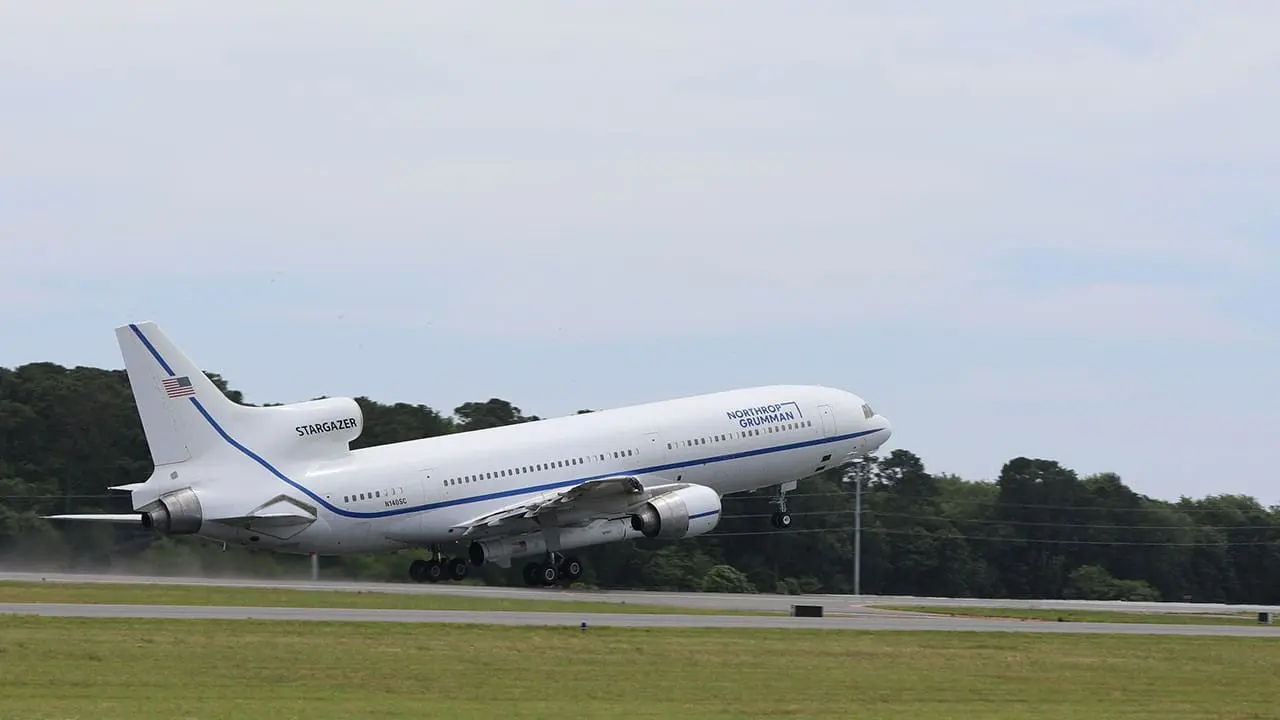
Northrop Grumman’s Stargazer aircraft departed NASA’s Wallops Flight Facility in Virginia on June 18, carrying a unique payload designed to extend the life of a vital space observatory. The modified L-1011 aircraft is en route to Kwajalein Atoll, part of the Republic of the Marshall Islands, transporting a Pegasus XL rocket and the LINK spacecraft built by Katalyst Space. NASA contracted Katalyst to rapidly address unexpectedly accelerated orbital decay of the Neil Gehrels Swift Observatory, a consequence of recent solar activity that caused the satellite to sink faster than anticipated. The mission will effectively “boost” Swift back to a stable orbit via an airborne launch later this month, demonstrating a novel approach to orbital maintenance.
Stargazer L-1011 Aircraft Deploys Pegasus XL with LINK
NASA contracted Katalyst Space to develop LINK, a robotic servicing spacecraft, to address the orbital decline. Katalyst selected Northrop Grumman’s Pegasus XL launch vehicle, determining it was the optimal solution given the urgent timeline and specific orbital requirements. Katalyst determined the Pegasus XL was the best means of reaching Swift, based on orbital and programmatic needs, highlighting the responsiveness required in modern space operations. Following arrival at Kwajalein Atoll, Stargazer will carry Pegasus and LINK to an altitude of approximately 40,000 feet before releasing the Pegasus XL, initiating a ten-minute sequence to deliver LINK into orbit. This operation underscores a growing trend toward in-space repair and maintenance, extending the lifespan of valuable scientific assets like the Swift Observatory and reducing the reliance on costly replacement missions.
Katalyst’s LINK Mission Counteracts Swift Observatory Orbital Decay
The ambitious Swift Boost mission relies on an unconventional launch profile, departing from traditional ground-based methods to address the decaying orbit of NASA’s Neil Gehrels Swift Observatory. This geographically dispersed operation underscores the logistical complexity of on-orbit servicing, requiring international coordination and specialized infrastructure to support the airborne launch platform. This airborne deployment method circumvents the need for dedicated launch facilities and offers greater flexibility in targeting orbital planes, a critical advantage given the time-sensitive nature of the mission to restore Swift’s operational altitude and ensure continued observations of gamma-ray bursts and other transient astronomical events. The success of LINK will not only extend the life of the Swift Observatory but also demonstrate the viability of robotic servicing as a crucial component of long-term space sustainability.
Spacecraft in low Earth orbit experience drag caused by our planet’s atmosphere, which gradually reduces their altitude if they do not have propulsion systems to counteract the effect.




See today’s quantum computing news on Quantum Zeitgeist for the latest breakthroughs in qubits, hardware, algorithms, and industry deals.