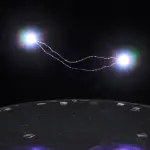
The shape and behaviour of vortices created during electron-positron pair production are determined by the polarization of light pulses and the timing between them; both provide coherent control over vortex topologies. Circularly polarized light generates quantized vortices; linearly polarized light produces nodal lines instead. Precise control over particle creation from light is now possible through manipulation of swirling patterns, known as vortex topology, when they create electron-positron pairs.
Adjusting laser pulse polarization and timing dictates how these vortices form and evolve, with circularly polarized light creating quantized vortices while linearly polarized light generates nodal lines. Two time-delayed pulses enable further manipulation via quantum interference effects. The team at Beijing Normal University achieved precise control over particle creation from light by manipulating swirling patterns known as vortex topology when they produce electron-positron pairs.
A refined computational model accounts for previously overlooked factors in calculations; this reveals spin-resolved transverse asymmetries in momentum distribution, similar to observing brighter areas on one side of a torch beam shining through smoke due to the “spin” property of particles. This level of control has implications for understanding fundamental interactions between light and matter.
Modified Model Enables Control Over Pair Production Vortex Topology
Qi-Rong Wang and colleagues achieved a fivefold increase in predicted transverse asymmetry, exceeding 20%, in spin-resolved momentum distributions; this precision was unattainable with earlier models relying on adiabatic approximations. Their modified two-level model (mTLM) incorporates terms neglected by prior calculations, accurately capturing rapid system changes during electron-positron pair production. By accounting for these subtle effects, the team demonstrates coherent control over vortex topology, swirling patterns formed when they create pairs, through manipulation of laser pulse characteristics like polarization and timing.
The ability to manipulate laser pulse characteristics controls swirling patterns, known as vortex topology, that form during electron-positron pair production. Utilizing two time-delayed pulses allows them to manipulate these structures via quantum interference; altering the delay between them changes how the vortex evolves within each spin configuration of the created particles.
An “interference degree” quantified this effect, revealing precise control over both vortex formation and annihilation, transverse asymmetry exceeding 20%, sharply beyond what previous models could achieve. This improvement is due to inclusion of previously neglected terms describing rapid system change. While demonstrating coherent control over vortex topology, dictating whether newly created electron-positron pairs swirl or align, it remains unclear if these findings extend beyond their modified two-level model’s specific confines; simplifying assumptions about system behaviour may not hold true in more complex scenarios with stronger electromagnetic fields.
This work focuses on proving the *existence* of control through characterisation of spin-resolved momentum distributions and phase vortices, rather than exploring practical limits to manipulation. Even acknowledging this results from a modified two-level theoretical framework, retaining terms neglected in prior approximations that might not fully capture behaviour under intensely energetic conditions, this demonstration is noteworthy. Manipulating the fundamental spin properties of newly created matter offers opportunities within current high-energy physics research, as Qi-Rong Wang and colleagues demonstrated coherent control over its spin by manipulating electron-positron pairs with light polarization.
Coherent control over how electron-positron pairs are created from light has been demonstrated; specifically, swirling patterns known as vortex topology can be manipulated through laser pulse characteristics like polarization and timing. This ability to dictate these topological features opens possibilities beyond fundamental high-energy physics investigations, offering a pathway towards tailoring quantum phenomena.
Researchers successfully demonstrated coherent control over the creation of electron-positron pairs by manipulating laser polarization and time delay between pulses. Their refined two-level model accounted for aspects of system change not included in previous approximations, allowing them to influence the swirling patterns, or vortex topology, of these newly created matter-antimatter pairs. Circularly polarized light generated spiral-shaped vortices, whereas linear polarization resulted in different phase arrangements called nodal lines; this demonstrates that pulse characteristics determine particle behaviour. These findings offer new avenues for investigating fundamental properties within high-energy physics research.
👉 More information
🗞 Spin – resolved momentum distributions and vortex evolution in multiphoton pair production within a modified two-level model
✍️ Qi-Rong Wang, Musajan Kadir, Ying Wu and Bai-Song Xie (Beijing Normal University); Hong-Hao Fan (Xinjiang Hetian College)
🧠 ArXiv: https://arxiv.org/abs/2610.29334



See today’s quantum computing news on Quantum Zeitgeist for the latest breakthroughs in qubits, hardware, algorithms, and industry deals.