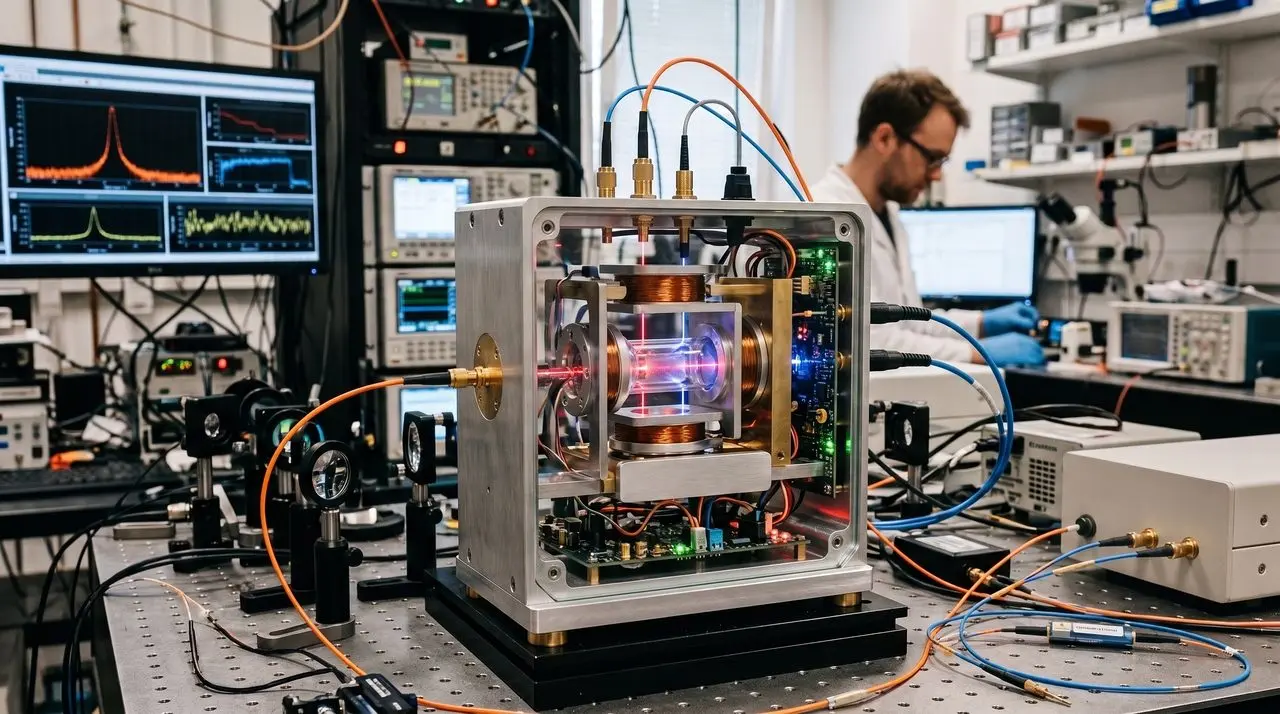
Researchers at the International Quantum Academy in Shenzhen have demonstrated autonomous quantum error correction extending the life of a logical qubit beyond that of its physical counterparts. This achievement, surpassing the critical “break-even point” for quantum computing, protects a qubit encoded in a superconducting microwave cavity from photon loss through engineered dissipation. The work further enhances the precision of frequency shift measurements, achieving a 6.3 dB metrological gain over existing methods. These results illustrate advantages for both fault-tolerant quantum computation and the development of robust quantum sensors.
Beyond-Break-Even Autonomous Quantum Error Correction Demonstration
Engineered dissipation now safeguards a logical qubit’s lifespan 18% beyond that of its constituent physical qubits, marking an unambiguous demonstration of beyond-break-even autonomous quantum error correction (AQEC). The AQEC procedure relies on a coherent controlled-unitary operation, denoted as R = g| + g|, to autonomously correct errors and reset ancilla states through engineered dissipation to a lossy bath. This approach circumvents the risk of propagating ancilla measurement errors, a potential drawback of measurement-based QEC.
The team’s AQEC protocol extends beyond simply prolonging qubit coherence; it also enhances the precision of quantum sensing. By employing this autonomous error correction with a Ramsey interferometer acting on a specific Fock superposition state, researchers achieved a 6.3 dB metrological gain over the most robust Fock-state superposition. The experimental setup uses the encoding |1⟩ + eiφ|4⟩, where φ is a variable phase, to demonstrate the protocol’s efficacy, even without definite photon number parity as an error syndrome.
Engineered Dissipation Enables Photonic Logical Qubit Protection
Engineered dissipation now extends the lifespan of logical qubits beyond that of their constituent physical components, a key step toward practical quantum computation. This unambiguous surpassing of the “break-even point” relies on a method that avoids resource-intensive measurement-feedback control, instead using engineered dissipation to remove error entropy. The AQEC procedure centers on a binomially encoded photonic logical qubit stored within a superconducting microwave cavity, coupled to a transmon qubit functioning as an ancilla.
Environmentally induced errors are coherently transferred to the ancilla, which is then reset through engineered dissipation into a lossy bath. This process autonomously returns the logical qubit to its original state after a photon is lost, effectively correcting the error without the need for direct measurement of error syndromes. The technique employs a coherent controlled-unitary operation, represented as R = g| + g|, to perform this autonomous correction.
By incorporating the AQEC procedure into a quantum metrological experiment designed to detect slight frequency shifts in the photonic mode, the team achieved a maximum Fisher information gain of 6.3 dB over an uncorrected physical qubit. This improvement, they report, demonstrates the potential for AQEC to advance fault-tolerant quantum computation and to build more robust quantum sensors.
“Our results open a promising perspective of AQEC for implementing fault-tolerant quantum computation, as well as for improving the performance of quantum sensors,” the researchers state in their report. The key metric for evaluating AQEC performance is the extension of the logical qubit’s lifetime relative to the best available physical qubit.
In their 3D circuit QED device, the researchers identified the Fock qubit, encoded in the two lowest Fock states |0⟩ and |1⟩, as the most robust physical qubit against dissipation without error correction. Measurements reveal that the binomial code, protected by AQEC, significantly outperforms the unprotected binomial code, the transmon qubit and even the Fock qubit in terms of process fidelity over time. This fully measurement-free QEC scheme represents a departure from conventional approaches that rely on measuring error syndromes and applying adaptive corrections.
By encoding quantum information in a binomial photonic qubit and using a dissipatively engineered ancilla reset process, the team has created a feedback-free error correction cycle. This autonomous correction avoids the propagation of errors from ancilla measurements, a common challenge in other QEC protocols. The researchers conclude that they have demonstrated a method that surpasses the break-even point “without resorting to error syndrome measurement and active feedback control”.
Binomial Encoding of Logical Qubits in Circuit QED
Engineered dissipation is central to the autonomous quantum error correction (AQEC) demonstrated by researchers, enabling ancilla reset and the removal of error entropy to a lossy bath. This process circumvents the need for ancilla measurement and classical feedback, a characteristic that favors scalable quantum computation by reducing resource demands. The logical qubit itself is encoded in a high-quality microwave cavity using the lowest-order binomial codewords, specifically |0L⟩ = (|0⟩ + |4⟩)/( √(2)) and |1L⟩ = |2⟩, where the numbers represent photon number in Fock states.
Single-photon loss, a dominant error mechanism, converts the logical state from the code space into the error space, defined by states like |0E⟩ = |3⟩ and |1E⟩ = |1⟩. Measurements of cavity Wigner functions, both with and without the AQEC cycle, lasting approximately 150 microseconds, confirm the protection afforded to the logical qubit. Further quantification through the quantum process χ matrix for a single AQEC cycle, compared to a scenario without AQEC protection, verifies the effectiveness of the correction.
AQEC Protocol Surpasses Physical Qubit Lifetimes by 18%
This achievement, demonstrated in a three-dimensional circuit quantum electrodynamics device, moves beyond the previously elusive “break-even point” where error correction actually enhances qubit stability. Unlike traditional quantum error correction methods, this approach avoids the need for real-time error syndrome measurements and adaptive corrections, streamlining the process and reducing potential error propagation. Under the AQEC protection, the logical qubit achieves a lifetime surpassing that of the best physical qubit available in the system by 18%.
The team determined these lifetimes by fitting experimental data to a specific function, allowing for a quantitative comparison of qubit stability under different conditions. Further demonstrating the protocol’s utility, the researchers applied AQEC to Ramsey interferometry experiments, a technique used for precise frequency measurements.
6.3 dB Metrological Gain via Autonomous Error Correction
The team demonstrated this break-even point achievement using a photonic logical qubit encoded within a superconducting microwave cavity, shielding it from photon loss. This advance moves beyond simply extending qubit lifetimes; it unlocks improvements in quantum sensing capabilities. This configuration allowed the researchers to assess the impact of AQEC on the clarity and precision of the interference pattern.
Comparison of Measurement-Based QEC and AQEC Procedures
The cavity, exhibiting a single-photon relaxation time of 1.4 milliseconds and a pure dephasing time of 6.5 milliseconds, interacts with the ancilla via a dispersive coupling described by the Hamiltonian Hqc = e|, where χqc is 2π× 0.88 MHz. This extension of logical qubit lifetime is not merely a theoretical advantage. It translates directly into improved performance in quantum sensing applications. This approach represents a departure from previous semi-autonomous QEC procedures that relied on measurement-feedback control, offering a potentially more robust and scalable path toward fault-tolerant quantum computation and enhanced quantum sensing capabilities.


See today’s quantum computing news on Quantum Zeitgeist for the latest breakthroughs in qubits, hardware, algorithms, and industry deals.