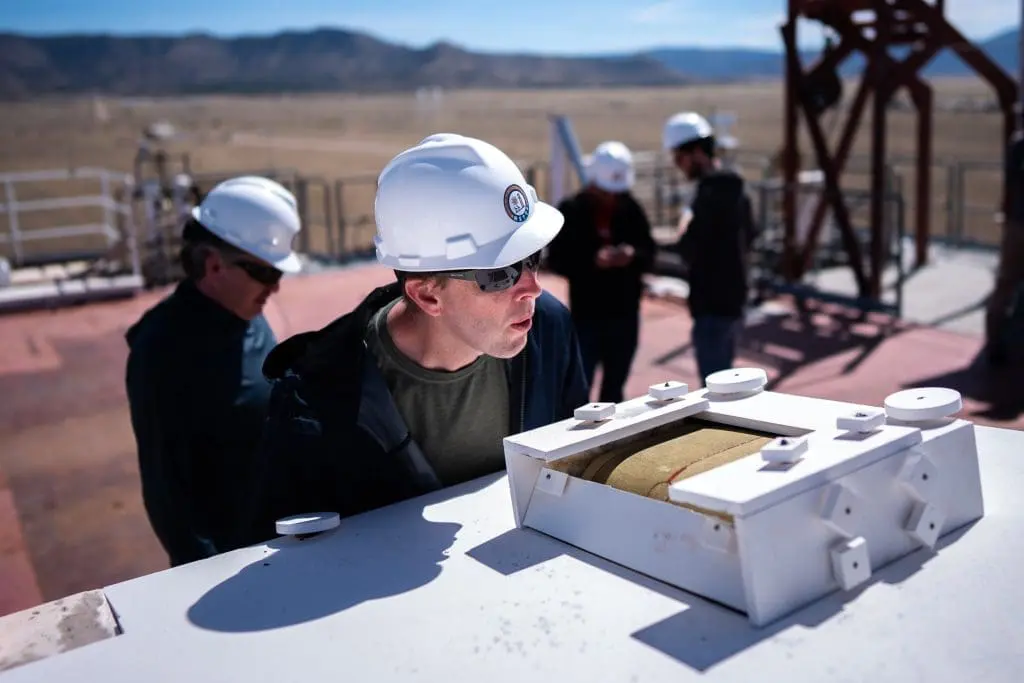
A 24-inch sample of heat shield material successfully withstood a heat pulse of 4,500°F at Sandia National Laboratories’ National Solar Thermal Test Facility, qualifying a critical system for NASA’s Dragonfly mission to Saturn’s moon Titan. The test recreated the extreme conditions the probe will encounter during its high-speed atmospheric entry, where friction and compression will generate intense heat. Hundreds of mirror-like heliostats focused sunlight onto the sample, delivering a controlled heat burst while the team flowed inert gas to simulate Titan’s unique atmosphere. Lockheed Martin engineers were present at the facility, checking samples before and photographing them after exposure. This capability also supports Sandia’s ongoing nuclear deterrence mission.
Sandia’s Solar Facility Recreates Titan’s Atmospheric Entry Heating
The facility’s unique capability to replicate flight-like heating on a large scale proved instrumental in assessing the performance of the heat shield’s thermal protection system, a feat previously unattainable at other ground-based facilities. During the sixth and final solar-tower test campaign, concluding a multiyear effort, teams meticulously varied the orientation of the heat shield segment, including the angle of concentrated sunlight exposure, to analyze performance under diverse conditions. Infrared cameras and diagnostic instruments recorded heat transfer across curved surfaces, edges, and gaps within the material, providing crucial data for validating the shield’s design. “We are able to simulate the heating profile on a physical scale and time scale that’s meaningful for flight, using concentrated sunlight to deliver repeatable tests, independent validation and opportunities to iterate,” said Ken Armijo, Sandia’s lead engineer and test director for the campaign.
The heat shield itself, constructed from PICA-D, Phenolic Impregnated Carbon Ablator-Domestic, developed by NASA’s Ames Research Center in California’s Silicon Valley, underwent testing in various configurations, including flat segments, rounded shoulders, and gap fillers. Lockheed Martin engineers played a key role in the validation process, inspecting samples before and after exposure to the intense heat and documenting any changes or degradation. Nick Courtney, a Lockheed Martin Space engineer, was photographed documenting samples post-test, while Derek Shannon checked samples prior to testing, demonstrating the collaborative effort between Sandia and the company supporting the Dragonfly mission. The data gathered will finalize qualification of the heat shield system, ensuring Dragonfly’s protection during its atmospheric entry. Beyond supporting the Dragonfly mission, this testing campaign has expanded a repeatable high-heat testing capability that benefits Sandia’s nuclear deterrence mission. The team also flowed inert gas over the heat shield sample to better approximate Titan’s atmosphere.
Heliostat Field Focuses 4,500°F Heat on PICA-D Heat Shield
The final test campaign involved subjecting a 24-inch sample of PICA-D, a heat shield material developed by NASA’s Ames Research Center, to a concentrated solar heat flux exceeding 4,500 degrees Fahrenheit. This extreme thermal pulse was generated by a field of hundreds of precisely aligned, mirror-like heliostats, each rotating to focus sunlight onto the test article positioned atop a 200-foot tower. Engineers intentionally replicated conditions expected during Dragonfly’s atmospheric entry, including flowing inert gas over the sample to simulate Titan’s nitrogen-rich environment. The tests focused not simply on reaching a high temperature, but on characterizing heat transfer across the complex geometry of the heat shield, examining curved edges, shoulders, and the performance of gap fillers. The team also evaluated both pristine samples and those with intentional imperfections, assessing the system’s robustness against minor manufacturing flaws. This collaborative effort highlights the synergy between Sandia’s testing capabilities and the expertise of the mission’s prime contractor.
The team will use data from the tests to complete qualification work for Dragonfly’s heat shield system.
NASA
Testing Validates Heat Shield Performance with Material Variations
This collaborative effort between Sandia and the aerospace company recently completed a sixth and final test campaign, concluding a multiyear effort focused on qualifying the heat shield’s performance during Dragonfly’s anticipated atmospheric entry into Titan, Saturn’s largest moon. The tests weren’t merely about confirming the material’s resilience; they represented an expansion of a repeatable high-heat testing capability that benefits Sandia’s nuclear deterrence mission. Crucially, the team also flowed inert gas over the sample, accurately mirroring the composition of Titan’s nitrogen-rich atmosphere and providing a more realistic test scenario. Researchers evaluated various configurations of the heat shield, including flat segments, rounded edges, and gap fillers, as well as samples with intentional imperfections to assess the system’s robustness under less-than-ideal conditions.
We are able to simulate the heating profile on a physical scale and time scale that’s meaningful for flight, using concentrated sunlight to deliver repeatable tests, independent validation and opportunities to iterate.
Ken Armijo, Sandia’s lead engineer and test director for the campaign
While designed to withstand the intense 4,500°F heat pulse anticipated during Dragonfly’s atmospheric entry into Titan, the work also expanded a repeatable high-heat testing capability that benefits Sandia’s nuclear deterrence mission. Engineers meticulously varied the sample’s orientation and the angle of concentrated sunlight, delivering a controlled heat pulse exceeding predicted levels.
This test series for NASA is not just leveraging Sandia’s engineering capabilities; it’s bolstering them.




See today’s quantum computing news on Quantum Zeitgeist for the latest breakthroughs in qubits, hardware, algorithms, and industry deals.