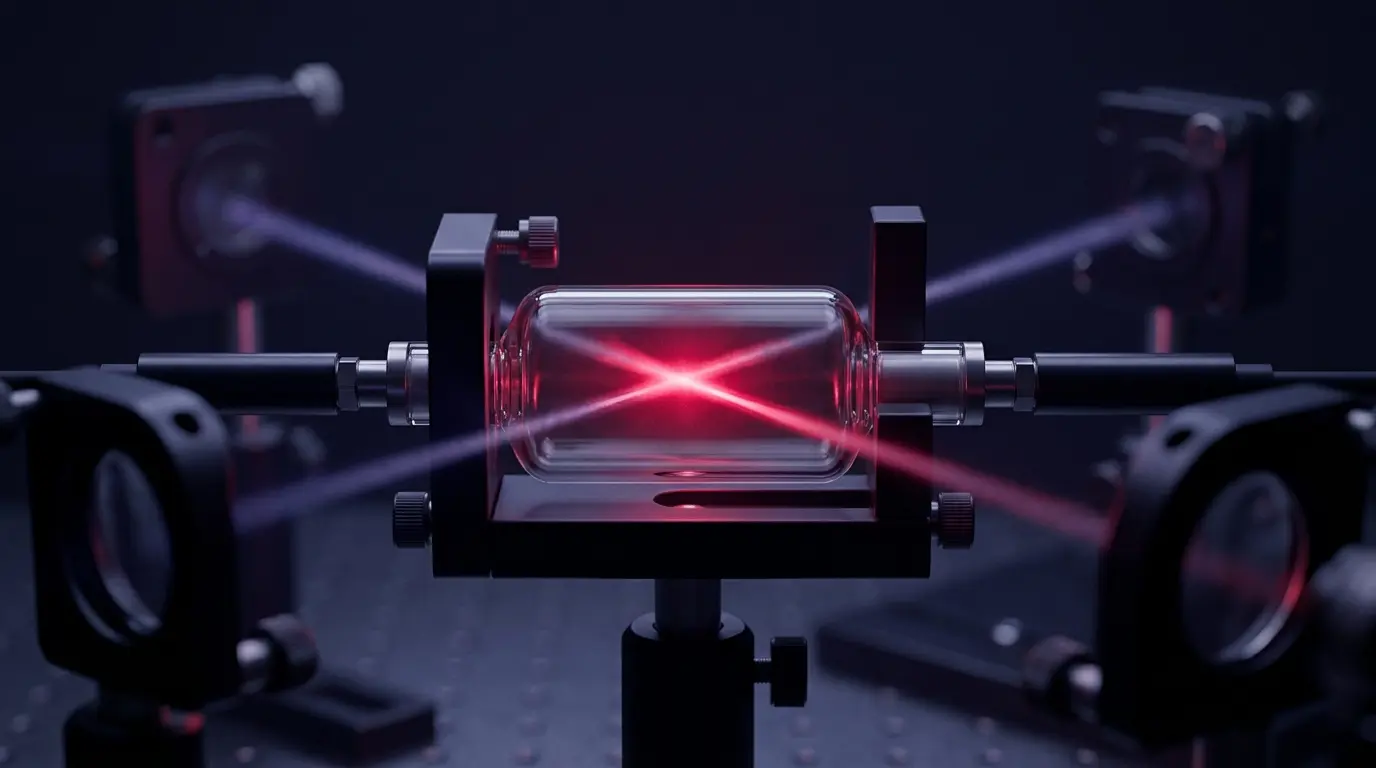
Researchers at Imperial College London and the University of Oxford have demonstrated a programmable processor capable of storing quantum data using 30 temporal modes of light, a significant expansion of channel capacity for future quantum networks. The team built the system around a Raman quantum memory within warm cesium vapor, enabling dynamic control and manipulation of light waveforms.
This approach establishes a coherent interface between drastically different speeds of light, bridging MHz- and GHz-bandwidth modes. By combining deterministic mode conversion with bidirectional bandwidth interfacing, the work establishes the Raman memory as a critical active node for scalable quantum information processing.
Atomic Interface Enables High-Dimensional Temporal Mode Quantum Networks
This achievement moves beyond previous limitations by using a higher-dimensional encoding scheme for quantum bits, or qubits. The Raman memory functions as a versatile processor, mapping photonic fields onto stationary atomic coherence through a two-photon interaction. By dynamically shaping a control field, the memory selectively addresses specific temporal waveforms, enabling on-demand storage, filtering and conversion of quantum data. The design overcomes a longstanding spectral mismatch between high-speed optical links and narrowband atomic nodes.
Broadband architectures, while capable of high-capacity transmission, typically operate at tens of gigahertz to terahertz, creating incompatibility with the megahertz-scale bandwidth of atomic systems. Conversely, traditional matter-based platforms, like Raman memories, offer bandwidth control but have struggled to scale to programmable, high-dimensional temporal mode control.
The demonstrated system bridges this gap, offering a unified interface for both storage and conversion of complex photonic modes. The Raman memory’s capability extends to deterministic mode conversion alongside bandwidth compression and expansion, establishing it as a robust, active node for scalable high-dimensional quantum networks. Researchers validated the platform’s selectivity across the 30 temporal modes, confirming its ability to process complex quantum information carriers. “Operation across the MHz–GHz regime positions the memory as a versatile quantum interface, bridging the spectral gap between narrowband atomic processing nodes and high-speed photonic interconnects,” the authors write.
Currently, storage efficiencies remain a limitation, but the demonstrated versatility positions the Raman memory as an essential building block for future scalable quantum networks. The system’s ability to function as a coherent interface is particularly significant, as it allows for direct connection between disparate quantum network nodes.
Raman Memory Exploits Single-Mode Interaction for Temporal Waveform Control
The ability to selectively store and retrieve quantum information encoded in temporal modes of light has been significantly advanced through a demonstration of filtering within a Raman quantum memory. This level of selectivity is achieved by exploiting the single-mode nature of the Raman interaction, dynamically shaping control fields to function as a tunable filter that addresses specific waveforms. The resulting system offers a pathway toward building more robust and efficient quantum networks capable of handling complex photonic information.
The demonstrated processor operates by manipulating the write and read control fields, allowing for deterministic storage, filtering and conversion of quantum states on demand. This dynamic programmability establishes a critical interface between MHz- and GHz-bandwidth modes, bridging a significant gap in quantum communication technologies.
While achieving high storage efficiency is a persistent challenge in Raman memory systems, the team found that operation as an ideal single-mode filter relies on maintaining a low-coupling limit. Numerical simulations confirmed that increasing optical depth or control power to boost efficiency inevitably opens coupling channels to higher-order eigenmodes, degrading the mode selectivity. This trade-off between efficiency and selectivity is a fundamental constraint. But the demonstrated system achieves a reconstruction fidelity of 0.943 ± 0.015 relative to an ideal single-mode filter, indicating a high degree of precision in the storage and retrieval process.
Component filtering of temporal mode superpositions was also demonstrated, with the system successfully distinguishing between complex combinations of HG modes. The researchers quantified the storage efficiency for each mode using singular values, finding that the distribution was sharply peaked, with the first singular value significantly larger than all others. This indicates that the memory primarily interacts with a single temporal mode, reinforcing its function as a temporal mode filter.
The system’s performance confirms that the Raman storage interaction operates as a near-ideal quantum filter, achieving high-fidelity selection of the target temporal mode. “Although near-unity efficiencies have been achieved in Raman systems, realizing high-fidelity temporal mode processing is fundamentally constrained by the trade-off between coupling strength and single-modeness,” the researchers note, acknowledging the inherent limitations of the approach.
30-Dimensional Hermite-Gaussian Mode Selectivity Validated via Process Tomography
This level of fidelity confirms the system’s ability to maintain the quantum state of information encoded within these complex light patterns during storage and manipulation. The process tomography rigorously assesses the quality of the quantum operation, ensuring minimal distortion of the encoded information. The core of this achievement lies in the use of a Raman quantum memory built within warm cesium vapor, a surprising medium for achieving such precise control over temporal waveforms.
This dynamic programmability allows the system to bridge the MHz-GHz bandwidth regime, establishing an important interface between diverse quantum network nodes. The ability to tailor these control fields enables the selective addressing of specific temporal waveforms, a key requirement for high-dimensional quantum information processing. Analysis of the storage process revealed a singular value decomposition of the storage kernel, separating input and stored spin-wave modes.
This decomposition highlights the system’s inherent single-mode nature, allowing for precise control over the interaction between light and the cesium vapor. The researchers quantified storage efficiency by comparing the integrated counts of reference input, leaked signal and retrieved signal, establishing a clear metric for performance. The measured storage ratios closely aligned with expected weights, confirming the device’s function as a coherent mode filter. This filtering capability is essential for isolating and manipulating specific temporal modes within a complex superposition, preventing unwanted crosstalk and maintaining the integrity of the quantum information.
The system’s performance extends beyond simple storage, demonstrating deterministic mode conversion between different Hermite-Gaussian modes. For example, optimization of the retrieval process successfully converted an HG1 input into an HG3 output, demonstrating the memory’s ability to reshape the temporal profile of the stored light. This conversion is achieved through the convolution of the stored spatial coherence with a tailored read control field, providing a mechanism for dynamically altering the characteristics of the retrieved photon.
Deterministic Mode Conversion and Bandwidth Control in Cesium Vapor
The ability to manipulate the temporal shape of light pulses is now extended to 30 distinct modes, a demonstration of scalable quantum data storage within a warm cesium vapor system. This achievement surpasses limitations inherent in earlier designs by enabling deterministic control over individual waveforms, effectively creating a programmable filter for quantum information. This dynamic control extends beyond simple storage, enabling the conversion of light pulses between different temporal modes and bandwidths.
This bidirectional bandwidth interfacing is critical for connecting disparate quantum network nodes, bridging the gap between high-speed emitters like quantum dots and slower, matter-based systems. The platform’s versatility is demonstrated by its ability to reshape orthogonal Hermite-Gaussian wavepackets, mapping them into and out of an atomic spin-wave via a programmable two-photon transition. The experimental platform itself uses a 75-mm-long cesium-133 vapor cell, stabilized at 105 ± 1 °C, achieving an effective optical depth of (4.8 ± 0.1)× .
The work demonstrates that a single programmable device smoothly integrates these functions, offering a versatile platform for manipulating and interfacing high-dimensional temporal modes. The researchers have thus established the Raman quantum memory as a versatile temporal mode processor, capable of processing high-dimensional temporal modes, such as orthogonal Hermite-Gaussian wavepackets.
Light-Matter Interaction Dynamics in a Λ-Type Energy Level System
Achieving stable storage and retrieval across a basis of temporal modes validates the platform’s selectivity. This capability stems from a carefully engineered interaction between light and matter within a Λ-type energy level configuration using cesium atoms, where a weak signal field and a strong control field couple hyperfine ground states to a virtual excited state. The process maps an input signal onto a long-lived collective spin-wave excitation distributed throughout the atomic ensemble, later reconverted into an optical field via a second control pulse.
To maximize storage efficiency, the researchers initialized the atomic ensemble via optical pumping, achieving 99.6 ± 0.1% population in the desired ground state. The coherent signal and control fields originate from a single continuous-wave laser, tuned to 351.7030 THz and the resulting spin-wave dynamics are described by a linear map transforming the input optical and control fields.
Characterization of this interaction relies on the storage efficiency, quantified by a process matrix that fully encapsulates the storage dynamics. Beyond simply storing information, the platform demonstrates dynamic control over temporal waveforms through manipulation of the read control pulse. The researchers further expanded the pulse energy range using a booster optical amplifier, enabling investigation of bandwidth conversion processes under two distinct retrieval regimes.
👉 More information
🗞 Atomic interface for high-dimensional temporal mode quantum networks
✍️ Shicheng Zhang, Aonan Zhang, Ilse Maillette de Buy Wenniger, Paul M. Burdekin, Jerzy Szuniewicz, Steven Sagona-Stophel, Sarah E. Thomas and Ian A. Walmsley
🧠 DOI: http://link.aps.org/doi/10.1103/s8dg-rmg2




See today’s quantum computing news on Quantum Zeitgeist for the latest breakthroughs in qubits, hardware, algorithms, and industry deals.