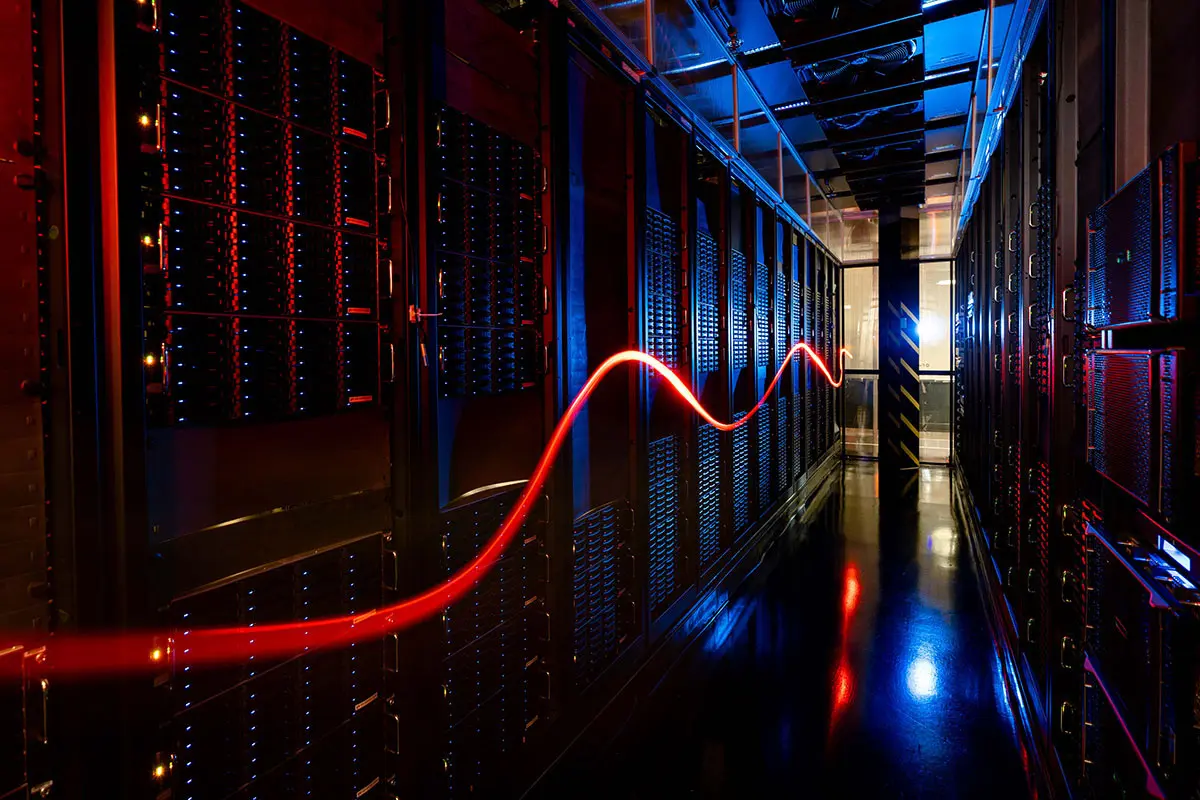
Thousands of hard drives at Fermilab are now forming a critical backbone for the Department of Energy’s Genesis Mission, providing the massive data storage needed to fuel a new era of artificial intelligence-driven scientific discovery. Selected as a key partner for the American Science Cloud, Fermilab’s Fermi Data Platform is delivering petabytes of storage alongside robust data-access tools and decades of institutional expertise in scientific data management. “At Fermilab, we orchestrate thousands of disks to provide petabytes of storage space, and we make sure researchers can access their data quickly and securely,” said Oliver Gutsche, lead of the Fermi Data Platform project. This infrastructure will enable the Genesis Mission to accelerate discovery across disciplines, from high-energy physics to materials science, by automating the process of scientific inquiry and reducing the time to meaningful answers.
Fermilab Data Platform Supports Genesis Mission’s AI Research
Built upon thousands of hard drives, the Fermi Data Platform is not simply a digital repository; it represents a substantial physical infrastructure selected as a key partner due to its capacity and reliability. This selection acknowledges the increasing need for robust data handling as AI transforms scientific workflows. Fermilab’s longstanding expertise in scientific data management, honed over decades working with experiments like the CMS experiment at CERN and its own Short Baseline Neutrino program, positions the laboratory as an institutional leader in this emerging field. This is about storing data and ensuring it’s readily available for the intensive demands of artificial intelligence.
The Genesis Mission aims to dramatically accelerate scientific progress by automating tasks like literature reviews and preliminary simulations. Gutsche illustrated the envisioned workflow by saying, “Give me the 10 most promising materials for batteries, the system does a literature search, runs some simulations to verify, narrows down that list, and presents it as an answer for further research.” Chin Guok, partner integration level 1 lead for the American Science Cloud, emphasizes the fundamental link between data and AI, stating, “Data is the common denominator behind major scientific endeavors, and AI is fundamentally data-driven.” Fermilab’s rapid response in offering data storage and access tools tailored for AI research underscores its commitment to facilitating this new era of discovery.
At Fermilab, we orchestrate thousands of disks to provide petabytes of storage space, and we make sure researchers can access their data quickly and securely.
Oliver Gutsche, lead of the Fermi Data Platform project
Petabyte-Scale Storage for CMS, Neutrino, and Quantum Data
Fermilab’s established infrastructure now underpins a critical component of the Department of Energy’s Genesis Mission; the Fermi Data Platform provides petabytes of storage capacity essential for AI-driven scientific breakthroughs across the American Science Cloud. Fermilab is also preparing to accommodate the substantial data demands of the upcoming Deep Underground Neutrino Experiment, demonstrating a proactive approach to evolving scientific needs. The platform’s role extends beyond mere storage; it actively bridges the gap between raw scientific data and the structured, metadata-rich format required by machine learning models.
At Fermilab, we orchestrate thousands of disks to provide petabytes of storage space, and we make sure researchers can access their data quickly and securely.”
Oliver Gutsche, lead of the Fermi Data Platform project
American Science Cloud Enables AI-Driven Scientific Workflows
Fermilab’s Oliver Gutsche is overseeing the integration of petabytes of scientific data into the Department of Energy’s Genesis Mission, a project designed to accelerate discovery through artificial intelligence. This infrastructure extends beyond simply archiving information; it actively prepares datasets for use in advanced AI workflows. Raw data from experiments, often lacking the necessary structure for machine learning, is processed and organized by the Fermi Data Platform to become “AI-ready.” This capability is central to the Genesis Mission’s ambition to automate key steps in scientific inquiry, from literature reviews to preliminary simulations. Gutsche envisions a system where a researcher could pose a question, such as identifying promising battery materials, and receive a curated response generated by AI. By offering readily accessible, well-organized data, Fermilab is laying a foundation for accelerated scientific breakthroughs across multiple disciplines, from high-energy physics to fusion energy research. This proactive approach is vital for accelerating the Genesis Mission’s goal of automating the scientific process, from literature reviews to simulation results.
To train and run AI models, you need large volumes of data.
Chin Guok, partner integration level 1 lead for the American Science Cloud


See today’s quantum computing news on Quantum Zeitgeist for the latest breakthroughs in qubits, hardware, algorithms, and industry deals.