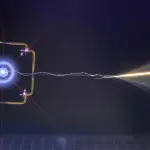
After nearly 20 years of searching Fermi data for definitive signals, astronomers have finally detected gamma rays from a supernova exhibiting an unusually powerful burst of energy. NASA’s Fermi Gamma-ray Space Telescope observed SN 2017egm, a superluminous supernova located 440 million light-years away, producing 10 or more times the amount of visible light normally seen. The gamma rays detected by Fermi occurred from July 5, 2017, to October 25, 2017, corresponding to 43 to 155 days after the supernova’s discovery, suggesting the explosion was powered by a supermagnetized neutron star formed in the star’s collapse. The team performed a deeper analysis to compare how well different models reproduced the observed features. The future Cherenkov Telescope Array (CTAO) could detect a similar supernova out to about 500 million light-years with 50 hours of observing time. This detection provides insight into a magnetar wind nebula, where interactions fuel the production of gamma rays.
Fermi Detects Gamma Rays from Superluminous Supernova SN 2017egm
The detection, detailed in a recent Astronomy & Astrophysics paper, suggests a supermagnetized neutron star, a magnetar, was likely responsible for the extraordinary brightness. SN 2017egm, located approximately 440 million light-years away in the constellation Ursa Major, was initially identified by the European Space Agency’s Gaia mission on May 23, 2017, and quickly distinguished itself as an exceptionally luminous event. Researchers have identified nearly 400 such superluminous supernovae in the last two decades, each producing 10 or more times the amount of visible light normally seen. The team performed a deeper analysis to compare how well different theoretical models reproduced the observed optical and gamma-ray features.
These magnetars, possessing magnetic fields up to 1,000 times stronger than typical neutron stars, or 10 trillion times stronger than a refrigerator magnet, generate a magnetar wind nebula. “About three months after the collapse, as the supernova debris expands and cools, the gamma rays can begin to leak out,” Acero said. Further research, potentially aided by the future Cerenkov Telescope Array Observatory, could detect a similar supernova out to about 500 million light-years with 50 hours of observing time and refine our understanding of these powerful cosmic explosions.
Core-Collapse Supernovae and the Origin of Superluminous Events
The supernova, a type of core-collapse event occurring when a massive star exhausts its fuel, is believed to have birthed a highly magnetized neutron star, known as a magnetar. This rapid rotation generates a strong outflow of electrons and positrons, forming a magnetar wind nebula. While the magnetar model effectively explains the initial observations, the team acknowledges that additional processes likely contributed to the supernova’s prolonged and irregular fading, including material falling back onto the magnetar and interactions with previously ejected stellar matter.
For nearly 20 years, astronomers have searched Fermi data for gamma-ray signals from thousands of supernovae, and while a few intriguing hints have been reported, none were definitive until now,” study lead Fabio Acero at the French National Centre for Scientific Research (CNRS) and the University of Paris-Saclay .
Magnetar Model Explains SN 2017egm’s Gamma-Ray and Visible Light
Guillem Martí-Devesa, formerly at the University of Trieste in Italy and now at the Institute of Space Sciences in Barcelona, Spain, explains that SN 2017egm shows evidence for gamma rays, confirming earlier hints that some supernovae can be as luminous in gamma rays as they are in visible light. The team performed a deeper analysis of the supernova’s observed optical and gamma-ray features to compare how well different theoretical models reproduced them. This model details how a rapidly spinning, newly formed magnetar, rotating hundreds of times per second, generates a powerful outflow of electrons and positrons. “This magnetar model best reproduces the supernova’s luminosity and the arrival time of its gamma rays during the first months,” Acero said, adding that further investigation is needed to fully explain the supernova’s irregular fading.
Only SN 2017egm shows evidence for gamma rays, confirming earlier hints that some supernovae can be as luminous in gamma rays as they are in visible light. This opens up a new window for studying these fascinating events.
Future Gamma-Ray Detection with Cerenkov Telescope Array Observatory
The detection of gamma rays from the superluminous supernova SN 2017egm has underscored the potential of multi-messenger astronomy, and future observations promise even greater insights with the advent of new facilities like the Cerenkov Telescope Array Observatory (CTAO). Researchers determined that a similar supernova event, if observed with the CTAO with 50 hours of observing time, could be detected out to a distance of approximately 500 million light-years, significantly extending the reach of current gamma-ray astronomy. The team performed a deeper analysis to compare how well different theoretical models reproduced the observed features.
The prevailing theory centers on the formation of a magnetar, a neutron star possessing exceptionally strong magnetic fields, as the engine powering these energetic explosions. “The magnetar central engine mechanism discussed in this paper builds upon a lot of observational and theoretical advances in magnetars over the last 20 years,” said Judy Racusin, a deputy project scientist for the Fermi mission at NASA’s Goddard Space Flight Center in Greenbelt, Maryland. The CTAO’s ability to detect gamma rays from these distant events will allow scientists to probe the physics of magnetar formation and the interactions between energetic particles and the surrounding supernova debris.
Specifically, the observatory will be able to observe the magnetar wind nebula and how it reprocesses gamma rays, ultimately contributing to the supernova’s luminosity. “Observing gamma rays from supernovae will give us a new way to explore their inner workings,” Racusin added, highlighting the synergy between ground-based observatories like the CTAO and space-based missions such as Fermi in unraveling the mysteries of the cosmos.
We searched for gamma rays from the six nearest superluminous supernovae seen during the first 16 years of Fermi’s mission,” said Guillem Martí-Devesa, a researcher previously at the University of Trieste in Italy and now a fellow at the Institute of Space Sciences in Barcelona, Spain.

See today’s quantum computing news on Quantum Zeitgeist for the latest breakthroughs in qubits, hardware, algorithms, and industry deals.