The EPSRC will distribute funding via Industrial Doctoral Landscape Awards to support six new doctoral studentships across the UK, focused on advancing quantum computing research. These studentships, offered through the National Quantum Computing Centre’s (NQCC) scheme, aim to bridge the gap between academic research and industrial application, fostering a new generation of skilled graduates for the growing quantum computing sector. The NQCC envisions the UK harnessing the power of quantum computing to solve complex and challenging problems, and this scheme is a key step towards realizing that goal. Universities interested in participating must submit Expressions of Interest (EOI) by July 14th, initiating a competitive process with final results expected in early November.
EPSRC Industrial Doctoral Landscape Awards Scheme Details
The National Quantum Computing Centre (NQCC) is currently supporting six fully-funded doctoral studentships through the EPSRC Industrial Doctoral Landscape Awards (IDLA) scheme, a commitment designed to accelerate the development of scalable quantum computing technologies within the United Kingdom. These studentships, the third cohort of the NQCC’s Doctoral Studentship Scheme, represent a focused effort to bridge the divide between academic research and practical industrial application, specifically targeting challenges in quantum hardware, software, and applications. Universities intending to host these studentships face a swift turnaround; the deadline for submitting Expressions of Interest (EOI) is July 14th, beginning a two-stage application process. Successful EOI submissions will be invited to develop full proposals in collaboration with an NQCC co-supervisor, with shortlisted applicants informed of the outcome in early August.
The NQCC is prioritizing research aligned with its technology program, which addresses key scaling challenges, and particularly welcomes proposals within five technical teams: trapped ions, superconducting circuits, tweezer arrays, software and control systems, and quantum applications. Specific research themes within these areas, such as ion trap chip fabrication and noise-aware compilation, are highlighted as areas of particular interest. The scheme’s aims extend beyond pure research, explicitly seeking to generate deeply skilled academic graduates who are highly employable across the UK quantum computing value chain. Applicants are encouraged to focus on research with a clear path to scaling or application, rather than fundamental investigations, reflecting the NQCC’s industrial focus. Interested parties can submit their EOI response form, and further guidance is available via Dr. Oindrila Deb at nqcc-studentships@stfc.ac.uk, ensuring prospective students and institutions have the resources needed to participate in this competitive program.
NQCC Priority Research Themes for Quantum Computing
The United Kingdom is actively bolstering its quantum computing capabilities through a new wave of doctoral studentships, building on existing efforts to translate theoretical advances into scalable technologies. Each team has defined priority research themes designed to accelerate progress in specific areas. Prospective applicants face a compressed timeline; the deadline for submitting EOIs is July 14th, with shortlisted candidates invited to develop full proposals by September 20th. Interested parties should contact Dr. Oindrila Deb at nqcc-studentships@stfc.ac.uk for further guidance and to access the EOI response form.
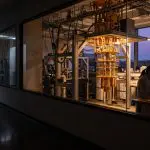
To help achieve this vision, the NQCC’s technology programme addresses key challenges associated with scaling quantum computing.
NQCC




See today’s quantum computing news on Quantum Zeitgeist for the latest breakthroughs in qubits, hardware, algorithms, and industry deals.