
Chess prodigy, video-game designer, neuroscientist and Nobel laureate. The co-founder and chief executive of Google DeepMind who is using artificial intelligence to remake science.
Few people have moved as fluidly between games, neuroscience and world-changing science as Demis Hassabis. The co-founder and chief executive of Google DeepMind began as a chess prodigy and a teenage video-game designer, trained as a neuroscientist, and then built the laboratory that taught machines to master the game of Go and to predict the shape of almost every known protein. In 2024 that protein work earned him a share of the Nobel Prize in Chemistry.
His career is unusual because it has a single thread running through it, a determination to understand intelligence and then put it to work on the hardest problems in science. This profile traces that arc, from a north London childhood to the leadership of one of the most powerful artificial intelligence labs on Earth, and asks where Demis Hassabis is trying to take the field next.
The chess prodigy who designed video games
Demis Hassabis was born in London in 1976, to a Greek-Cypriot father and a Singaporean mother of Chinese descent, and he showed a startling talent for chess as a child. He reached master standard by the age of thirteen and captained English junior teams, learning early the kind of pattern-recognition and long-range planning that would later shape his view of intelligence. By his early teens he was the second highest rated player in the world for his age group, and he later won the Pentamind title at the Mind Sports Olympiad five times.
Rather than follow chess into a career, he turned to computers and games. As a teenager he joined the games studio Bullfrog, where he co-designed and programmed the hit simulation Theme Park, and he later founded his own studio, Elixir, building ambitious titles that tried to simulate whole worlds. Game design taught him how to build artificial systems that behave intelligently, a craft that would prove central to everything he did next.
Before that he was lead AI programmer on the god game Black and White at Peter Molyneux’s Lionhead Studios, and Elixir went on to produce the cult titles Republic: The Revolution and Evil Genius with Hassabis as executive designer. The common thread was always the artificial minds inside the games, the characters whose behaviour fascinated him more than the graphics. Building believable digital agents was, in hindsight, an apprenticeship for building real ones.
From games to the science of the mind
Wanting to understand real intelligence rather than simulate it, Demis Hassabis returned to university and earned a doctorate in cognitive neuroscience at University College London. His research focused on memory and imagination, showing that the same brain systems we use to recall the past are also used to picture the future, work that was recognised as one of the scientific breakthroughs of its year.
That training gave him a conviction that would define his life’s work, that the brain is the one example we have of general intelligence, and that studying it could guide the building of artificial intelligence. He came to see neuroscience and computer science not as separate fields but as two halves of a single question about how minds work.
Founding DeepMind
In 2010 Demis Hassabis co-founded DeepMind in London with Shane Legg and Mustafa Suleyman, setting it an audacious mission, to solve intelligence and then use it to solve everything else. The company combined ideas from neuroscience, machine learning and games, training systems that learned for themselves rather than following hand-written rules.
DeepMind’s promise was obvious enough that Google acquired it in 2014 for a sum reported in the hundreds of millions, while allowing it to keep its research culture and its London base. The acquisition gave Hassabis the computing power and stability to pursue long-term goals that a startup could never have afforded, and the results followed quickly.
An early sign of what was coming had arrived in 2013, when DeepMind unveiled a system that learned to play classic Atari video games directly from the pixels on screen, with no instruction beyond the score. It was a striking demonstration of general learning, a single program mastering many different games, and it helped persuade Google of the company’s promise.
AlphaGo and the moment machines learned to play
The breakthrough that made DeepMind famous came in 2016, when its AlphaGo program beat Lee Sedol, the winner of eighteen world Go titles, by four games to one, in a game so complex it had been considered decades beyond the reach of computers. The victory stunned the field, not least because AlphaGo produced moves no human would have played, hinting at a genuinely creative kind of machine intelligence.
DeepMind soon went further with AlphaZero, a single system that taught itself Go, chess and shogi from scratch, with no human games to learn from, simply by playing against itself. For Demis Hassabis these games were never the point in themselves, they were a proving ground, a way to develop methods that could later be turned on real scientific problems.
One move in particular, the now-famous move thirty-seven against Lee Sedol, was so unconventional that commentators first assumed it was a mistake before grasping its brilliance. For Hassabis it captured the goal exactly, machines that do not merely copy human play but discover genuinely new ideas. That capacity for creative search was what he hoped to aim at science.
AlphaFold and the protein-folding breakthrough
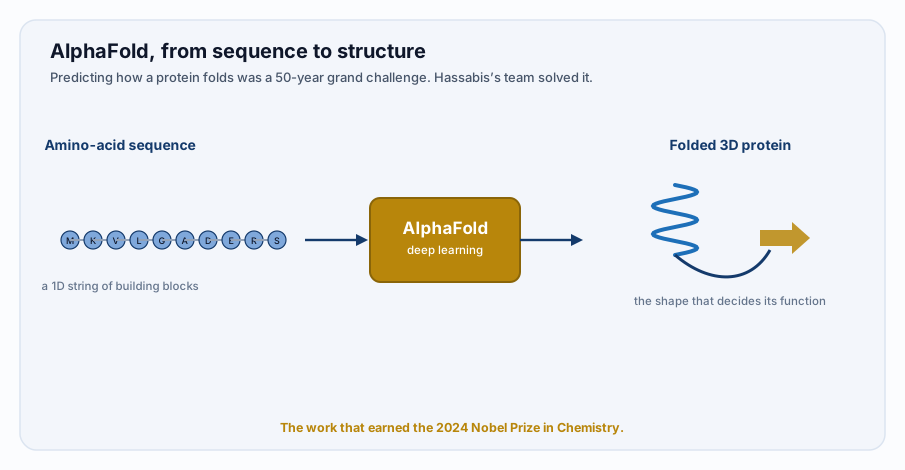
That turn to science produced AlphaFold, the achievement that may define his legacy. For half a century, predicting how a protein folds into its three-dimensional shape from its sequence of amino acids had been one of biology’s grand challenges, because that shape determines what the protein does. In 2020 AlphaFold solved it to a remarkable degree of accuracy, as the diagram below illustrates.
DeepMind then released the predicted structures of nearly every protein known to science in a free public database, handing biologists a tool that would otherwise have taken decades of laboratory work. It was a vivid demonstration of Hassabis’s thesis, that artificial intelligence could compress the timescale of scientific discovery from years into days.
A Nobel Prize for artificial intelligence
In October 2024 the work was crowned with the highest honour in science, when Demis Hassabis and his colleague John Jumper shared the Nobel Prize in Chemistry with the biochemist David Baker, for protein structure prediction and design. It was a striking moment, an artificial-intelligence system at the centre of a Nobel in a traditional experimental science.
The award marked a wider shift, the arrival of computation and machine learning as first-class tools of discovery rather than mere supports. For a researcher who had set out to use intelligence to solve science, it was the clearest possible vindication, and it placed Hassabis among the most decorated scientists of his generation while still in his forties.
The award also fed a wider debate about credit in the age of AI, since the prize honoured a computational tool alongside decades of experimental biochemistry. Hassabis was careful to frame AlphaFold as a partner to laboratory science rather than a replacement, a collaboration between human insight and machine pattern-finding. That framing has shaped how he talks about every DeepMind project since.
Leading Google DeepMind
Today Demis Hassabis leads Google DeepMind, the combined artificial-intelligence division formed when Google merged DeepMind with its Brain team in 2023, putting him at the helm of one of the largest concentrations of AI talent in the world. He now oversees the development of Google’s most advanced models alongside the company’s long-running scientific research.
The role places him at the centre of the global race to build ever more capable artificial intelligence, balancing breakneck commercial competition against his stated commitment to developing the technology safely and responsibly. He has been notably more measured than some rivals, warning against hype while pursuing the long-term goal of artificial general intelligence.
Under his leadership Google DeepMind develops the Gemini family of models that now sit at the core of Google’s products, putting Hassabis in charge of both frontier research and technology used by billions of people. He has argued that reaching artificial general intelligence will demand genuinely new ideas as well as raw scale, distancing himself from those who believe that simply enlarging today’s models will be enough.
AI, science and the quantum frontier
Hassabis describes his ultimate aim as building artificial intelligence that acts as the ultimate tool for science, accelerating progress across chemistry, biology, materials and physics. Through Isomorphic Labs, a DeepMind spinout, he is applying the AlphaFold approach to drug discovery, hoping to do for medicine what it did for protein structures.
Founded in 2021 and also led by Hassabis, Isomorphic Labs aims to reimagine drug discovery from first principles and has signed major partnerships with pharmaceutical companies. It is the clearest expression of his belief that artificial intelligence will become a discovery engine across the sciences, shortening the path from idea to medicine.
This vision intersects naturally with quantum computing, the other great frontier of scientific computation, since both promise to model nature in ways classical methods cannot. Artificial intelligence and quantum machines are increasingly seen as complementary, with AI helping to design and control quantum experiments and quantum hardware extending what AI can simulate. Hassabis sits at the heart of that convergence between machine intelligence and the physics of computation.
The scientist who wants to solve intelligence
What sets Demis Hassabis apart is the coherence of his ambition. The chess, the games, the neuroscience and the Nobel-winning AI are not a scattered set of interests but stages in a single project, to understand intelligence well enough to build it, and then to aim it at the deepest problems humanity faces. Few people have pursued one idea across so many fields with such success.
Whether artificial general intelligence arrives on the timeline he hopes for remains uncertain, and he is careful to say so. He often sums up the goal in a single phrase, to solve intelligence and then use it to solve everything else, and he appears to mean it almost literally. From climate modelling and fusion control to pure mathematics and medicine, he sees a general scientific assistant as the prize that would justify the whole enterprise.
But the protein database, the Nobel Prize and the laboratory he built have already changed science, and the story of Demis Hassabis is still very much being written.
Frequently asked questions
Who is Demis Hassabis?
What did Demis Hassabis win the Nobel Prize for?
What is AlphaFold?
What is DeepMind?
How does Demis Hassabis connect AI and quantum computing?




See today’s quantum computing news on Quantum Zeitgeist for the latest breakthroughs in qubits, hardware, algorithms, and industry deals.