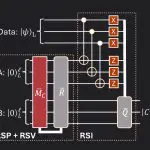
Cisco’s Network-Aware Quantum Compiler now factors the physical limitations of networks, switches, fiber and finite entanglement, directly into the compilation process, shifting from abstract connectivity models to a realistic network model. The release includes a full distributed error-correction package, integrating network operations needed to measure the seam between surface-code patches residing on different quantum processing units (QPUs) into the logical error model.
This allows the compiler to proactively plan for these operations rather than troubleshoot them reactively. A useful fault-tolerant quantum computer may require hundreds of thousands to millions of physical qubits, driving Cisco to develop technologies to scale quantum computing across multiple interconnected processors.
Network-Aware Compilation Addresses Distributed Quantum Challenges
This shift fundamentally alters how distributed quantum computations are planned, integrating network characteristics directly into the scheduling and partitioning of qubits. The compiler represents quantum processing units (QPUs) alongside the resources connecting them, including link loss, latency, communication qubits and qubit decoherence time, to create a model for optimization that considers all these factors. The compiler’s design prioritizes co-designing computation, communication and distributed error correction from the outset, rather than treating them as sequential steps; partitioning and scheduling decisions are made against these physical network constraints.
Version 0. 2. 0 of the compiler expands on this vision with support for distributed error correction and a unified network model, carrying realistic network assumptions throughout the compilation workflow. This approach is critical because network operations directly influence the errors accumulated during error correction, a factor now modeled within the compilation process itself.
Cisco’s Network-Aware Quantum Compiler includes a network-aware decoder with selectable models for network operations, allowing the same distributed circuit to be evaluated under different network conditions and error assumptions. This capability captures how imperfections in entanglement generation and network-assisted operations affect the performance of error correction, enabling architects and researchers to assess trade-offs before building systems at production scale.
“The compiler must also account for topology, entanglement availability, communication constraints, scheduling, and distributed error correction,” according to Cisco, “In other words, it must optimize the system as a whole.” The compiler’s functionality extends beyond circuit optimization to consider the broader system implications of distributed quantum computing. Fault-tolerant quantum computation relies on encoding logical qubits across numerous physical qubits and continuously measuring error-correction information, and in a distributed architecture, some of these error-correction operations inevitably cross QPU boundaries.
By modeling these network effects as part of compilation, the compiler aims to minimize the impact of network-induced errors on the overall computation. The resulting distributed execution plan is then passed to Cisco’s Quantum Network Controller for execution through the same application programming interfaces (APIs) used by any application, the company says.
The integration of network considerations into the compilation process is a departure from traditional approaches, which often treat networking as a separate problem to be solved after compilation. Access to the software development kit and technical documentation can be requested at outshift. cisco. com/docs/qndk.
Partitioning Strategies Minimize Cross-QPU Communication Costs
The compiler employs three distinct partitioning strategies, Kernighan-Lin, METIS and a novel window-based approach, to minimize interactions that cross QPU boundaries while adhering to each QPU’s qubit capacity. This optimization is framed as a capacity-constrained weighted graph-cut problem, prioritizing qubit placement to reduce the demand for network resources during computation. The window-based partitioner allows for dynamic qubit reassignment across execution windows, trading the cost of qubit teleportation for a reduction in remote operations.
The impact of effective partitioning is substantial. Poorly distributed qubits can transform local two-qubit operations into remote operations, significantly increasing the need for Bell pairs and other network resources. By keeping strongly interacting qubits together, the compiler minimizes communication overhead, treating qubit placement as a network-aware optimization rather than a static mapping. This approach allows the compiler to proactively address network limitations, such as quantum switch capacity, link loss and latency, during the compilation process itself.
Surface codes provide a specific example of how network constraints are integrated into fault-tolerant distributed quantum computing. These codes encode logical qubits across a two-dimensional patch of physical qubits, using ancilla qubits to detect errors through repeated stabilizer measurements. A critical parameter is the code’s distance, which dictates its ability to tolerate physical errors. This integration allows for proactive planning of these operations, rather than reactive troubleshooting after deployment.
“Partitioning can therefore be formulated as a capacity-constrained weighted graph-cut problem—minimize the cost of interactions that cross QPU boundaries while respecting the number of qubits each QPU can host,” explains the documentation. By directly linking qubit placement to network demand, the compiler optimizes for efficiency and reliability in distributed quantum systems. The compiler’s framework is designed to support multiple error-correction approaches, allowing network operations and communication costs to be incorporated directly into the error model.
Compiler Models Quantum Network Resources & Constraints
This integration allows for realistic assessments of resource demands during circuit design, rather than identifying bottlenecks after a circuit is mapped onto the network. The compiler represents quantum processing units alongside their connecting resources, including quantum switches and the characteristics of the links between them, to inform partitioning and scheduling decisions. A two-qubit gate executed locally on a single quantum processing unit is a simple operation, but when performed between qubits residing on different QPUs, it becomes a networked remote gate requiring a shared entangled pair.
The number of these cross-QPU gates, determined by how a quantum circuit is partitioned, directly impacts overall execution time and is a key metric the compiler aims to minimize. The Quantum Network Model package within the compiler captures available network resources, including each QPU’s network interface, switches and link characteristics.
Executing a remote operation reserves communication resources for the duration of the protocol, meaning resource capacity and availability directly influence scheduling and overall execution time. This is critical because different error-correcting codes structure redundancy differently, but all face the same challenge in a distributed architecture. This capability is a departure from traditional approaches that often rely on guesswork to assess the viability of a given layout.
By modeling the network’s impact on error correction, the compiler can determine how factors like imperfect entanglement generation affect performance. Architects can now compare different configurations using a Total Logical Error Rate (TLER) metric, which combines the effects of physical errors and network-induced noise. The source notes that increasing the code distance, a measure of a code’s ability to tolerate errors, can be offset by additional network-induced noise in certain regimes.
This highlights the need to model computation and communication together, as the appropriate code distance depends on both the physical error rate and the available network resources. Full API details for accessing these features are available in the technical documentation. The compiler’s ability to predict and mitigate network-induced errors is particularly important as quantum computers scale. The team’s companion paper, Impact of Network Constraints on Fault-Tolerant Distributed Quantum Computing, details the underlying error model and its derivation.
Distributed Error Correction Integrated into Compilation Workflow
Cisco’s Network-Aware Quantum Compiler now estimates a Total Logical Error Rate (TLER) for each compiled circuit, combining errors from local operations, network-crossing operations, qubit memory and magic-state consumption to provide a comprehensive performance metric. This metric allows architects to compare different quantum configurations before physical construction, assessing the trade-offs between network topology, qubit connectivity and error correction overhead. The compiler’s ability to model these factors explicitly is a departure from previous methods that often relied on abstract connectivity models and guesswork to assess viability.
Version 0. The system now lays out logical surface-code patches across multiple quantum processing units (QPUs), identifies the seams created by distributed lattice-surgery operations, and schedules the entanglement resources needed to support these operations.
This co-design of computation, communication, and error correction is critical, as the network itself introduces errors during the error correction process. This means that factors like imperfect entanglement generation and the latency of network-assisted operations are not simply acknowledged, but actively incorporated into the error model. “The network affects the errors accumulated while performing error correction,” explains the documentation, highlighting the need to treat network characteristics as integral to the overall system performance.
The decoder’s selectable models for network operations enable a more realistic assessment of how these imperfections impact error correction effectiveness. The implications extend beyond simply improving error rates; the compiler’s approach fundamentally alters how distributed quantum systems are designed.
The source notes that distributed quantum computing is often framed as a scaling problem, but argues that computation and communication can no longer be treated as separate concerns. “It is no longer enough to optimize a circuit against a collection of processors,” the documentation states. This integrated approach allows architects and researchers to explore different configurations and optimize for performance, resource use and the behavior of error correction in a distributed environment, ultimately clearing the way for more robust and scalable quantum computing architectures.
QPU Topology Impacts End-to-End Routing & Performance
Cisco’s Network-Aware Quantum Compiler now models intra-QPU connectivity alongside inter-QPU communication, accounting for the end-to-end routing cost of distributed circuits rather than solely focusing on communication between quantum processing units. This detailed approach extends beyond abstract connectivity models to consider the physical limitations of each QPU, including how native two-qubit gate availability impacts circuit depth and error exposure. Systems with limited local qubit connectivity, such as superconducting transmon architectures, incur additional overhead from intra-QPU routing implemented through SWAP operations, a cost the compiler now quantifies.
The compiler’s Network-Aware Scheduler determines when distributed quantum operations can execute and reserves the necessary communication resources, factoring in network topology, entanglement availability and communication constraints. The key difference is that the network is now a part of the distributed compilation process.
The Compiler represents the QPUs together with the resources connecting them: quantum switches, link loss and latency, communication qubits, qubit decoherence time and Bell-state measurement capacity. “The network is not an afterthought in the compilation process; the Compiler plans computation and communication together,” the documentation states. Increasing code distance strengthens error suppression, but also demands more Bell pairs for each syndrome-extraction round in distributed operations.
While a larger code is beneficial if the network can deliver these pairs without increasing distribution time, finite entanglement-generation capacity can create a bottleneck. Supplying more Bell pairs takes longer, increasing idle qubit time and accumulated noise, a trade-off the compiler now models.
By modeling the internal connectivity of each QPU alongside the quantum network, the compiler can quantify how these factors affect the scheduling and performance of distributed computation. This detailed modeling allows for a more realistic assessment of end-to-end routing costs, moving beyond the assumption that communication between QPUs is the sole determinant of performance.



See today’s quantum computing news on Quantum Zeitgeist for the latest breakthroughs in qubits, hardware, algorithms, and industry deals.