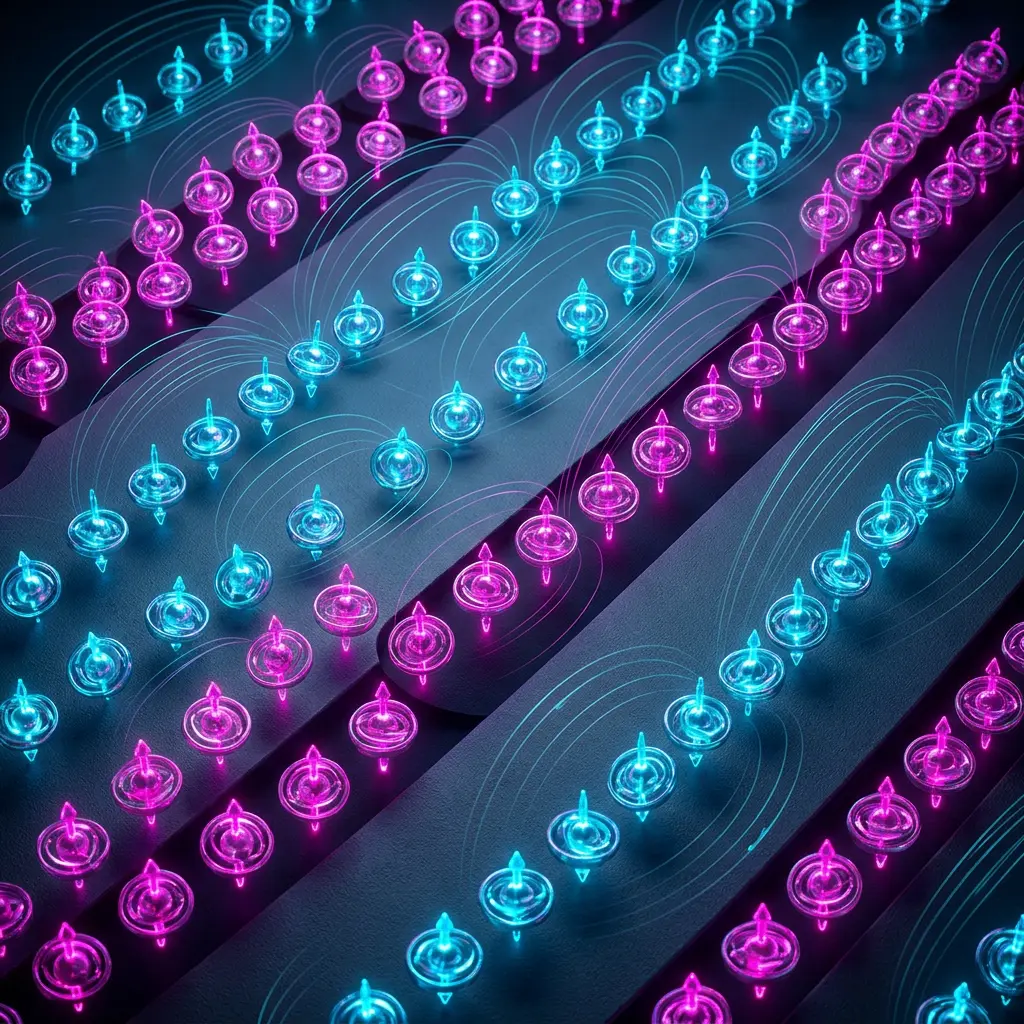
Researchers at Chouaïb Doukkali University, along with collaborators at Cadi Ayyad University, the Universidad de La Serena, and the Universidad de Tarapacá, are investigating 8-Pmmn borophene, a unique sheet material, as a platform for engineering magnetic barriers to control the flow of electrons. Using a low-energy effective Hamiltonian, they calculate the conductance, revealing that both magnetic strength and barrier width can tune the charge transport properties. The resulting transmission exhibits strong anisotropy, with pronounced suppression for specific incident directions, suggesting directional filtering of carriers. The calculations demonstrate that the transmission is not uniform. The resulting tunneling characteristics are highly sensitive to incident energy, angle, and barrier geometry. These results demonstrate that engineered magnetic barriers in 8-Pmmn borophene enable precise control over electron flow, offering a platform for anisotropic transport control and tunable quantum devices.
Borophene’s Lattice Structure and Unique Phases
Unlike graphene’s simple hexagonal lattice, borophene’s arrangement, a combination of hexagonal and triangular motifs, gives rise to a unique anisotropic Dirac spectrum, fundamentally altering how electrons behave within the material. This anisotropy is not merely a structural quirk, but a key to directional control, as demonstrated in recent theoretical work exploring electron tunneling through magnetic barriers. Rachid El Aitouni, Sanae Zriouel, Clarence Cortes, David Laroze, and Ahmed Jellal’s calculations reveal that the transmission exhibits strong anisotropy, with pronounced suppression for specific incident directions, suggesting directional filtering of carriers. This arises from the inherent characteristics of the 8-Pmmn structure, meaning it is not uniform. Further analysis, employing a low-energy effective Hamiltonian and the Landauer-Büttiker formalism, showed that both magnetic strength and barrier width can tune the charge transport properties, offering a pathway to create tunable quantum devices.
The results demonstrate that engineered magnetic barriers in 8-Pmmn borophene enable precise control over electron flow, offering a platform for anisotropic transport control and tunable quantum devices. The characteristics are highly sensitive to incident energy, angle, and barrier geometry, opening opportunities for engineering electron flow with greater control.
The pursuit of materials beyond graphene continues to drive innovation in two-dimensional electronics, with borophene emerging as a promising alternative due to its distinct properties. Researchers are now focusing on manipulating electron flow within specific borophene structures, notably the 8-Pmmn phase, by introducing magnetic barriers. This investigation, led by Rachid El Aitouni, Sanae Zriouel, Clarence Cortes, David Laroze, and Ahmed Jellal, details a theoretical exploration of electron tunneling through such barriers created by depositing ferromagnetic strips onto the borophene sheet. This means that electron passage is not uniform; instead, it exhibits strong anisotropy, suggesting a pathway toward circuits that favor electron flow along preferred orientations. The researchers used a low-energy effective Hamiltonian to model the system, solving the Dirac equation across the three regions, before, within, and after the magnetic barrier, and ensuring wave-function continuity at the interfaces.
The team, led by Rachid El Aitouni, Sanae Zriouel, Clarence Cortes, David Laroze, and Ahmed Jellal, is investigating how magnetic barriers deposited onto this borophene sheet can manipulate the flow of electrons with unprecedented precision. Their calculations reveal that the transmission exhibits strong anisotropy, with pronounced suppression for specific incident directions.
The potential for manipulating electron flow in two-dimensional materials like 8-Pmmn borophene extends beyond fundamental physics and directly addresses the need for increasingly sophisticated nanoscale electronics. Researchers, including Rachid El Aitouni, Sanae Zriouel, Clarence Cortes, David Laroze, and Ahmed Jellal, have moved beyond simply demonstrating directional electron transmission in this material; they have quantified it using the established Landauer-Büttiker formalism, a cornerstone of mesoscopic physics. This approach allows for the precise calculation of conductance, a measure of how easily electricity flows, through the engineered magnetic barriers. The calculations reveal that the transmission exhibits strong anisotropy, with suppression occurring for certain incident angles. The team calculated the conductance, revealing that both magnetic strength and barrier width can tune the charge transport properties. This ability to selectively transmit electrons based on their direction and energy opens doors to designing circuits with unprecedented functionality.
The expectation that electrons flow equally in all directions within a material breaks down in 8-Pmmn borophene, a unique two-dimensional sheet material now under scrutiny for its potential in advanced electronics. This is not simply about blocking or allowing current; it’s about dictating where electrons can travel most easily. A key to this directional control lies within the material’s electronic band structure. Calculations by Rachid El Aitouni, Sanae Zriouel, Clarence Cortes, David Laroze, and Ahmed Jellal reveal that the transmission exhibits strong anisotropy, with pronounced suppression for specific incident directions, a phenomenon the team terms directional filtering of carriers. According to the researchers, these combined features position magnetic-barrier-engineered 8-Pmmn borophene as a promising platform for anisotropic transport control and tunable quantum devices, bridging the gap between fundamental physics and practical applications. The work, submitted on July 2, 2026, details how engineered magnetic barriers in this material could ultimately enable a new generation of devices with tailored electron pathways.
Researchers Rachid El Aitouni, Sanae Zriouel, Clarence Cortes, David Laroze, and Ahmed Jellal are now leveraging theoretical models to understand and optimize this phenomenon, potentially paving the way for novel quantum devices. Their work utilizes a low-energy effective Hamiltonian to model the anisotropic Dirac spectrum inherent to this material. The team’s detailed numerical analysis calculates the conductance, revealing that both magnetic strength and barrier width can tune the charge transport properties. The transmission exhibits strong anisotropy, with pronounced suppression for specific incident directions. The resulting tunneling characteristics are highly sensitive to incident energy, angle, and barrier geometry.
The pursuit of increasingly sophisticated control over electron behavior is driving material scientists, with 2D materials like 8-Pmmn borophene emerging as promising alternatives. Researchers Rachid El Aitouni, Sanae Zriouel, Clarence Cortes, David Laroze, and Ahmed Jellal are now focusing on the precise manipulation of electron flow at interfaces within these materials, specifically by engineering magnetic barriers to exploit unique quantum properties. Their work centers on solving the Dirac equation within the borophene sheet, accounting for the material’s anisotropic Dirac spectrum. This anisotropy, stemming from the 8-Pmmn structure, is critical; the team’s calculations reveal that the transmission exhibits strong anisotropy, meaning it is not uniform. This interplay between the material’s intrinsic properties and externally applied magnetic fields offers rich opportunities to manipulate Dirac fermions, paving the way for advanced, low-dimensional electronic systems.
Their work focuses on exploiting the unique electronic properties of this boron allotrope to achieve precise control over electron flow. Rachid El Aitouni, Sanae Zriouel, Clarence Cortes, David Laroze, and Ahmed Jellal’s theoretical models demonstrate that the transmission exhibits strong anisotropy due to the tilted Dirac cones, meaning electron passage is not uniform; instead, transmission is suppressed for specific incident directions.
Source: https://arxiv.org/abs/2607.02077


See today’s quantum computing news on Quantum Zeitgeist for the latest breakthroughs in qubits, hardware, algorithms, and industry deals.