Researchers at POSTECH, in collaboration with Samsung Research, have constructed an augmented reality optical system measuring just 1.5 millimeters thick, a critical advancement for making AR glasses practical for everyday wear. The team reports in Nature that by precisely controlling light paths within a metasurface waveguide, they dramatically reduced light loss, achieving legible images even in bright sunlight.
The Ministry of Science and ICT announced that a research team led by Professor Junsuk Rho of POSTECH, in collaboration with Samsung Research of Samsung Electronics, has developed an optical technology that dramatically reduces light loss inside a metasurface waveguide, producing bright images even as the position of the eye changes.
Metasurface Waveguide Design Reduces Light Loss for Thin AR Optics
A 1.5-millimeter-thick augmented reality waveguide, developed by researchers at POSTECH and Samsung Research, now delivers bright images even as eye position shifts, addressing a key limitation of existing AR optics. The team demonstrated that precise nanoscale control over light paths within the metasurface waveguide minimizes unwanted light loss, a critical factor for producing clear visuals in bright outdoor environments. Conventional AR systems rely on waveguides to direct light from a display to the eye. But these systems often suffer from light escaping in unintended directions, dimming the projected image.
The researchers tackled this issue by focusing on the entire light path through the waveguide, rather than individual microstructures. They report demonstrating, through both theoretical modeling and experimentation, that carefully engineered light paths at the nanoscale can significantly reduce this loss while maintaining image sharpness as the user’s gaze moves.
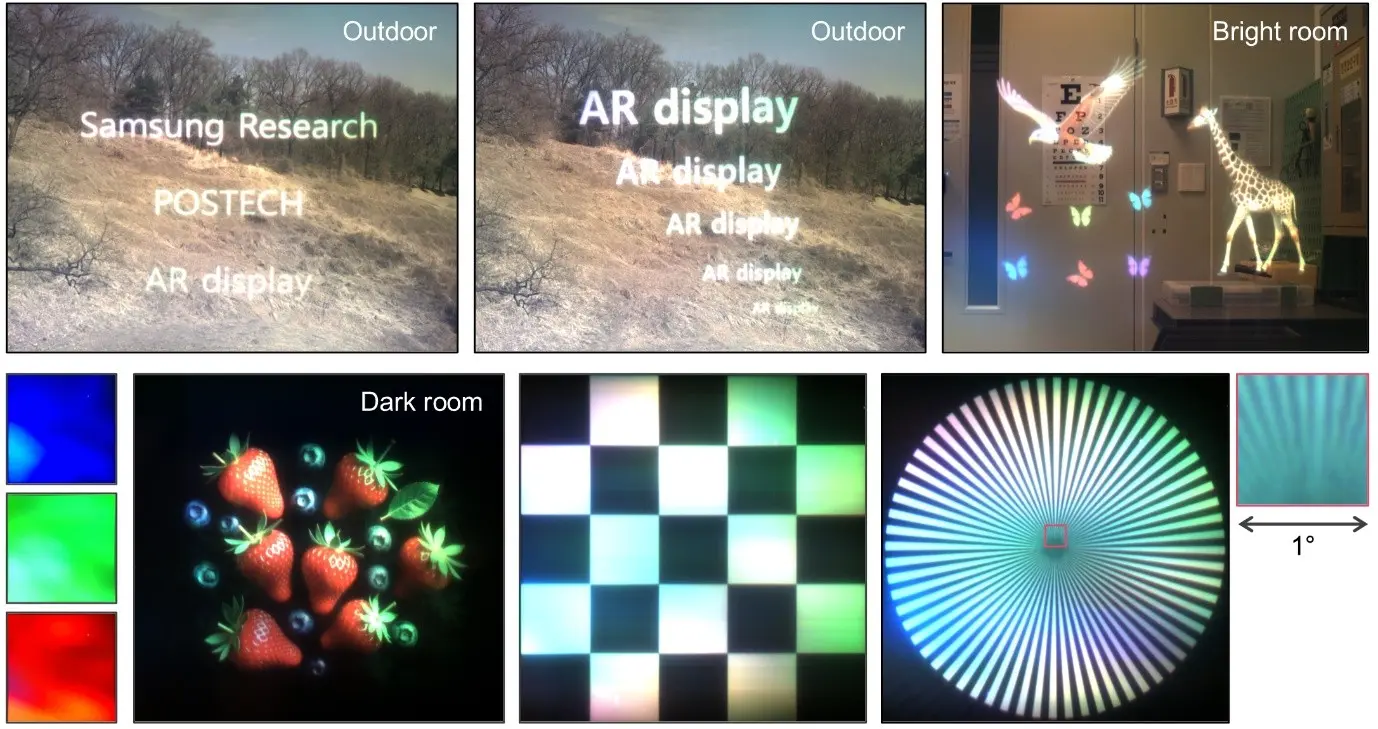
The team also addressed the challenge of accurate color reproduction, a common issue in AR displays. To display natural color images, the researchers stacked layers designed to transmit specific wavelengths of light; a layer primarily transmitting blue and green light was placed atop one transmitting red and green light. This configuration minimized differences in light delivery efficiency across colors, preventing distortions where certain colors appear overly bright or dim.
The researchers state that this study shows that by precisely controlling the path of light inside a lens, even a thin lens can produce bright, sharp images outdoors, highlighting the potential for comfortable, everyday AR eyewear. Prototype glasses incorporating the 1.5-millimeter waveguide successfully overlaid white text onto real-world scenery in bright sunlight and displayed color images indoors, remaining visible even with moderate eye movement.
The team plans to reduce rainbow artifacts caused by light and secure mass-production technologies, while combining the technology with AI-based personalized image processing to develop AR glasses that people can wear comfortably in everyday life.
This study shows that by precisely controlling the path of light inside a lens, even a thin lens can produce bright, sharp images outdoors.
Junsuk Rho, Professor at POSTECH
Source: https://www.postech.ac.kr/eng/research/research_results.do?mode=view&articleNo=56069