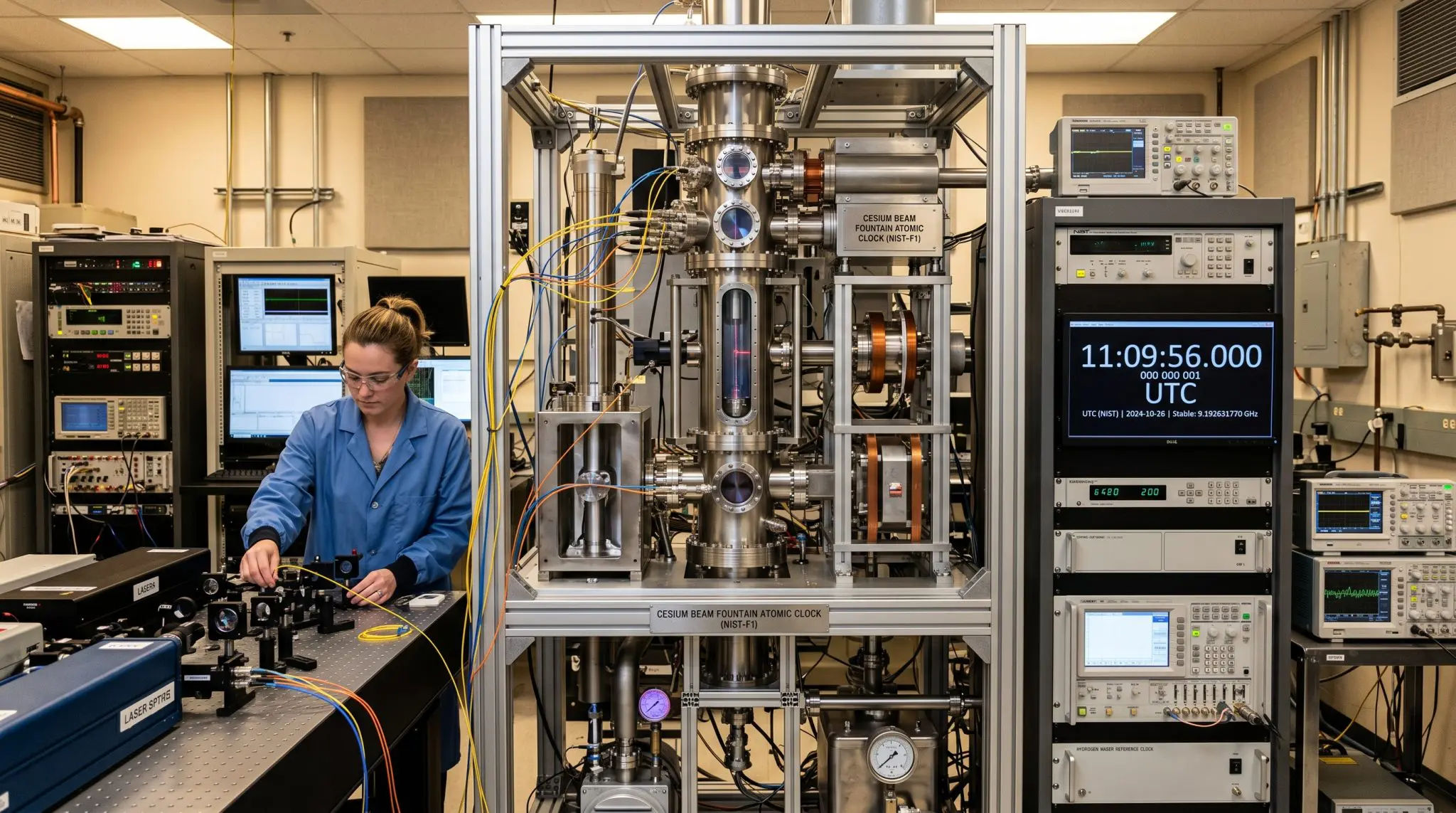
A new method for synchronising quantum network nodes without dedicated timing-distribution infrastructure has been achieved. Jacob E. Humberd and colleagues at University of Tennessee validate this link-free approach using miniature rubidium atomic clocks and computational post-processing on a metropolitan-scale telecom fibre network spanning three nodes. Achieving timing performance comparable to White Rabbit benchmarks and maintaining stability over eight hours, the researchers observed Hong-Ou-Mandel interference with over 70% visibility. This first observation of quantum interference across a deployed network synchronised entirely without dedicated timing links represents a key step towards scalable and practical quantum networks, particularly for challenging environments like airborne and space-based applications.
Metropolitan quantum interference achieved via stabilised atomic clocks and post-processing
Hong-Ou-Mandel interference visibility exceeded 70%, matching performance previously only attainable with White Rabbit systems. The University of Tennessee and UTC Quantum Centre team have validated a scalable, topology-independent alternative using miniature rubidium atomic clocks and computational post-processing. This moves beyond the need for star-shaped network topologies, a first for deployed networks and demonstrating quantum interference across a metropolitan fibre network without dedicated timing links. The Hong-Ou-Mandel effect, a fundamental phenomenon in quantum optics, relies on the indistinguishability of photons; achieving high visibility requires precise temporal overlap, making accurate synchronisation paramount. Previous demonstrations of this effect across networks have heavily relied on White Rabbit, a system employing fibre optic cables and precision timing protocols to distribute a common time reference. This new approach circumvents the need for such dedicated infrastructure, offering significant advantages in terms of flexibility and deployment.
Miniature rubidium atomic clocks, combined with drift correction algorithms, maintained stable timing for eight continuous hours. This opens possibilities for quantum networks in challenging environments like airborne and space-based applications. Rubidium atomic clocks operate by measuring the resonant frequency of rubidium atoms, providing a highly stable time base. These miniature clocks, while less precise than their larger counterparts, offer a favourable balance between size, weight, and performance for distributed quantum networking. The drift correction algorithms are crucial for mitigating the inherent frequency drift of these clocks, which accumulates over time and introduces timing errors. A two-stage coincidence-peak search algorithm proved key in recovering photon correlations despite initial timing uncertainties exceeding one second, while drift compensation corrected accumulated phase evolution between the independent clocks over several hours of operation. The initial timing uncertainty represents the challenge of establishing a common time reference without a direct link; the coincidence-peak search algorithm effectively sifts through the data to identify correlated photon events, while the drift compensation ensures that the timing remains aligned throughout the eight-hour period.
Stable timing is vital for practical quantum networks, particularly those operating in active or remote locations. Validation of this approach occurred on a deployed metropolitan fibre network spanning three geographically separated nodes, demonstrating a scalable and topology-independent alternative for distributing time. The metropolitan network, utilising existing telecom fibre, provided a realistic testbed for evaluating the performance of the link-free synchronisation scheme. The three nodes were strategically positioned to represent a typical urban quantum network deployment. While these results represent a substantial advance, the 70% visibility does not yet reflect the performance needed for complex quantum protocols requiring many entangled photons. More sophisticated protocols, such as quantum repeaters or large-scale quantum key distribution, demand significantly higher visibility to overcome losses and maintain fidelity. Improving visibility will require optimisation of the optical setup, including reducing losses in the fibre network and enhancing the efficiency of the photon detectors.
Significant work remains to reduce loss and improve detection efficiency, highlighting the need for further optimisation to support more demanding quantum applications. Loss in the fibre network attenuates the photon signal, reducing the probability of detection. Improving detection efficiency requires employing more sensitive detectors and minimising background noise. For the first time, quantum interference was observed across a network without relying on dedicated timing-transfer infrastructure. Current quantum networks demand geographically separated nodes share a common time reference with extreme accuracy, essential for processes like entanglement distribution and quantum key distribution. Entanglement distribution, a cornerstone of quantum networking, requires precise synchronisation to ensure that entangled photons are created and measured at the correct times. Quantum key distribution, a secure communication protocol, relies on the precise timing of photon transmissions to prevent eavesdropping.
Atomic-clock-based synchronization achieved timing performance approaching that of a White Rabbit benchmark, a widely used system for distributing precise time signals across networks. Independently operating miniature rubidium atomic clocks and computational post-processing were employed to achieve link-free synchronization. White Rabbit utilises a precision time protocol (PTP) over fibre optic cables to achieve sub-nanosecond synchronization accuracy. The comparable performance achieved with the atomic clock-based system demonstrates its potential as a viable alternative. The demonstration was limited to an eight-hour period, and the system’s performance over longer durations or with a greater number of nodes remains an open question. Long-term stability is crucial for practical deployments, and further research is needed to assess the system’s performance over days, weeks, or even months. Scaling the system to a larger number of nodes will also present challenges, as the complexity of the drift compensation algorithms increases.
Further research is needed to understand potential performance degradation with increased network complexity and to characterise the achieved signal-to-noise ratio. A new method for synchronising quantum network nodes without relying on dedicated timing links has been demonstrated, circumventing limitations inherent in existing systems like White Rabbit networks. These systems restrict network topology and pose challenges for deployment in certain environments. The topology limitations stem from the need for a central timing server and dedicated links to each node. This new approach allows for a more flexible and adaptable network architecture.
This work provides a practical pathway towards terrestrial, airborne, and space-based quantum networks, in particular in scenarios where laying dedicated timing cables is impractical. For example, in airborne or space-based applications, the weight and complexity of dedicated timing cables would be prohibitive. Utilising miniature rubidium atomic clocks and computational refinement, this demonstration of link-free quantum network synchronisation establishes a pathway beyond the limitations of conventional timing infrastructure. Achieving Hong-Ou-Mandel interference across a metropolitan fibre network without dedicated links validates the scalability of this approach. The team’s success opens questions regarding extending the eight-hour stability window and assessing performance with increasingly complex network topologies. Investigating alternative drift compensation algorithms and exploring the use of more stable atomic clocks could potentially extend the stability window. Further investigation will determine the feasibility of deploying strong quantum networks in environments where installing dedicated timing cables is impractical, such as airborne or space-based systems. The ability to establish a quantum network without relying on dedicated timing infrastructure represents a significant step towards realising the full potential of quantum communication and computation.
The researchers successfully demonstrated a new method for synchronising quantum network nodes using miniature rubidium atomic clocks and computational post-processing, achieving performance comparable to White Rabbit systems. This is important because it removes the need for dedicated timing-distribution infrastructure, offering greater flexibility and scalability for quantum networks, particularly in challenging environments like airborne or space-based applications. The team validated this approach across a metropolitan telecom fibre network spanning three nodes, observing Hong-Ou-Mandel interference with over 70% visibility. The authors intend to extend the eight-hour stability window and assess performance with more complex network topologies.
👉 More information
🗞 Link-Free Multi-Node Timing Synchronization for Scalable Quantum Networking
🧠 ArXiv: https://arxiv.org/abs/2606.14077



See today’s quantum computing news on Quantum Zeitgeist for the latest breakthroughs in qubits, hardware, algorithms, and industry deals.