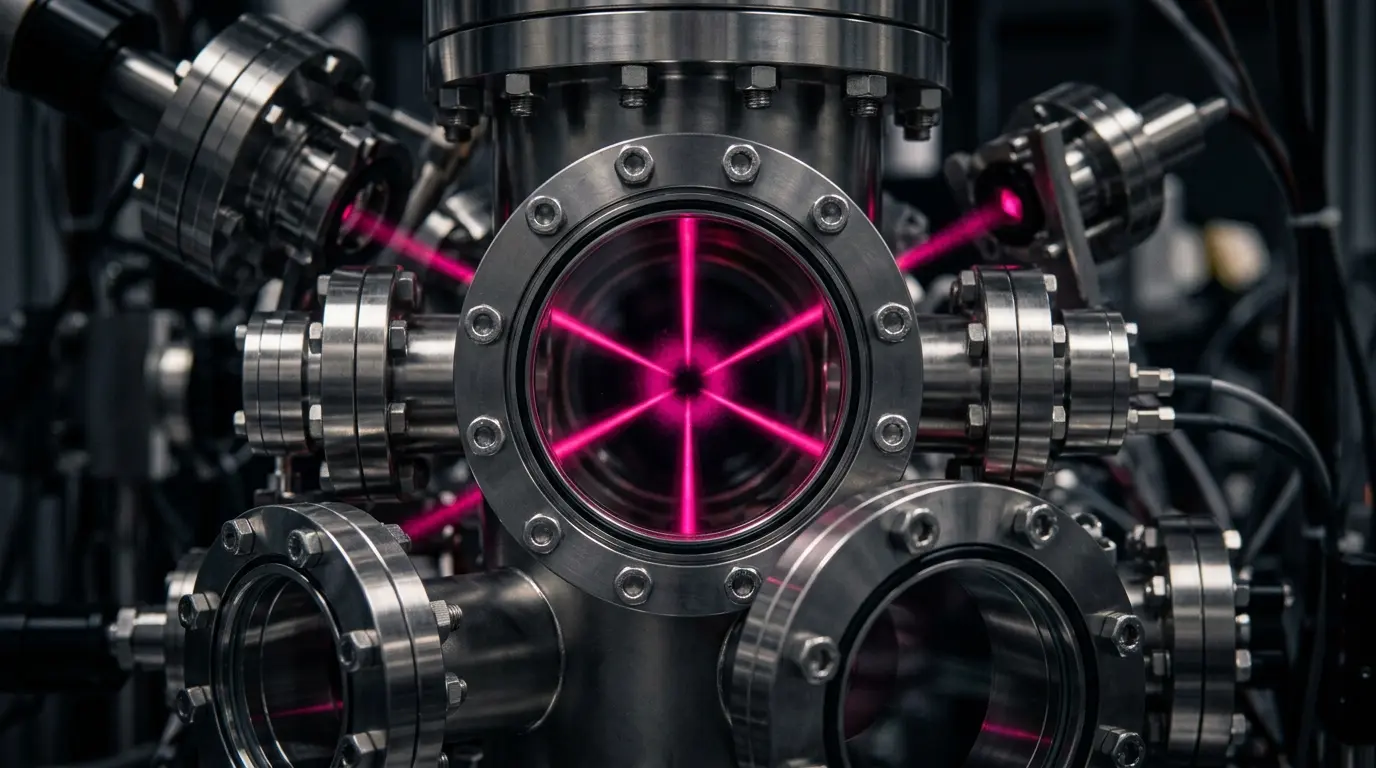
Bell-type inequalities are commonly associated with quantum nonlocality. Their mathematical structure also reflects more general constraints on the joint probability distributions assigned to measurements performed in different contexts. Researchers examined this distinction through the Wigner, Bell inequality using a classical optical field with two nonseparable degrees of freedom. Beginning with a subsystem response-factorization assumption, they derived a Wigner-type probability bound. This bound requires that pairwise measurement statistics align with a single nonnegative global joint distribution. The analysis focuses on classically nonseparable optics.
Classical Light Violates Established Bounds on Optical Projections
An 8% violation of the Wigner, Bell inequality was demonstrated using classically nonseparable light at Stevens Institute of Technology; previously, such violations were thought impossible without invoking quantum mechanics or spatial separation. This finding reveals an incompatibility between how optical projections are measured and assigning global probabilities within the Wigner construction, a key element in understanding Bell-type inequalities. The demonstration showed that classical optics can break established bounds not through any failure of existing physics but because of inherent limitations when describing context-dependent measurements with standard probability assignments.
The findings extend to multiple analyzer settings relevant to optical measurements, proving this isn’t limited to a single scenario. An ‘extended Wigner, Bell bound’ was derived accounting for imperfect correlations commonly found in real experiments, ensuring the test wasn’t reliant on ideal state preparation.
Building upon prior research involving joint-projection interferometers, researchers proposed a practical experimental design using classically entangled thermal light to reconstruct these important joint probabilities from simple intensity readings. While achieving strong violations consistently and scaling up such demonstrations remains challenging, indicating that translating these findings into tangible technologies is still some way off, the experiment allows direct observation of how context-dependent measurement statistics clash with standard probability assignments within the Wigner construction.
Classical Light Mimics Quantum Behaviour Through Global Probability Assignments
That classically prepared light can mimic behaviours previously thought exclusive to the quantum realm forces a reassessment of where genuinely non-classical resources become essential; this isn’t about uncovering new physics but refining our understanding of what constraints arise from mathematical formalism alone. These violations occur without spatial separation or exotic materials. They depend on carefully constructed probability frameworks, specifically assigning global probabilities to measurements performed across different contexts. Still, these findings don’t invalidate years of research into genuine non-classical phenomena, instead, it reframes how we view them.
By establishing an incompatibility between measured projections and global probability models, the results offer a benchmark for distinguishing effects arising solely from Hilbert space structure versus those requiring uniquely quantum resources. The assignment of probabilities across measurement settings introduces a specific constraint: a mathematical requirement rather than physical reality that clarifies where quantum resources truly become indispensable. This provides an optical benchmark for differentiating between effects stemming from basic probability rules and those originating from uniquely quantum behaviours like entanglement or superposition. Likely spurring new investigations into the boundaries between classical and quantum systems as refining our understanding of probability is only the first step towards utilising genuinely non-classical resources here.
This research demonstrated that a classically prepared optical field with two degrees of freedom violates a Wigner, Bell bound, meaning its measurable properties are incompatible with certain global probability assignments. The findings reveal this violation arises not from spatial separation or exotic materials but from constraints within the mathematical framework used to describe probabilities across different measurement contexts. Researchers propose an interferometric experiment to reconstruct these joint probabilities directly from intensity measurements.
👉 More information
🗞 When Malus’ Law Meets the Wigner-Bell Inequality: Violation by Nonseparable Classical Light
✍️ Xiao-Feng Qian (Stevens Institute of Technology)
🧠 ArXiv: https://arxiv.org/abs/2611.33729


See today’s quantum computing news on Quantum Zeitgeist for the latest breakthroughs in qubits, hardware, algorithms, and industry deals.