Bundesdruckerei GmbH researchers discovered that a carefully tuned interaction extension improves performance when solving complex Max-Cut problems on an 8-bit Coherent Ising Machine; however, overly aggressive approaches diminish results. The team found bounded-coefficient encoding and augmented Lagrangian penalties offer selective improvements dependent upon both problem structure and how data is encoded within the machine itself.
Bundesdruckerei GmbH researchers discovered that applying optimisation methods from other systems doesn’t guarantee better results on new computer types; adjustments are key depending on both the specific problem *and* how it translates for use by the machine. The team found success with techniques like interaction extension, modifying interactions between variables, but only when carefully balanced against potential drawbacks. Bundesdruckerei GmbH researchers have demonstrated optimising methods designed for one type of processor don’t automatically translate to improvements on another; careful adjustment is key.
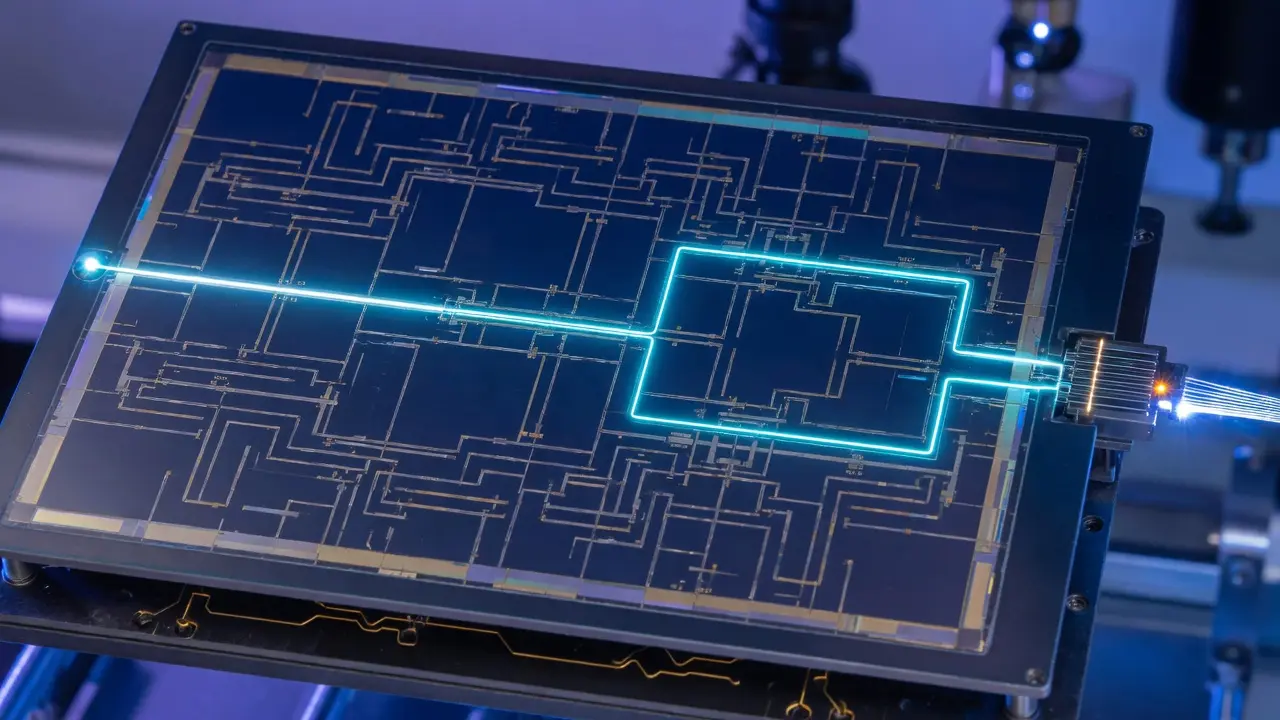
Their work focused on an 8-bit Coherent Ising Machine (CIM), a system where optical oscillators represent variables seeking low energy states, think of it like adjusting the connections between speakers to lessen the impact of weak signals. The team investigated three techniques, interaction extension, bounded-coefficient encoding, and augmented Lagrangian penalties, originally developed for quantum annealing computers.
They found success was selective; limiting the range of numbers used in calculations, similar to rounding decimals for simpler maths, didn’t always improve results. These coefficient mitigation methods must be carefully tuned to both the problem itself *and* how data encodes within the machine; but will these benefits persist when applied across different hardware architectures.
Intermediate Interaction Extension Yields Max-Cut Gains With Fixed Computational Cost
Researchers achieved a 12% improvement in mean best Max-Cut objectives using intermediate interaction extension. Importantly, they did this while maintaining the same number of Coherent Ising Machine (CIM) calls, something that previously demanded significantly increased computational resources.
Balancing auxiliary variable introduction proved crucial; overly aggressive interaction extension actually diminished optimisation effectiveness, an insight gained through understanding coefficient resolution’s interplay with solver dynamics. While bounded-coefficient encoding selectively improved results for one rucksack instance, augmented Lagrangian penalties only boosted feasibility when initial constraint settings were inadequate; these findings emphasize tuning mitigation strategies to both problem structure and data representation within the CIM.
Parameter Tuning Is Key To Coherent Ising Machine Performance
Systems mimicking neural networks with optical oscillators, coherent Ising Machines, can sometimes yield better results using techniques borrowed from quantum annealing. However, a fundamental challenge remains: simply applying those methods doesn’t guarantee success on this new hardware architecture. Careful parameter tuning is essential to balance benefits against potential drawbacks, yet establishing general rules for optimal settings has proven elusive across their Max-Cut, knapsack and quadratic assignment test problems. Even though these coefficient-range mitigation techniques don’t offer guaranteed improvements in all scenarios, they establish an important principle; adapting techniques from quantum annealing requires subtle control because merely transferring methods isn’t enough to unlock the full potential of optical systems as brain-inspired computers. Future advances will likely begin with a deeper understanding of how carefully tailored problem formulations influence machine response here.
This research investigated whether strategies used in quantum annealing could improve optimization performance on an 8-bit Coherent Ising Machine (CIM). Results showed that intermediate interaction extension increased mean best Max-Cut objectives by 12% without increasing computational cost, but overly aggressive application reduced effectiveness. While bounded-coefficient encoding and augmented Lagrangian penalties offered selective improvements across weighted Max-Cut, multidimensional knapsack, and quadratic assignment problems, the study highlights that effective coefficient-range mitigation requires tuning to both the specific problem and its data representation within the CIM.
👉 More information
🗞 Coefficient-Range Mitigation on an 8-Bit Coherent Ising Machine
✍️ Manuel Radons, Lars Simon and Andreas Wilke (Affiliation: Bundesdruckerei); Raoul Heese (Affiliation: NTT DATA Deutschland); Kensuke Inaba, Toshimori Honjo and Hiroki Takesue (Affiliation: Basic Research Laboratories, NTT)
🧠 ArXiv: https://arxiv.org/abs/2611.34168




See today’s quantum computing news on Quantum Zeitgeist for the latest breakthroughs in qubits, hardware, algorithms, and industry deals.