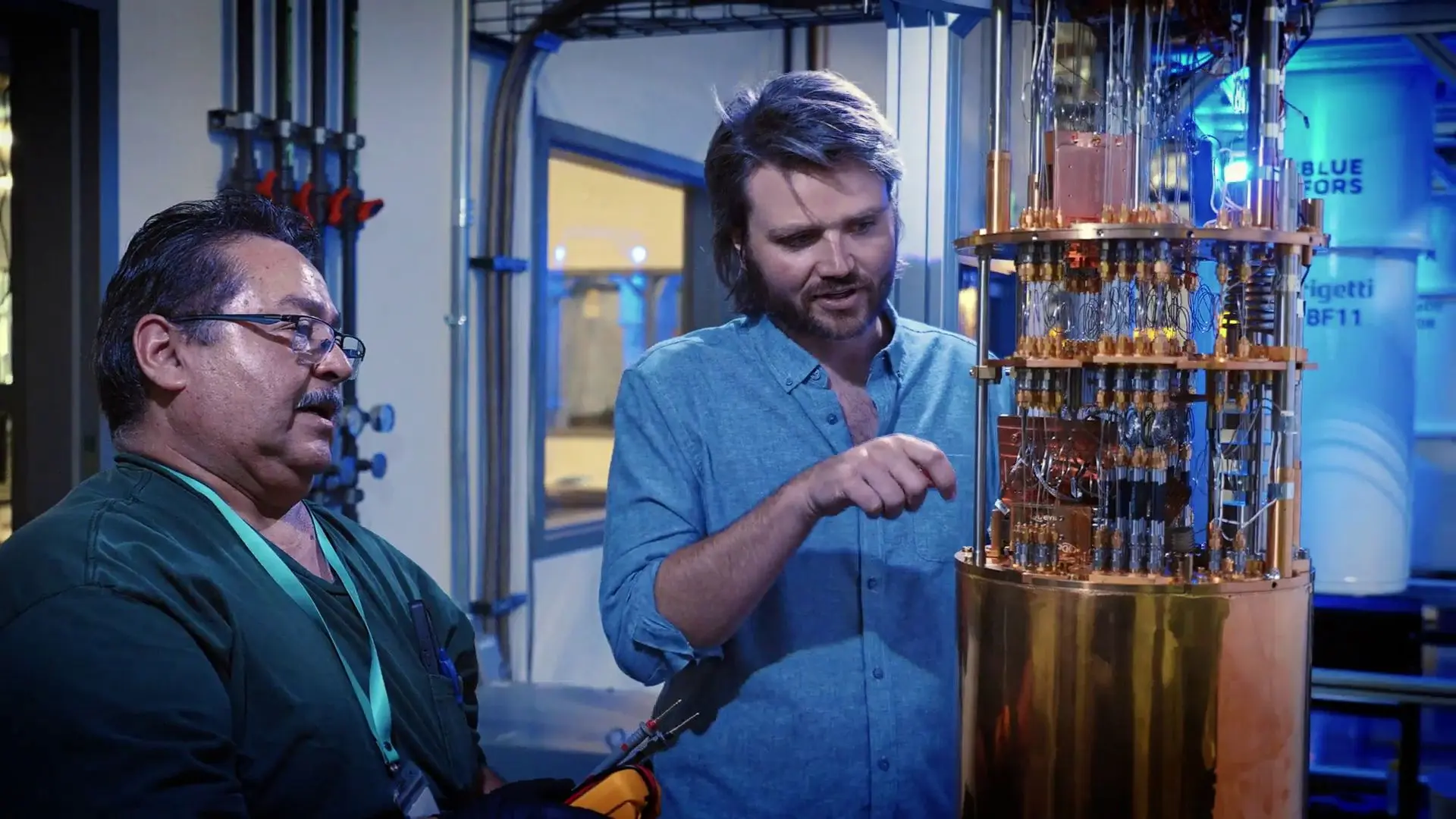
Andrew Bestwick, Chief Technology Officer at Rigetti Computing and David Gunnarsson, Chief Business Development Officer at Bluefors, are collaborating to integrate quantum systems with existing high-performance computing environments. The companies are focusing on hybrid architectures that combine quantum and classical resources to tackle complex problems in optimization, chemistry and physics.
“The consensus is that to do a quantum computation, you also need quite a lot of classical computation,” explains Gunnarsson, as Rigetti works toward building larger quantum computers from modular chiplet technology designed to “make large quantum computers out of small individual units that we can make over and over again,” according to Bestwick.
Rigetti’s Modular Chiplet Approach to Qubit Scaling
Rigetti is focusing on a chiplet-based approach to processor construction, aiming to circumvent limitations inherent in monolithic quantum processing unit designs. Instead of relying on one increasingly large processor, the company aims to build larger quantum computers from smaller units that can be manufactured and interconnected repeatedly. “Our approach to scaling up to large qubit counts is to modularize the problem,” explained Andrew Bestwick, Rigetti’s Chief Technology Officer, emphasizing the benefits of repeatable manufacturing processes.
This strategy extends beyond the quantum processor itself, influencing the design of supporting infrastructure for scalable quantum computing. Bluefors is addressing the physical demands of these larger, modular systems with developments in cryogenic cooling and wiring solutions. The company’s KIDE Cryogenic Platform significantly increased available cooling capacity and payload space, allowing for greater flexibility in hardware configuration and accommodating the growing size of quantum processors.
The success of this modularity hinges on creating a system that functions as a cohesive computer, not merely a laboratory demonstration. According to Bestwick, “For this to work, the quantum computer can’t just be like a science experiment. It has to be a computer. It has to work reliably. It has to have high uptime.” Rigetti’s Novera QPU Partner Program further supports this goal, encouraging an ecosystem of hardware and software providers to ensure smooth integration and deployment of complete quantum computing systems. The program aims to simplify the process for customers integrating on-premises quantum computing, and Bluefors actively participates in this collaborative effort.
Our approach to scaling up to large qubit counts is to modularize the problem. We want to make large quantum computers out of small individual units that we can make over and over again.
Andrew Bestwick, Chief Technology Officer at Rigetti
Bluefors’ Modular Cryogenic Platform for Increased Capacity
Bluefors addresses the escalating demands of quantum scaling with its Modular Cryogenic Platform, an architecture designed to support systems ranging from 1,000 to 10,000 qubits without requiring a complete overhaul of cryogenic infrastructure at each stage. This platform prioritizes efficient installation within high-performance computing environments, acknowledging the premium placed on physical space.
The design moves beyond simply increasing cooling capacity and payload, focusing instead on simplifying system expansion and operation as quantum processors grow in complexity. The platform’s modularity extends beyond the cryogenic system itself, encompassing cooling units and wiring inserts that can be configured and expanded in tandem with quantum system development.
David Gunnarsson of Bluefors explains this approach, stating, “We have modular systems, modular cooling, and modular chips.” This coordinated development is facilitated by close collaboration between Bluefors and Rigetti Computing, allowing them to anticipate future needs in cooling capacity, payload space and quantum input/output requirements. Rigetti’s focus on modular chiplets complements Bluefors’ cryogenic advancements, creating a scalable pathway for superconducting processors. The low form factor and modular footprint of the platform are specifically engineered to maximize space use in HPC centers.
This design consideration acknowledges that physical space is becoming a critical constraint as quantum systems increase in size and complexity. By aligning technology roadmaps, Bluefors and Rigetti aim to ensure that cryogenic infrastructure evolves in sync with processor development, enabling the construction of increasingly powerful and reliable hybrid quantum-classical computing systems.
For this to work, the quantum computer can’t just be like a science experiment. It has to be a computer. It has to work reliably. It has to have high uptime.
Andrew Bestwick, Chief Technology Officer at Rigetti
Reliability and Uptime for Quantum Data Center Integration
A functional quantum computer within a data center demands consistent performance, a departure from the experimental nature of early prototypes. Bestwick stated, “It has to be a computer. It has to work reliably. It has to have high uptime.” The supporting infrastructure is integral to maintaining that reliability. Rigetti’s experience with Bluefors, operating its initial dilution refrigerator for over a decade alongside an additional 20 LD and XLD Systems, highlights the importance of long-term dependability in cryogenic systems. This sustained operation demonstrates a level of robustness for integrating quantum resources into existing computational facilities.
The consensus is that to do a quantum computation, you also need quite a lot of classical computation. The push now is to make quantum computers fit for data centers.
David Gunnarsson, Chief Business Development Officer at Bluefors



See today’s quantum computing news on Quantum Zeitgeist for the latest breakthroughs in qubits, hardware, algorithms, and industry deals.