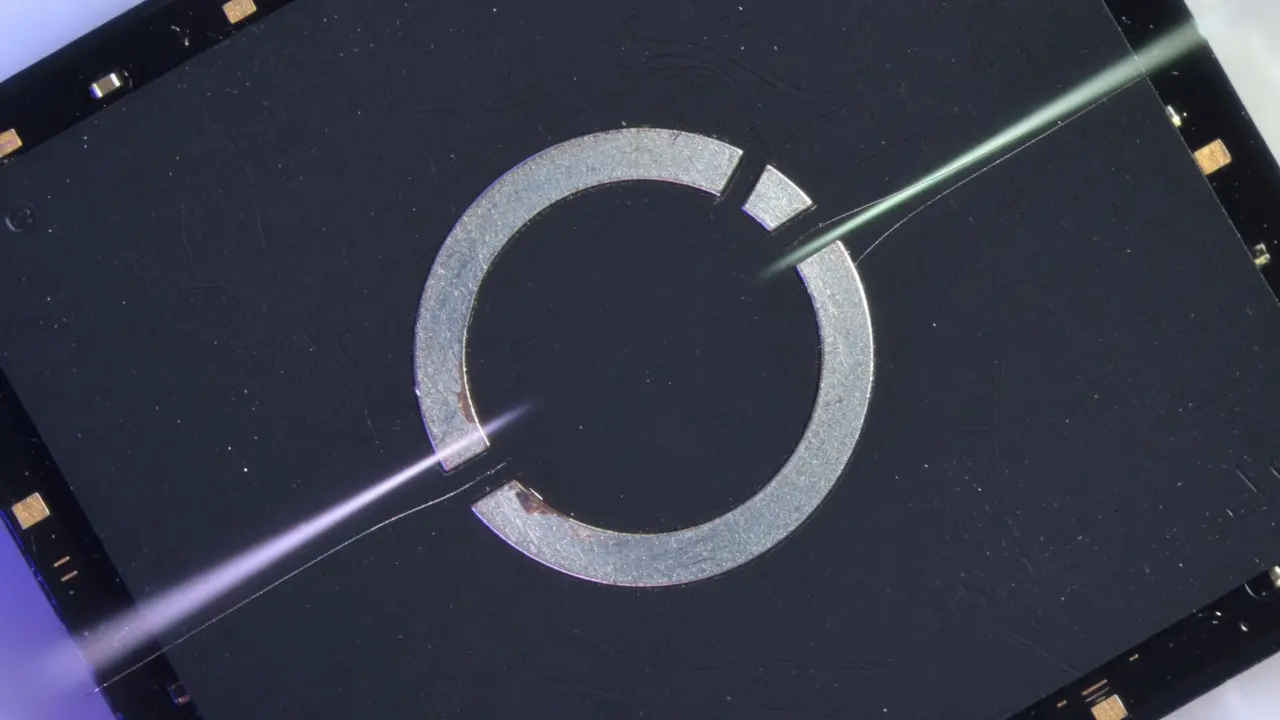
Researchers from the AWS Center for Quantum Computing in Pasadena, California, alongside colleagues at the California Institute of Technology and The Hebrew University of Jerusalem, have proposed a new cross-cross-resonance gate operating on two transmon qubits. The gate uses a cavity driven at a frequency near-resonant with the qubits, enabling a controlled-phase gate through the state of the cavity itself. This approach also allows for simultaneous operations on multiple qubit pairs linked by arrays of coupled cavities. The work demonstrates a method for canceling dispersive coupling, a dominant source of error in these systems.
Cavity-Mediated Cross-Cross-Resonance Gate Proposal
The operation of this new gate returns the cavity to its original state in phase space, but with a phase dependent on the frequency, which itself is determined by the state of the two transmon qubits, ultimately realizing a controlled-phase gate. Gate infidelity stemming from qubit decoherence is also addressed, with the analysis assuming that the T2 and T1 times of the qubits are comparable.
The simulations used a flat-top pulse with a Nuttall window, defined by specific coefficients: a0 = 0. 355768, a1 = 0. 487396, a2 = 0. 144232, and a3 = 0. 012604, to shape the drive pulses. The team began by simulating the gate’s operation between two qubits, modeled as two-level systems, driven with a specific amplitude.
Transmon Qubit Control via Near-Resonant Cavity Drive
The realization of a gate between superconducting elements relies on driving qubits at a frequency closely matching that of the cavity used to mediate interaction. Beyond the basic gate function, this method facilitates simultaneous operations on multiple qubit pairs. These pairs are linked through arrays of coupled cavities, effectively creating a network for parallel quantum computation. The researchers propose two schemes for canceling the dominant error, which is the qubit-cavity dispersive coupling.
Controlled-Phase Gate Realization with Cavity State
The proposed gate realizes a controlled-phase operation by manipulating the state of a cavity in phase space, with the area of that circle directly linked to the two qubits’ combined state. This approach is similar to Mølmer-Sørensen gates used with trapped-ion qubits. The team’s design employs a cross-resonant drive, simultaneously exciting both qubits, and defines the resulting operation as a cavity-mediated cross-cross-resonance gate. This specific drive method allows for the realization of multiple long-range two-qubit gates when qubits are coupled through an array of cavities, each gate mediated by a distinct cavity eigenmode.
Error Cancellation Schemes for Qubit-Cavity Coupling
The effectiveness of this cross-cross-resonance gate hinges on minimizing errors stemming from qubit-cavity dispersive coupling, and the team proposes two distinct strategies to address this challenge. Recognizing the impact of decoherence, the team also investigated methods to accelerate the gate, increasing the coupling strength g/2π from 2 MHz to 40 MHz. This adjustment not only speeds up the gate operation but also enhances its resilience against environmental noise, a critical factor for scaling quantum systems.
The technique allows for the implementation of entanglement-generating terms, denoted as M, essential for gate operation. The proposed gate uses a metamaterial, an array of coupled cavities, to extend operations beyond two qubits, mirroring techniques used with trapped-ion qubits.
Advantages of Fixed-Frequency Transmons in Gates
This stability stems from the design of these qubits, which avoids the need for continuous frequency adjustments that can introduce noise and accelerate decoherence. This compatibility reduces the complexity of implementation, as the same hardware and calibration routines can be used for both single- and two-qubit operations. The research team notes that a detailed investigation of correlated errors during simultaneous gate implementation remains outside the scope of this work.
Simultaneous Gates Across Coupled Cavity Arrays
This capability arises from a scheme allowing independent two-qubit gates, or even multi-qubit gates, to occur concurrently via the same resonator; for instance, four qubits coupled to a single resonator can enact two independent gates when driven with a specific phase shift. Driving qubits 3 and 4 π/2 out of phase relative to qubits 1 and 2 yields a coupling proportional to Z1 + Z2 + i(Z3 + Z4), isolating and couplings. Significant cavity population resulting from this near-resonance driving enables faster gate operations, but also uniquely positions the gate for parallel application across multiple qubit pairs.
Comparison of Cross-Cross-Resonance and RIP Gates
Simultaneous gates are achievable even when qubits share similar frequencies, a feature distinguishing this approach from many existing methods. This parallelization is enabled by a design that minimizes the need for precisely tuned qubit frequencies, simplifying system calibration and potentially increasing scalability. Analysis of these errors for systems with only two driven qubits reveals that qubit decoherence contributes to overall gate infidelity, scaling approximately with, where T is the gate duration and is the qubit’s T1 time.
👉 More information
🗞 Cavity-Mediated Cross-Cross-Resonance Gate
✍️ Alexey V. Gorshkov et al.
🧠 DOI: http://link.aps.org/doi/10.1103/1nt2-f7gl



See today’s quantum computing news on Quantum Zeitgeist for the latest breakthroughs in qubits, hardware, algorithms, and industry deals.