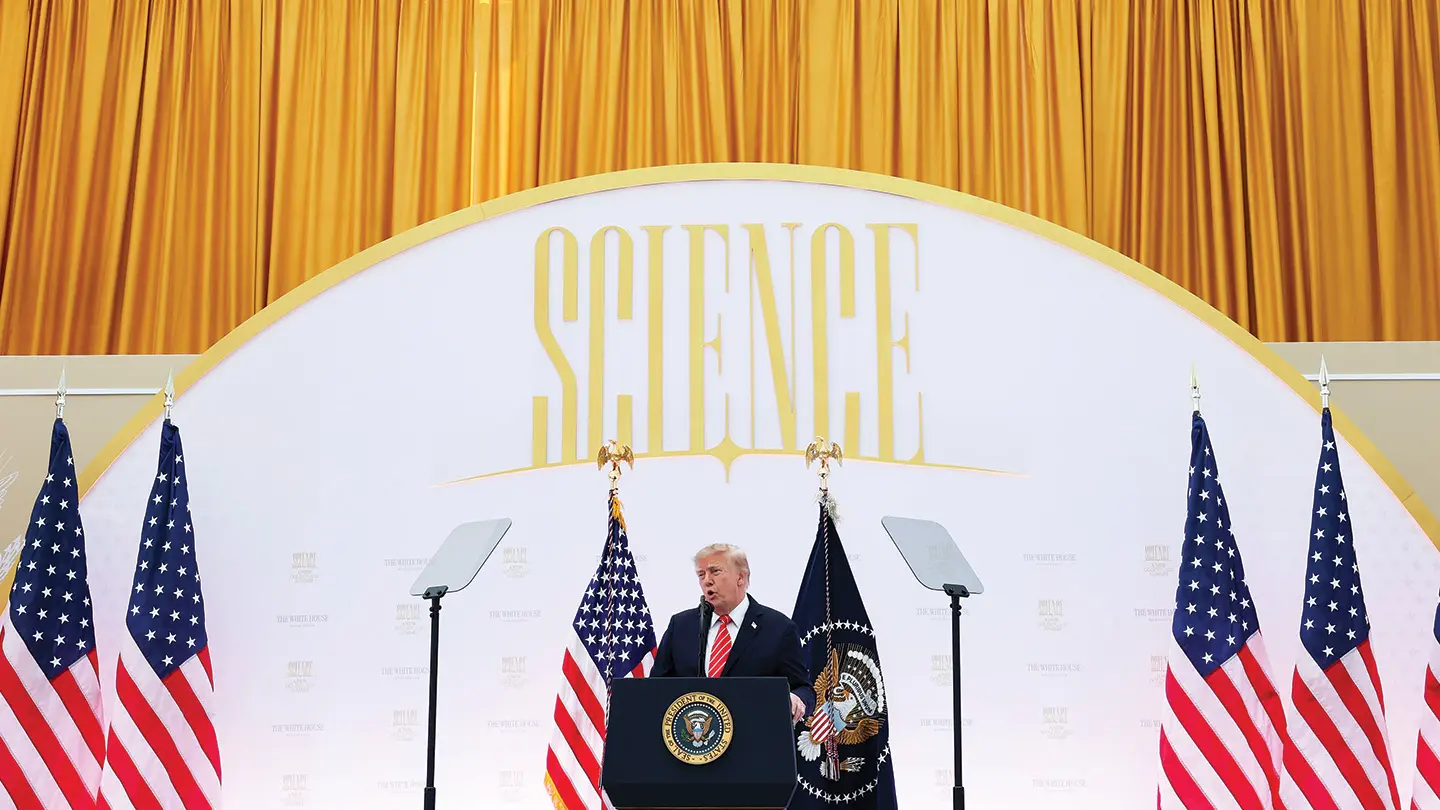
President Donald Trump unveiled new federal science priorities on October 8, 2026, signaling a clear shift in focus toward artificial intelligence and quantum technologies. The administration launched the $5 billion Genesis Mission in November 2025, a whole-of-government effort now spanning over 15 federal agencies to advance science via AI..S, the company says. Department of Energy, as some fields face funding cuts and delays.
Genesis Mission Drives $5 Billion AI Initiative
Darío Gil, undersecretary for science at the U.S., described artificial intelligence, quantum science, and supercomputing as “the three legs of the stool that is going to transform how science and engineering is done.” This vision underpins the Genesis Mission, a $5 billion whole-of-government effort launched in November 2025 to advance science through artificial intelligence, now encompassing over 15 federal agencies beyond its initial base. The initiative’s scope extends to projects accelerating nuclear reactor development, simulating the U.S. electric grid and studying nuclear fusion, demonstrating a broad application of AI tools across diverse scientific domains.
Federal agencies including the National Science Foundation and the National Institutes of Health have also initiated their own Genesis efforts, focusing on National Science and Technology Challenges spanning health, biology, energy, space and national security. The intends to use its extensive data repositories and computing facilities to establish a standardized set of AI tools and a collaborative ecosystem for scientific research. Astronomer Rachel Mandelbaum of Carnegie Mellon University in Pittsburgh characterizes this approach as “conceptually a very powerful idea,” highlighting the potential for AI to enhance data analysis and discovery across disciplines.
The Vera C. Rubin Observatory in Chile is already participating in a federal project to train AI models using astronomical data, demonstrating the practical implementation of this strategy. This year, the funded nearly 300 projects through Genesis, including one led by Mandelbaum.
Brad Marston, a physicist at Brown University and president of the American Physical Society, says, “Priorities have to be chosen, but getting a good balance is important, because you never know where some advance will come from.” This sentiment highlights the importance of maintaining a diverse research portfolio to maximize the potential for unexpected breakthroughs, even as the administration focuses on AI and quantum technologies.
My strongest opinion … is that I want to see all fields of science supported.
Brad Marston, a physicist at Brown University and president of the American Physical Society
Shifting Priorities Raise Concerns for Existing Science Funding
The allocated approximately $400 million to the Genesis Mission from its Office of Science budget, a figure that, while substantial, has prompted scrutiny regarding the broader impact on established research areas. In July, the White House Office of Science and Technology Policy issued a 123-page report describing its vision for a “golden age” of federal science, in which agencies align investments in research and development with administration priorities.
This strategic focus, while intended to accelerate innovation, has raised questions about the potential for disproportionate funding towards these areas at the expense of others. The recent resurgence of artificial intelligence and quantum computing, once considered niche fields, has further complicated the funding landscape. He poses a critical question: “Are there risks if you get the balance wrong? Equally well, 100 percent.” This highlights the delicate balance between supporting innovation in promising new areas and maintaining the vitality of established scientific disciplines.
The expansion of the Genesis initiative beyond the to encompass more than 15 federal agencies demonstrates the scale of the administration’s commitment to AI and quantum technologies. This whole-of-government effort aims to use data and computing resources to create a shared ecosystem for scientific advancement. The long-term implications of these shifting priorities remain to be seen as the scientific community navigates the challenges and opportunities presented by this new era of federal science funding.
If the reality is that some of this [funding] is coming out of the baseline research budget in my field, then I think that it would be beneficial for the DOE to engage the scientific community about those trade-offs.
Rachel Mandelbaum of Carnegie Mellon University in Pittsburgh



See today’s quantum computing news on Quantum Zeitgeist for the latest breakthroughs in qubits, hardware, algorithms, and industry deals.