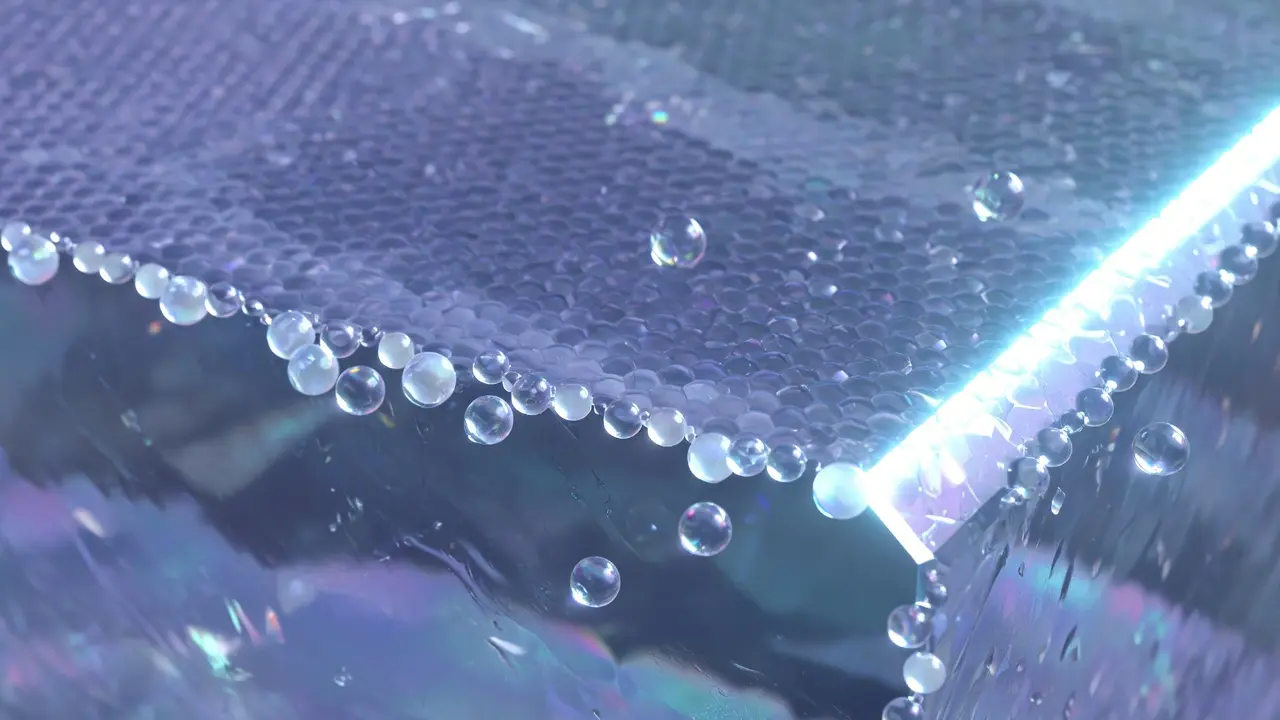
Researchers have linked atomically-localized color centers within hexagonal boron nitride to hyperbolic phonon polaritons, establishing a cavity-QED framework where a single emitter generates these mid-infrared light waves. This work overcomes limitations of previous HPP control methods reliant on classical near-field probes, instead using a quantum source. The team quantified the resulting interaction and demonstrated two distinct generation schemes, including a stimulated Raman process launching HPPs that propagate over micrometer distances. By connecting color-center quantum optics with hyperbolic polaritonics, the approach enables quantum emitters to act as on-chip quantum sources and controls for HPPs.
Hexagonal Boron Nitride Enables Mid-Infrared Hyperbolic Polaritons
Hexagonal boron nitride confines mid-infrared light to scales smaller than the wavelength of the light itself, a phenomenon with potential for creating extremely compact optical components. This confinement arises from the material’s unique ability to hybridize photons with its anisotropic optical phonons, forming hyperbolic phonon polaritons (HPPs). The resulting HPPs exhibit highly directional energy flow, a property that helps manipulate light at the nanoscale.
Researchers at ETH Zürich and affiliated institutions have established a framework for treating the interaction between color centers within hBN and these HPPs as analogous to light trapped within a cavity, a concept known as cavity-QED. This approach allows for precise quantification of the interaction strength between the quantum emitter and the HPPs.
Jie-Cheng Feng of ETH Zürich’s Department of Physics, along with colleagues, demonstrated that a single hBN color center can function as a source of HPPs, moving beyond previous methods that relied on classical near-field probes for HPP control. The team’s work, detailed in a recent publication, connects color-center quantum optics with hyperbolic polaritonics. By scanning a laser frequency and monitoring the photoluminescence intensity of a second emitter, researchers can confirm the presence of HPP rays and even extract information about the relative vertical positions of both emitters.
This integrated system points towards new possibilities for mid-infrared photonic experiments, uniting strong coupling, spectral selectivity and spatial reach within a single material. The ability to confine light to deep-subwavelength scales, coupled with the quantum properties of color centers, may lead to novel devices and applications in areas such as quantum information processing and advanced sensing. The research demonstrates how such emitters can serve as compact quantum sources of HPPs.
Color Centers as Quantum Sources for HPP Generation
The ability to generate single hyperbolic phonon polaritons (HPPs) represents a shift from previous methods relying on classical excitation, as a single hexagonal boron nitride (hBN) color center can now function as a source for these mid-infrared light carriers. This contrasts with earlier approaches that used classical near-field probes to control HPPs, limiting exploration at the quantum level, and opens the possibility of creating non-classical radiation sources within the material.
Researchers established a framework to model the interaction between the color center and the resulting HPPs, drawing parallels to cavity-QED systems where light is trapped and amplified. This framework predicts two distinct mechanisms for HPP generation: spontaneous emission into phonon sidebands and resonant stimulated Raman scattering. Spontaneous emission, modeled using a Fröhlich-type electron-phonon coupling, can potentially produce individual HPP events, and in ultrathin hBN slabs, this emission becomes single-mode with an enhanced decay rate.
The second method, stimulated Raman scattering, offers frequency selectivity and tunable conversion rates, launching spatially confined HPPs that propagate over micrometer distances. Researchers also outline a two-emitter correlation measurement that can directly test the single-polariton character of these emissions. The study details, outlining a Hanbury Brown-Twiss-type measurement adapted for phonon polaritons.
Spontaneous Emission into Phonon Sidebands Creates Single HPPs
This process, modeled using a Fröhlich-type electron-phonon coupling, offers a pathway to create these quantum entities directly from atomically-localized emitters, bypassing the need for classical excitation methods. The resulting HPPs are not merely a statistical collection of excitations, but potentially discrete quantum events. This ability to produce single HPPs represents a key advantage over previous approaches relying on classical near-field probes, as color centers function as quantum systems capable of emitting nonclassical radiation.
Researchers also detailed a complementary method, stimulated Raman scattering, which provides greater control over the HPP’s frequency and conversion rate through narrowband excitation. This process launches spatially confined, ray-like HPPs capable of propagating over micrometer distances. To verify the single-polariton nature of these emissions, the team outlined a correlation measurement involving two emitters.
This measurement directly tests whether the observed emissions are truly individual HPP events, confirming their quantum character. “As two-level systems, they not only provide the atomic-scale localization but can also serve as sources of nonclassical radiation, including single phonon polaritons,” the study notes, highlighting the potential for creating and controlling quantum states of light and matter.
Stimulated Raman Process for Tunable HPP Excitation
The stimulated Raman process detailed in this work offers a pathway to generate hyperbolic phonon polaritons (HPPs) with precise frequency control, a feature absent in spontaneous emission methods. This approach uses two laser drives, one resonant with the emitter’s excitation energy and a second to stimulate HPP emission at a defined frequency, to coherently convert optical energy into a polariton of fixed frequency. Analysis reveals that this Raman scheme drives the emitter from its ground to excited state with a pump laser, while a second laser stimulates emission into the HPP manifold.
The resulting HPP frequency is determined by the difference between the two laser frequencies, allowing for tunable conversion rates and narrowband excitation. This contrasts with spontaneous emission into the phonon sideband, which can produce single-HPP events, but lacks this level of control.
The researchers demonstrated that as the thickness of the hexagonal boron nitride (hBN) slab decreases, the coupling concentrates into the lowest branch, resulting in a Purcell-like increase in emission. This is achieved through a rotating-wave transformation and subsequent simplification of the Hamiltonian, enabling the prediction of HPP behavior under different excitation conditions. This process offers additional control over HPP generation, enabling selection of the frequency, tuning of the transition rate and balancing quantum statistics with long-range coherence. This level of control is important for applications requiring precisely tailored HPP properties.
Cavity-QED Framework Coupling Color Centers to HPPs
The framework detailed in this work quantifies the interaction between color centers and hyperbolic phonon polaritons (HPPs) by modeling the emitter as a dipole coupled to the HPP electromagnetic field, a connection analogous to Fröhlich-type electron-phonon coupling. The team’s analysis of spontaneous emission via phonon sidebands relies on the observation that many color centers exhibit strong phonon sidebands in their photoluminescence spectra, overlapping with the Reststrahlen band.
This overlap suggests a pathway for generating HPPs during the de-excitation of the emitter through phonon-assisted processes, offering a means to create HPPs without relying on classical excitation methods. The framework extends beyond simply generating HPPs. It allows for precise control over their properties, a key factor for applications demanding tailored light-matter interactions at the nanoscale.
HPP Propagation Distance Reaches Micrometer Scales
Narrowband excitation of color centers within hexagonal boron nitride (hBN) enables hyperbolic phonon polariton (HPP) propagation over micrometer distances. Calculations reveal that broad linewidths, such as 1 terahertz, limit HPP field persistence to within 1 micrometer, while narrowing the linewidth to below 10 gigahertz sustains propagation across several micrometers with a predictable power-law decay. This dependence on excitation method highlights a critical distinction in how HPPs are generated and controlled.
The analysis further demonstrates that the polariton linewidth, determined by the drive and lifetime, is a key parameter governing spatial behavior. The team’s calculations show field amplitudes normalizing to the value at 10 nanometers, with narrower linewidths enabling propagation over several micrometers, reflecting the combined effects of geometric spreading, material loss and linewidth-induced broadening. The study suggests that in-plane confinement, such as bound-state-in-the-continuum designs, could further extend propagation distances.
Two-Emitter Correlation Tests Single-Polariton Emissions
A two-emitter correlation measurement offers a direct way to verify the generation of single hyperbolic phonon polaritons (HPPs) within hexagonal boron nitride, moving beyond standard photon correlation techniques. This approach relies on linking two color centers embedded in an hBN slab, separated by several micrometers, to assess the quantum statistics of the emitted polaritons. The source emitter, when excited resonantly, launches an HPP that propagates across the slab towards a second, detector color center.
Specifically, the detector is illuminated by a laser slightly off-resonance, requiring the HPP to provide the remaining energy for excitation. Time-correlated counts between the source’s phonon sideband emission and the detector’s resulting luminescence then reveal the nature of the launched polaritons; observation of antibunching in this correlation would confirm single-HPP emission. Beyond confirming single-polariton character, this time-resolved two-emitter setup also allows for the determination of the HPP group velocity. The analysis details two distinct HPP generation schemes: spontaneous emission via the phonon sideband and stimulated Raman scattering, each offering unique advantages.
If reliably generated and controlled, single HPPs could unlock a new solid-state platform for quantum optics, allowing for direct implementation of single-photon protocols like interference, entanglement and quantum information transfer, without the need for free-space photons. This measurement, therefore, is a verification step and a pathway towards realizing practical quantum technologies based on HPPs.
Long-Range HPPs Mediate Interactions Between Quantum Emitters
The ability to mediate interactions between spatially separated quantum emitters represents an advancement enabled by this work, extending beyond the limitations of traditional near-field techniques. This spatial reach is essential for building more complex solid-state quantum devices, moving beyond localized interactions to networked systems. This confinement not only extends the propagation length of HPPs but also enhances the coupling between emitters and the polaritonic field, effectively creating a waveguide for mid-infrared light.
Beyond simple confinement, tailoring the in-plane geometry of hBN structures could create HPP resonators, focusing rays to mediate interactions between distant impurities and potentially implement quantum gates. Such structures suggest that HPPs in hBN could serve as building blocks for solid-state quantum devices, enabling controlled transport of energy and, in the quantum regime, the transfer of quantum states and information.
The long-range, ray-like HPPs provide a means for spatially separated emitters to interact, broadening opportunities within the rapidly developing hBN color-center landscape. This approach extends to spin-active defects, where HPP-mediated interactions could be used to generate and manipulate entanglement between remote spins, opening possibilities for quantum state transfer, entanglement distribution and logical operations between solid-state qubits.
👉 More information
🗞 Color centers and hyperbolic phonon polaritons in hexagonal boron nitride: A new platform for quantum optics
✍️ Jie-Cheng Feng, Johannes Eberle, Sambuddha Chattopadhyay, Johannes Knörzer, Eugene Demler and Ataç İmamoğlu
🧠 DOI: http://link.aps.org/doi/10.1103/rst6-xnn4
See today’s quantum computing news on Quantum Zeitgeist for the latest breakthroughs in qubits, hardware, algorithms, and industry deals.