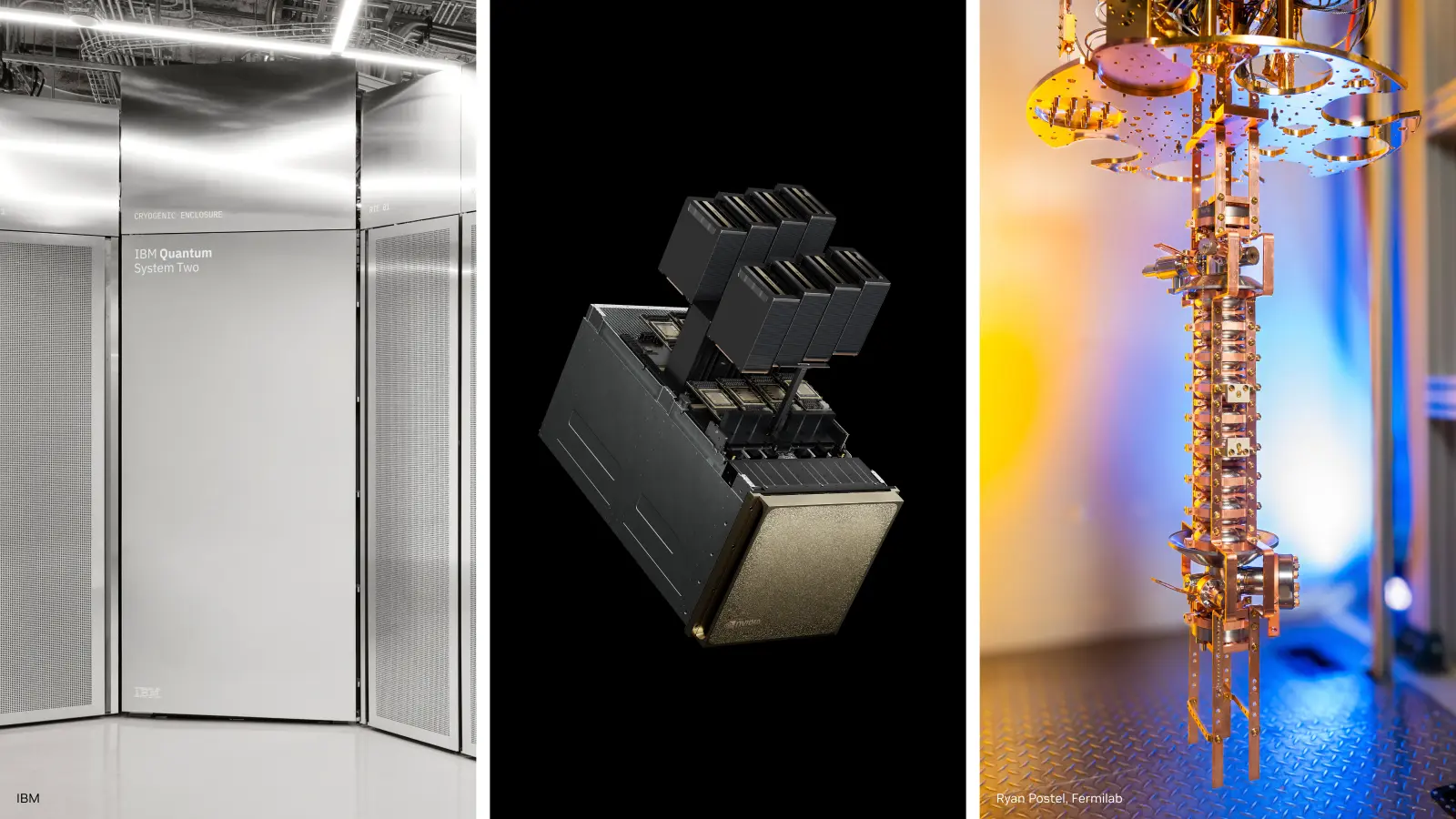
NVIDIA reports a speedup of up to 13,000 times for quantum error-correction research with its new TCBP-JOBS decoding algorithm, part of the CUDA-Q platform. The company is collaborating with IBM and Fermi National Accelerator Laboratory to launch a quantum classical codesign platform, integrating NVIDIA DGX B200 systems directly with IBM Quantum Nighthawk, IBM’s most powerful processor.
“Making quantum computers useful for science requires advances in error correction, applications and the systems that bring quantum processors and accelerated computing together,” said Krysta Svore, vice president of applied research for quantum computing at NVIDIA. This collaboration aims to scale quantum computers and explore their scientific capabilities.
NVIDIA, IBM, and Fermilab Launch Quantum Codesign Platform
This platform will focus on advancing error-correction codes, decoding algorithms and quantum-classical applications specifically for demanding scientific challenges in high-energy and nuclear physics. The collaboration centers on applying this technology to quantum error correction and HENP applications, defining requirements for future fault-tolerant quantum computers and the science they will enable.
“Accelerated computing and superintelligence will play an important role in how we design algorithms, study errors and coordinate increasingly complex quantum systems,” said Anna Grassellino, chief technology officer and director of the SQMS Center. The codesign platform’s architecture is intended to allow researchers to evaluate how classical systems can scale alongside multiple, interconnected quantum processors.
Faster decoding allows scientists to efficiently assess candidate error-correction approaches and explore different code and decoder configurations, accelerating the path toward practical fault-tolerant quantum computing. NVIDIA states that the algorithm’s performance gains reduce computation time for researching new quantum computing designs from 12 weeks to just 45 minutes.
NVIDIA is also expanding the open-source Slurm workload manager to simplify the integration of quantum processors into supercomputing environments. IBM is contributing to this integration through its Quantum Resource Management Interface, connecting IBM quantum resources to the new Slurm capabilities, which aims to reduce the engineering and maintenance burden on supercomputing centers as they add quantum processors and develop hybrid applications.
The expanded Slurm capabilities will allow researchers to schedule quantum processors alongside CPUs and GPUs using familiar commands, policies and tools, NVIDIA says. “Some of the most fundamental problems in science remain out of reach without access to quantum computing. Scaling quantum and classical together will open new frontiers in high-energy and nuclear physics and beyond,” said Jerry Chow, IBM Fellow and chief technology officer of quantum-centric computing. Scaling quantum and classical systems together will open new frontiers in high-energy and nuclear physics and beyond.”
Making quantum computers useful for science requires advances in error correction, applications and the systems that bring quantum processors and accelerated computing together.
Krysta Svore, vice president of applied research for quantum computing at NVIDIA




See today’s quantum computing news on Quantum Zeitgeist for the latest breakthroughs in qubits, hardware, algorithms, and industry deals.