
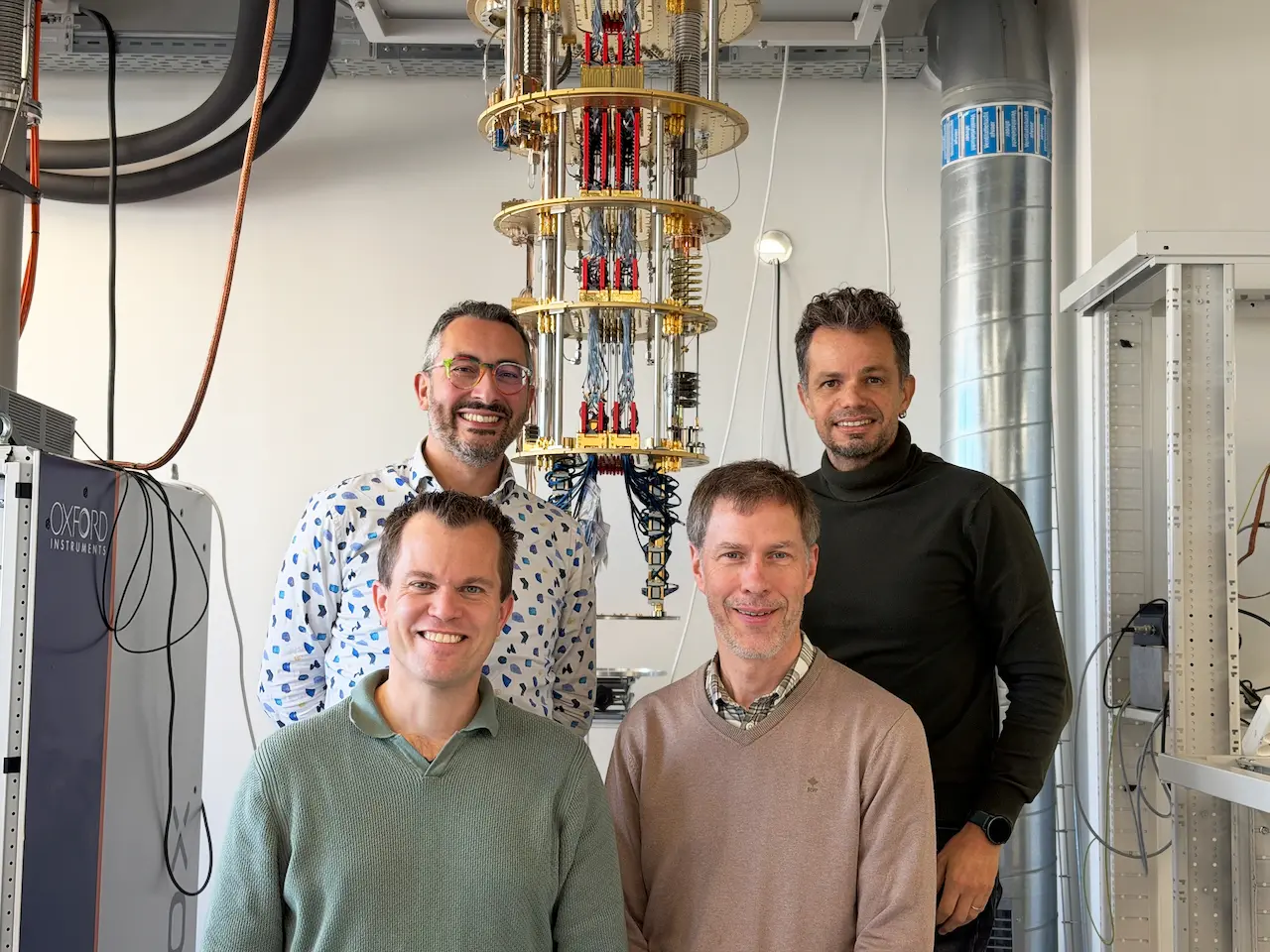
Four Delft researchers are collaborating on a six-year project, UniQ, funded by a European Research Council grant, to build scalable spin qubits. The team aims to use decades of semiconductor engineering expertise by exploring how to process quantum information on a large scale using qubits, tiny components that offer room for large numbers on a chip.
“Spin qubits are reaching an inflection point,” says Menno Veldhorst, as the team works to connect and control these qubits, ultimately building the logical qubits needed for meaningful quantum computation. UniQ will integrate qubit architectures, materials, and supporting electronics to create processors that can grow while preserving fragile quantum information.
UniQ Project: Scaling Spin Qubits with Integrated Electronics
Integration tests will begin immediately, allowing researchers to assess how nearby electronics influence qubit behavior and how control signals are altered as they travel through circuits. Lieven Vandersypen will lead these experiments, focusing on the interplay between qubits and their supporting electronics to identify areas for material or device design improvements.
This approach aims to optimize the entire system, not just individual components, recognizing that performance is interconnected. “If we can make the qubits less demanding to operate, we can give them smaller, simpler circuits that dissipate minimal power.” This array will incorporate pre-amplifiers and electronics for signal routing, establishing a platform to investigate both the chip’s architecture and its potential for error correction.
Researchers believe that improving the material properties of spin qubits can simplify their design, which in turn enables the creation of smaller, more efficient control circuits, Delft says. “A better material can simplify a qubit, and a simpler qubit can make a smaller circuit possible; our experiments will tell us how far we can take that together,” a researcher stated.
The project seeks to demonstrate how qubit movement within arrays can enhance connectivity and facilitate the implementation of error-correction schemes requiring fewer physical qubits per logical qubit. “We can control them increasingly well, and we are learning how to connect and move them. That gives us a much richer starting point for building the logical qubits we ultimately need,” the team reports.
“What makes this exciting is that progress in one area can unlock something in another,” they add, highlighting the collaborative nature of the research. “Every qubit that behaves differently asks something extra of the control system,” further emphasizing the need for a fully integrated and optimized system.
What makes this exciting is that progress in one area can unlock something in another.
Lieven Vandersypen, Researcher at QuTech and TU Delft
Germanium Engineering for Consistent Qubit Environments
Giordano Scappucci will engineer germanium structures designed to provide stable conditions for qubits while simultaneously accommodating the transistors for their supporting electronics. This process centers on meticulously controlling the material’s purity and structure, minimizing electrical and magnetic interference, and customizing regions for specific functions. Improving the material, according to the team, fundamentally alters design possibilities; qubits exhibiting more uniform behavior require less individual calibration, lessening the demands on control circuits.
Materials development, qubit design, and electronic engineering will progress through continuous exchange, with discoveries in one area influencing possibilities in others. The chip’s layout itself offers opportunities for these fields to converge, creating a collaborative environment. “The qubits and electronics can help make each other’s job easier,” they add.
The qubits and electronics can help make each other’s job easier.
Fabio Sebastiano, Researcher at QuTech and TU Delft
Voltage Pulse Control to Simplify Qubit Operation
Veldhorst’s work focuses on operating qubits using voltage pulses, a method designed to lessen the stringent timing demands on the associated electronics. This approach extends beyond individual qubit physics, potentially reducing the size and power consumption of Sebastiano’s circuits, and facilitating their integration onto a single chip alongside the quantum states they protect.
Integrated Chip Testing for Spin Qubit Architecture & Error Correction
UniQ’s design prioritizes simultaneous testing of qubit performance and supporting electronics, beginning immediately with integration tests designed to map signal alterations as they travel through circuits. The team will specifically examine how the proximity of conventional electronics impacts qubit behavior, a critical step toward co-location of quantum and control hardware. The project’s architecture aims to create a platform for investigating both qubit array design and error correction strategies, with a focus on high connectivity between individual spin qubits.
Lieven Vandersypen is leading experiments to determine if these architectural goals can be realized on a single, integrated chip. This continuous exchange of discoveries will allow researchers to push the boundaries of what’s possible in each field, with advancements in one area potentially unlocking progress in another.
Every qubit that behaves differently asks something extra of the control system.
Giordano Scappucci, Researcher at QuTech and TU Delft



See today’s quantum computing news on Quantum Zeitgeist for the latest breakthroughs in qubits, hardware, algorithms, and industry deals.