Quantum algorithms now efficiently calculate energy levels in complex spin glass systems at substantial circuit depth. A method for computing these energies using tensor networks allows analysis of the Quantum Approximate Optimisation Algorithm (QAOA) beyond previous capabilities. A new computational technique enables detailed analysis of quantum algorithms designed to solve complex problems; this overcomes limitations in assessing these algorithms at significant ‘depths’.
Calculations involving numerous layers within the algorithm can be simplified by treating individual components as interacting with simpler systems, according to Google Quantum AI. A new computational method allows analysis of quantum algorithms at greater ‘depths’ than previously possible, centring on calculations of energy levels in complex spin glass systems using tensor networks.
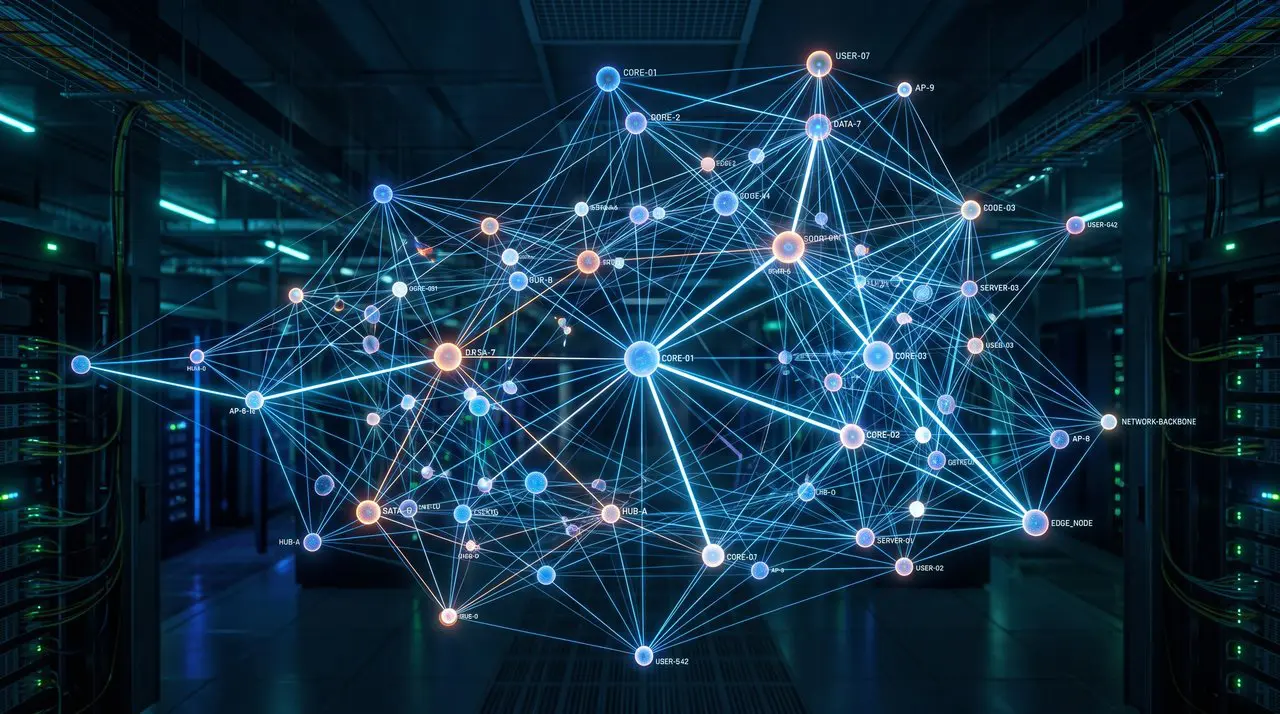
Spin glasses can be imagined as groups of magnets arranged randomly where each magnet attempts alignment with its neighbours but conflicting forces hinder it creating a complicated energetic landscape. Tensor networks function like building something large with Lego bricks, connecting smaller structures efficiently instead of modelling every individual piece, enabling computations for very intricate systems without requiring immense computing power. The team demonstrated that calculating the energies within these algorithms involving numerous layers could be simplified by treating components as interacting with simpler systems.
Spin decoupling unlocks sharply deeper Quantum Approximate Optimisation Algorithm calculations
A seventeen-fold increase in Quantum Approximate Optimisation Algorithm analysis depth has been achieved at Google compared to prior techniques. Previously, methods limited calculations to approximately ten layers, but now researchers perform calculations up to depths exceeding one hundred and sixty layers. This breakthrough stems from demonstrating that spins within dense spin glasses decouple into independent spin-boson systems; this simplification becomes exact when considering an infinite system size, establishing a new “spin-boson mapping” framework for understanding QAOA’s behaviour.
The team optimised QAOA on both pure and mixed spin glass problems, revealing higher-degree challenges require more computational layers for equivalent accuracy while optimising the algorithm’s parameters grows increasingly difficult with greater complexity. Researchers performed numerical optimisation across these models, providing initial analytical insights into algorithmic performance at finite sizes. Increasing problem difficulty necessitates additional Quantum Approximate Optimisation Algorithm layers to maintain comparable precision, further complicating parameter optimisation. Calculations were conducted using up to seventeen spins, exceeding previous depth limitations and confirming observed trends.
Recursive tensor network analyses via spin-boson mapped quantum algorithms
Tensor networks represent a key methodological leap forward; it is similar to building something large with Lego bricks where smaller structures are connected efficiently instead of modelling every single brick individually. This approach avoids the exponential computational costs typically associated with analysing quantum algorithms as ‘depths’ increase, referring to the number of sequential operations within the algorithm itself. The team developed this “spin-boson mapping”, effectively recasting complex interactions between spins in the spin glass as simpler relationships between individual spins and hypothetical boson particles, sharply simplifying calculations.
Treating these components as interacting systems rather than monolithic blocks enabled recursive computations using tensor networks, a technique that scales far more favourably for intricate problems requiring extensive analysis. These methods were employed to analyse Quantum Approximate Optimisation Algorithm performance on complex spin glass problems up to seventeen spins; sidestepping limitations encountered when examining algorithms with many sequential operations revealed higher-degree challenges require increased layers for equivalent accuracy while optimising angles presents greater difficulties.
Predicting performance scaling in layered quantum optimisation algorithms
Finding algorithms capable of outperforming classical methods is crucial for practical quantum computation but verifying this advantage remains elusive as calculations become more complex. Recursive formulas have been devised to predict how well the Quantum Approximate Optimisation Algorithm performs, a leading contender for early quantum devices, yet these techniques falter when applied to circuits with numerous layers, limiting their usefulness at potentially advantageous depths. Despite not allowing full simulation requiring an actual quantum computer for final results, applying this new technique represents strong progress. This work establishes a novel computational framework enabling analysis of quantum algorithms at previously inaccessible depths by using tensor networks; it represents complex systems with interconnected simpler components. By demonstrating spins decouple into independent spin-boson systems within dense spin glasses and simplifying QAOA energy calculation, researchers created a recursive procedure for efficient computation. Decoupling becomes exact in theoretical infinite systems allowing deeper exploration of how problem complexity impacts optimisation challenges and approximation ratios without full simulation on quantum hardware.
The research demonstrated that spins within mixed dense spin glass problems approximately behave as independent spin-boson systems when calculating Quantum Approximate Optimisation Algorithm (QAOA) energies. This decoupling allows scientists to compute QAOA performance at larger sizes and depths using tensor networks, overcoming computational limitations previously encountered with layered circuits. The method facilitates evaluation of QAOA energies but still requires a quantum computer to sample the final bitstrings.
👉 More information
🗞 Decoupling of the QAOA into independent spin-boson systems and high-depth performance on pure and mixed spin glasses
✍️ Sami Boulebnane, Abid Khan, Pragna Subrahmanya, Dylan Herman, Edward Farhi, Benjamin Villalonga and Ruslan Shaydulin (Google)
🧠 ArXiv: https://arxiv.org/abs/2609.40309
See today’s quantum computing news on Quantum Zeitgeist for the latest breakthroughs in qubits, hardware, algorithms, and industry deals.