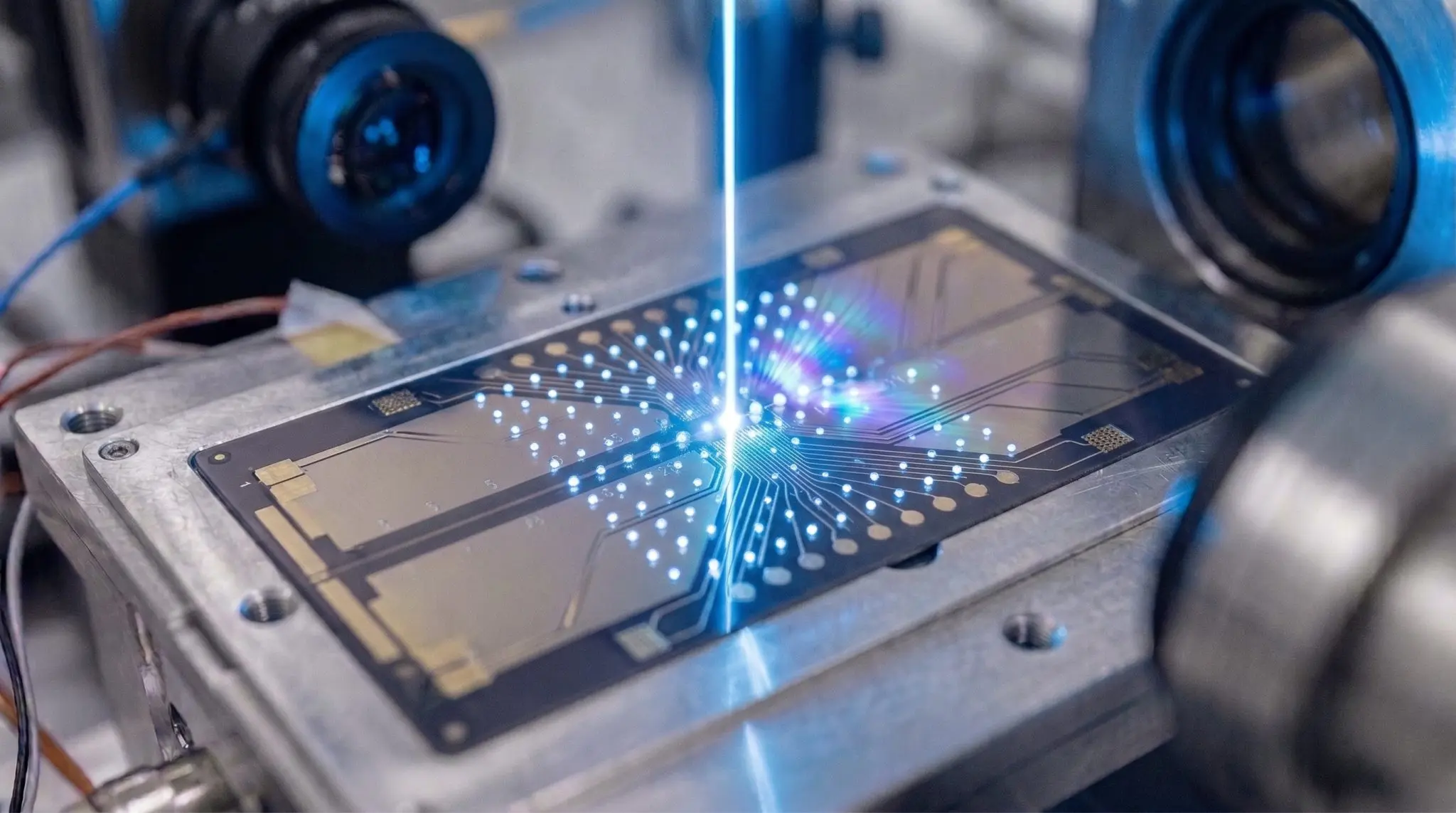
Terra Quantum and Empa have developed an artificial intelligence model, LP-FNO (Laser Processing Fourier Neural Operator), that predicts three-dimensional melt-pool dynamics in laser welding up to 100,000 times faster than conventional methods, the company says. This advance removes a critical computational barrier to real-time process control and the deployment of industrial digital twins.
“The ability to compress hours of physics simulation into milliseconds is not an incremental improvement, it is the kind of change that makes entirely new applications possible,” says Markus Pflitsch, CEO and Founder of Terra Quantum. The model, trained on simulations of Ti-6Al-4V titanium alloy, currently achieves full 3D predictions in as little as 8 milliseconds at standard resolution.
LP-FNO: Real-Time Melt-Pool Prediction for Laser Welding
Simulations that once required six minutes at 10 µm resolution now complete in milliseconds thanks to LP-FNO, a new artificial intelligence model developed by Terra Quantum and Empa. This speed increase, achieved through a Fourier Neural Operator architecture, allows for full 3D melt-pool predictions previously unattainable in real-time, fundamentally altering laser welding process control.
The model’s ability to learn relationships between laser parameters and resulting temperature fields bypasses the limitations of conventional multiphysics simulations, which struggle with the computational demands of accurate 3D modeling. The LP-FNO model was trained using high-fidelity simulations of Ti-6Al-4V titanium alloy, covering a broad range of laser power, from 40 to 190 watts, and scan speeds up to 1 meter per second.
This training encompassed both conduction and stable keyhole welding regimes, a feat previously unachieved by surrogate models. A researcher involved in the project explained that this broad perspective gives the model its resolution-invariant property, as the spectral weights learned on coarse training data generalize naturally to finer evaluation grids, according to Terra Quantum. Combined with the quasi-steady reformulation, this resulted in a single trained model that handles both conduction and keyhole regimes with consistent accuracy across the process window.
The resulting temperature accuracy averages a relative error of approximately 2.5%, while melt-pool boundary segmentation achieves an intersection-over-union (IoU) score exceeding 0.9. Terra Quantum, founded in 2019, is positioning itself as a leader in the emerging field of quantum-as-a-service, offering cloud-based access to quantum computing resources and algorithms. The company’s current trajectory includes a pending SPAC listing with Axiom Intelligence Acquisition Corp 1, valuing it at $3.5 billion and a recent partnership with Apex.AI.
Terra Quantum successfully connected Melita’s data centers in Malta using existing fiber infrastructure.
The ability to compress hours of physics simulation into milliseconds is not an incremental improvement, it is the kind of change that makes entirely new applications possible.
Markus Pflitsch, CEO and Founder of Terra Quantum
Quasi-Steady Reformulation Enables Operator Learning for Keyhole Welding
This acceleration stems from a novel approach to framing the problem, a quasi-steady reformulation that transforms the transient laser-scanning process into a more manageable form for operator learning. By shifting to a reference frame moving with the laser and applying temporal averaging, the team effectively converted a time-dependent challenge into one suitable for the Fourier Neural Operator architecture.
This reformulation is critical to the model’s ability to accurately represent stable keyhole welding dynamics, a complex regime involving deep vapor depressions and significant laser-absorption variation. The research team explains that Fourier Neural Operators are architecturally well-suited to this class of problem because they learn in spectral space, mixing information across the full physical domain at each layer rather than propagating it locally through convolutional neighborhoods.
The implications extend beyond faster simulations; the team reports an intersection-over-union (IoU) score exceeding 0.9 for melt-pool boundary segmentation, and a relative temperature error of approximately 2.5%. According to the team, with LP-FNO, industrial operators can run process optimization in real time, build digital twins that stay synchronized with the physical process, and explore parameter spaces that were previously too expensive to probe.
This is what deploying AI on the toughest problems in manufacturing looks like. This partnership between Empa and Terra Quantum brought together expertise in laser processing, materials science, process-modelling and advanced machine learning, culminating in a system capable of handling both conduction and stable keyhole welding within a single framework.
This partnership brought together Empa’s expertise in laser processing, materials science, and process-modelling know-how with Terra Quantum’s capability in advanced machine learning and neural operator methods.
Dr. Elia Iseli, Head of Light-Matter Dynamics Group, Empa
Empa & Terra Quantum Combine Expertise in AI & Laser Processing
Terra Quantum’s expertise extends beyond algorithm development to encompass practical delivery of quantum solutions, offering “Quantum Computing as a Service” through both simulated and physical quantum processing units. This commitment to accessibility is reflected in their broader portfolio, which also includes “Quantum Security as a Service” and “Quantum Algorithms as a Service,” positioning the company as a comprehensive provider in the emerging quantum landscape. The newly developed LP-FNO model achieves resolution invariance, a critical feature allowing accurate predictions even when applied to data with finer granularity than it was originally trained on.
This capability bypasses the need for costly retraining, streamlining the process of scaling simulations to higher resolutions essential for detailed analysis. Iseli notes that the level of agreement between LP-FNO’s predictions and those of high-fidelity models highlights the predictive power of the surrogate approach and represents a result that would have been impossible without the combined expertise of Empa and Terra Quantum.
Fourier Neural Operators are architecturally well-suited to this class of problem because they learn in spectral space, mixing information across the full physical domain at each layer rather than propagating it locally through convolutional neighborhoods.
Florian Neukart, Chief Technology Officer at Terra Quantum
Source: https://finance.yahoo.com/technology/ai/articles/terra-quantum-empa-develop-ai-110000993.html



See today’s quantum computing news on Quantum Zeitgeist for the latest breakthroughs in qubits, hardware, algorithms, and industry deals.