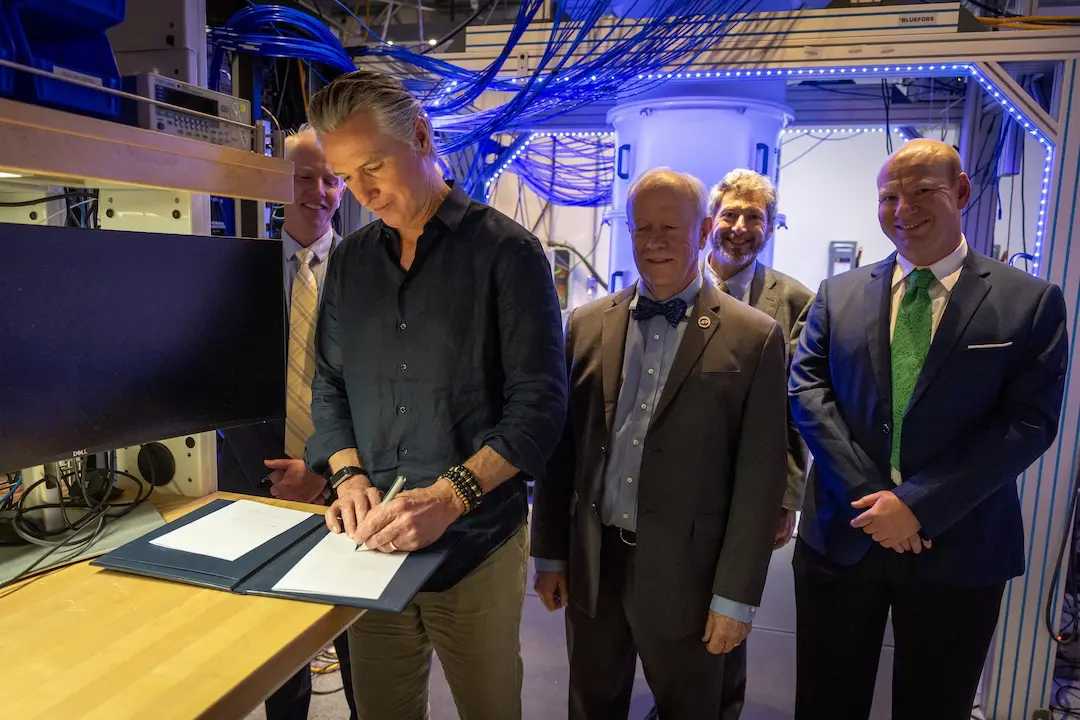
Governor Newsom signed legislation establishing a strategic plan for fusion energy development in California, alongside a major investment bolstering quantum research. The bills aim to expand research opportunities and assess the potential for new nuclear power plants to help the state reach 100% zero-carbon electricity by 2045. Senator Jerry McNerney stated, “Fusion energy has the potential to provide nearly limitless clean, safe, and reliable power, while creating an economic ecosystem that will rival Silicon Valley.” Assemblymember Lisa Calderon added that advanced nuclear technology could help meet California’s long-term electricity needs.
California Legislation Advances Fusion Energy and Research
The bills signed into law establish a framework extending beyond research funding, directing agencies to create a comprehensive plan for integrating fusion into California’s energy portfolio. This plan will incorporate public input during the assessment of potential new nuclear facilities, a notable step given broader national trends away from nuclear energy expansion.
The legislation addresses both the technological and economic aspects of fusion, directing state resources towards advancing fusion manufacturing and supporting a commercial fusion strategy. Senator Jerry McNerney (D-Pleasanton) emphasized the potential of this technology, stating, “SB 925 lays the groundwork for widespread adoption of fusion energy in the state and will help ensure that California is a fusion technology leader in the coming decades.” This proactive stance positions California as a potential hub for the burgeoning fusion industry, building on its existing strengths in federal research facilities and private investment.
California currently hosts the DIII-D National Fusion Facility in San Diego and Lawrence Livermore National Laboratory’s National Ignition Facility, where researchers achieved laboratory fusion ignition in December 2022. “Nuclear energy is the United States’ largest source of clean power, supplying nearly 20% of the nation’s electricity while avoiding over 470 million metric tons of carbon dioxide emissions,” she said. “Fifty years ago, California made a choice based on the technologies and needs of that era.
Today, we face an entirely different reality. Our families and businesses need affordable electricity.” The state’s commitment to fusion is emphasised by previous investments, including a $5 million initiative established last year to advance fusion research and development. This new legislation builds on that foundation, signaling a sustained effort to capitalize on California’s position as the nation’s largest fusion ecosystem. The state’s fusion ecosystem currently boasts world-leading federal research facilities and private investment firms that drive the state’s fusion innovation system.
Beyond fusion, the legislation also acknowledges the synergistic potential of quantum technology, with investments aimed at strengthening the workforce and research infrastructure in this rapidly evolving field. California’s leadership in quantum science is evident in its concentration of Nobel-winning breakthroughs, talent at institutions like UC Berkeley, UCLA and Caltech, and a growing number of quantum-focused companies. The state is actively encouraging career pathways in both quantum and fusion, including a $2.7 million Quantum FAST Challenge and a $3 million Workforce Accelerator Fund.
These initiatives aim to build a skilled workforce capable of supporting the development and deployment of these advanced technologies. California’s dominance in the production of critical minerals, accounting for approximately 15% of global rare-earth supply, positions it as a key player in the quantum hardware supply chain. Recent tax credits, extended by Governor Newsom, are further bolstering the semiconductor and critical mineral supply chain, attracting over $1 billion in private investment from companies like Samsung Semiconductor and MP Materials.
This investment highlights the state’s commitment to securing the necessary resources for the growth of both quantum and fusion industries. The state’s economic performance, with a GDP exceeding $4.25 trillion in 2025 and a 3.7% annualized growth rate in the first quarter of 2026, provides a strong foundation for these ambitious initiatives. The legislation reflects a broader strategy to use California’s economic strength and technological innovation to address the challenges of climate change and energy security.
California has made substantial progress towards its climate goals. But fusion energy has the potential to provide nearly limitless clean, safe, and reliable power, while creating an economic ecosystem that will rival Silicon Valley.
Sen. Jerry McNerney (D-Pleasanton)




See today’s quantum computing news on Quantum Zeitgeist for the latest breakthroughs in qubits, hardware, algorithms, and industry deals.