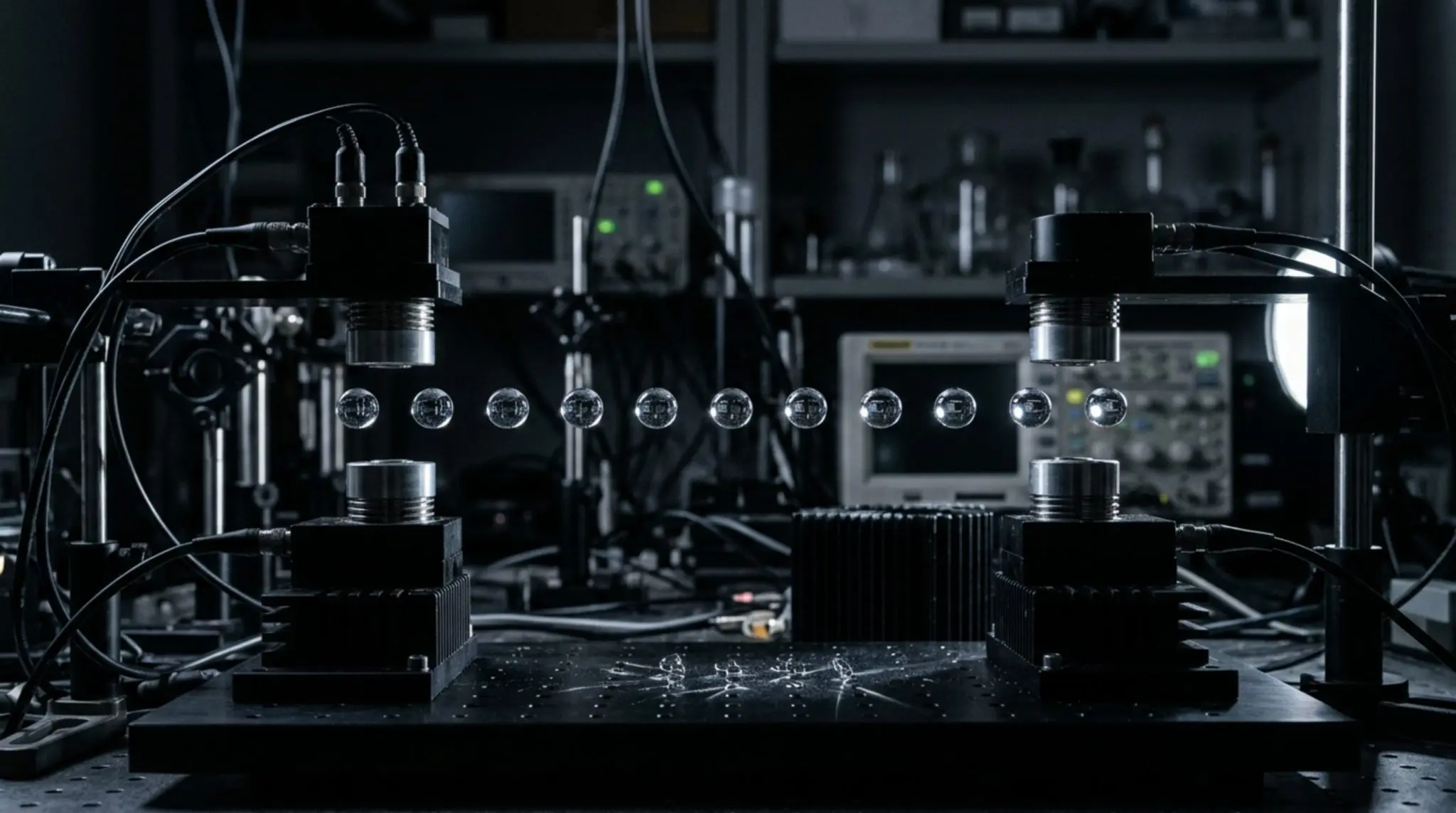
Monarch University researchers have predicted a stable droplet formed from a unique mixture of bosons and fermions, challenging the long-held belief that such droplets were unlikely in strongly interacting systems. The study details how an attractive force between particles is exactly balanced by pressure from fermions, preventing collapse, a mechanism distinct from everyday liquid droplets relying on surface tension.
Lead author and Monash PhD candidate Sam Foster said that they’ve shown these two very different types of particles can balance each other perfectly to create a stable droplet that effectively holds itself together, potentially impacting the development of ultra-precise sensors and quantum computing.
Bose-Fermi Mixtures Predict Stable, Self-Bound Quantum Droplets
The predicted stability of these quantum droplets arises from a unique balancing act between attraction and pressure, a phenomenon unlike anything seen in classical liquids. An attractive force binding the bosons and fermions is precisely countered by the inherent pressure generated by the fermions themselves, preventing gravitational collapse and maintaining the droplet’s structure without relying on surface tension. This mechanism, detailed in a recent publication in Physical Review Letters, challenges previous theoretical limitations which struggled to model such systems with strong particle interactions.
Associate Professor Jesper Levinsen and colleagues demonstrated that the predicted droplets are within reach of current experimental capabilities using ultracold atom setups, suggesting a pathway for direct observation and validation of the theoretical findings. Beyond the droplets themselves, the team observed quantum behavior mirroring the transition between liquid and gaseous states, revealing a complex range of potential quantum phases within the mixture.
This discovery expands the known understanding of quantum phases, offering new avenues for exploration. The implications of this research extend beyond fundamental physics, potentially impacting the development of advanced technologies. “Understanding how matter organizes itself under extreme quantum conditions gives us new tools for designing and controlling quantum systems,” said Sam Foster, a PhD candidate at Monash University and lead author of the study.
“While this is fundamental research, discoveries like this often become the foundation for tomorrow’s quantum technologies.” Foster explained that previous theoretical models were limited in their ability to accurately describe these systems when particle interactions were strong, but their new approach overcomes those limitations, unlocking access to more interesting and complex physics. The team’s work, conducted in collaboration with researchers from Heidelberg University, provides a new theoretical framework for experiments aiming to create and manipulate quantum matter. This framework could be important in the pursuit of ultra-precise sensors and the development of more robust quantum computers, where controlling the behavior of individual particles is paramount.
Understanding how matter organises itself under extreme quantum conditions gives us new tools for designing and controlling quantum systems. While this is fundamental research, discoveries like this often become the foundation for tomorrow’s quantum technologies.




See today’s quantum computing news on Quantum Zeitgeist for the latest breakthroughs in qubits, hardware, algorithms, and industry deals.