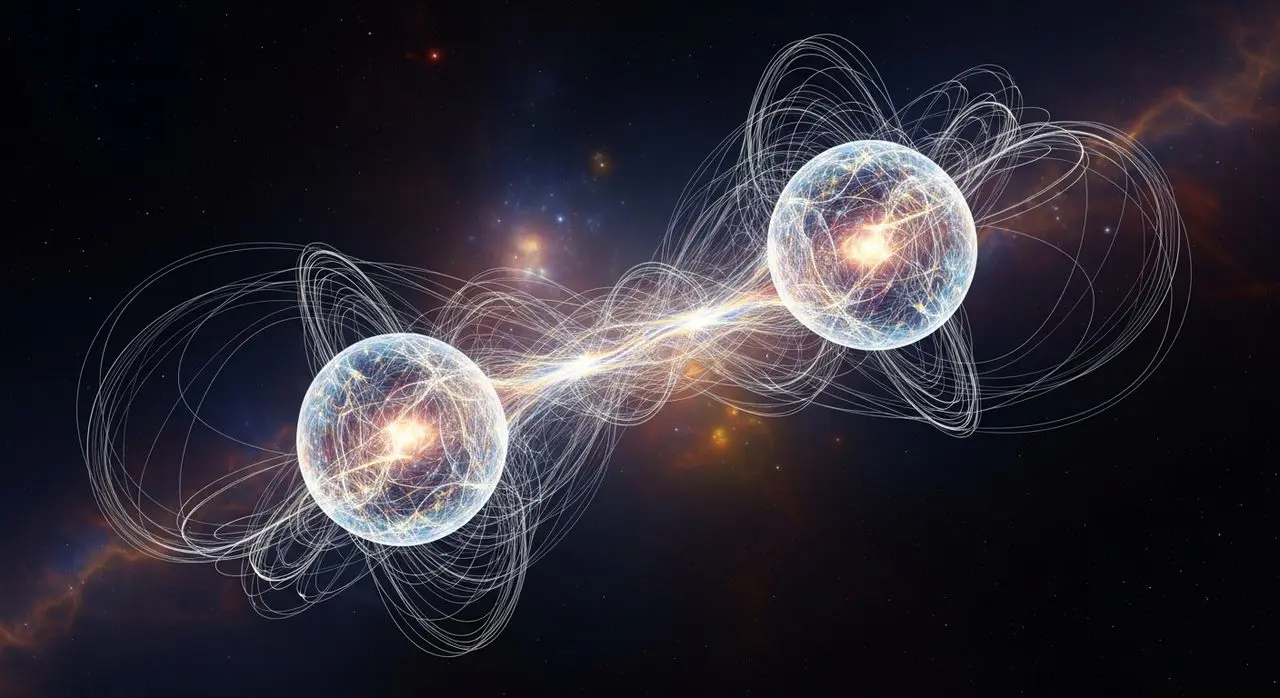
Yu-Xuan Zhang of Nankai University and Jing-Ling Chen have proven that every entangled rank-2 two-qubit state is EPR steerable. This resolves a long-standing question of how entanglement and EPR steering relate for rank-2 two-qubit states, building on Gisin’s theorem which established a link for pure states. The researchers used a local-unitary parametrization of rank-2 two-qubit states and a state-dependent nonlinear steering inequality in their proof, establishing these states as certifiable resources for quantum information technologies.
Rank-2 Two-Qubit States are Universally EPR Steerable
This result extends Gisin’s theorem, which previously linked pure-state entanglement to Bell nonlocality, by proving a similar connection for a broader class of quantum states, specifically those with a rank of two. EPR steering describes a quantum phenomenon where one party, through local measurements, can seemingly prepare the state of another entangled particle, a concept central to quantum communication and computation.
The ability to reliably generate and verify steerable states is crucial for applications like quantum teleportation and quantum key distribution, where secure information transfer depends on the unique properties of entangled particles. The researchers highlight the practical implications of their findings in their published work.
The team’s work builds on decades of research into quantum nonlocality, beginning with the 1935 EPR paradox and Bell’s theorem in 1964, which further developed the EPR paradox and laid the groundwork for understanding the fundamental differences between quantum mechanics and classical physics. Prior investigations established a hierarchy of quantum nonlocality, with Bell nonlocality being the strongest form, EPR steering intermediate, and entanglement the most general.
However, the precise relationship between these forms, particularly for rank-2 two-qubit states, remained an open question until now. In 1989, Werner demonstrated that entanglement and Bell nonlocality are not always equivalent, showing that some entangled states do not exhibit Bell nonlocality.
The current study definitively answers that question for rank-2 two-qubit states, establishing that these states provide certifiable EPR-steering resources in quantum information. This means researchers can confidently utilize these states in quantum technologies, knowing that they possess the necessary properties for EPR steering without needing to perform complex and potentially unreliable tests to verify it. This analytical characterization offers a powerful tool for designing and optimizing quantum protocols that rely on EPR steering, potentially accelerating the development of practical quantum technologies.
Gisin’s Theorem Connects Entanglement to Bell Nonlocality
The relationship between quantum entanglement and other forms of nonlocality has long been a central question in quantum information theory. While quantum entanglement represents the broadest category of nonlocality, both Einstein-Podolsky-Rosen (EPR) steering and Bell nonlocality represent more restrictive forms. In 1964, John Bell proposed a theorem establishing a clear distinction between entanglement and the stronger phenomenon of Bell nonlocality, building on the 1935 EPR paradox. This prompted further investigation into the precise connections between these quantum properties, particularly for mixed states, those that aren’t in a pure, definitive quantum state.
Hierarchical Structure of Quantum Nonlocality Forms
Their work demonstrates that every entangled rank-2 two-qubit state is EPR steerable, meaning one party can reliably influence the quantum state of another through local measurements and communication. The implications of this work extend beyond theoretical clarification; the ability to guarantee steerability is vital for designing robust and reliable quantum systems, as it ensures the resource will perform as expected.
While Gisin’s theorem established a clear connection for pure states, extending that understanding to the more complex realm of mixed states proved challenging. By providing a certifiable resource for EPR steering, the researchers have removed a significant obstacle to the practical implementation of these technologies.
Werner States Distinguish Bell Nonlocality and Entanglement
This finding moves beyond theoretical possibility, establishing a guaranteed characteristic for these states and offering a pathway to building more robust quantum technologies. “Gisin’s theorem therefore provides a benchmark example in which entanglement leads to an experimentally testable form of quantum nonlocality,” the paper states. This work confirms that within the realm of rank-2 two-qubit states, entanglement guarantees steerability.
Setting Linear Inequality Certifies EPR Steerability
The assumption that entanglement automatically guarantees the ability to “steer” a quantum state has long been a point of investigation for physicists. The analytical characterization achieved in this study is not merely a theoretical exercise because the tools used in the proof, a local-unitary parametrization of rank-2 two-qubit states and a state-dependent nonlinear steering inequality, can also be used to verify that a given state possesses this crucial property.
This verification is essential for building reliable quantum devices and networks, where the ability to predictably manipulate quantum states is paramount. This work confirms that for rank-2 two-qubit states, entanglement guarantees steerability.
Schmidt Decomposition Reveals Pure State Bell Violation
Extending this understanding to mixed states, however, proved more challenging. The ability to remotely influence a quantum state is at the heart of many quantum information protocols. This verification is particularly important given the hierarchical relationship between entanglement, EPR steering, and Bell nonlocality, where EPR steering lies intermediate between them. This finding is significant because it provides a concrete, provable link between these two fundamental quantum properties.
See today’s quantum computing news on Quantum Zeitgeist for the latest breakthroughs in qubits, hardware, algorithms, and industry deals.