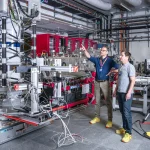
Researchers at the University of Birmingham have demonstrated a novel approach to understanding the fundamental nature of time by observing cycles of expansion and recollapse in a Bose-Einstein condensate. The experiment partitioned the ultracold gas using a thin optical barrier, creating “observed” and “unobserved” sectors designed to mirror concepts within the Wheeler-DeWitt framework and relational-time theories. By constructing an entropic time from an experimentally defined coarse-grained entropy, Giovanni Barontini at the University of Birmingham constructed the entropic time and demonstrated that it can robustly order the events in the observed sector across repeated cycles of expansion and recollapse. These results, published in Physics Letters A, establish a controlled experimental setting for quantitatively testing constructions related to the problem of time in quantum gravity.
Bose-Einstein Condensate Setup for Relational Time Testing
Researchers have demonstrated the ordering of events within a partitioned Bose-Einstein condensate using only internal degrees of freedom, a feat with implications for fundamental understandings of time itself. This precise partitioning allowed for the investigation of whether time could emerge as a property of the system itself, rather than an external parameter. Cycles of expansion and recollapse within the condensate were observed, providing repeated opportunities to test the internal consistency of any derived time metric. Giovanni Barontini at the University of Birmingham constructed an entropic time by calculating coarse-grained entropy from experimentally defined parameters. This internally-defined time was then successfully used to order events occurring solely within the observed sector of the condensate.
The researchers noted that the total entropy was effectively proportional to the number of atoms in the bright sector, meaning entropy flow is directly linked to atom number dynamics. This connection between entropy and atomic number proved important in establishing the entropic time and its ability to accurately model the condensate’s behavior. The ability to generate and control optical potentials for ultracold atoms, using a superluminescent diode, was also a vital component of the experimental design. The team asserts these results provide a controlled experimental setting in which relational-time constructions can be quantitatively tested, opening new avenues for exploring the elusive nature of time in quantum systems.
Entropic Time Construction from Coarse-Grained Entropy
The quest to understand time’s fundamental nature has long been dominated by frameworks struggling to reconcile its apparent flow with the time-symmetric laws of physics; however, a new approach sidesteps this issue by constructing time not as an external parameter, but as an emergent property of entropy within a quantum system. Researchers are now demonstrating that time can, in effect, be built from the internal dynamics of a system itself, rather than imposed upon it. This builds on decades of theoretical work, including the Wheeler-DeWitt framework and relational-time approaches, which posit that time is not absolute but relational to the observed system. This created an “observed” and “unobserved” sector, a configuration mirroring concepts central to relational-time theories. Crucially, the team didn’t simply observe these cycles; they built a metric for time from the system’s entropy. They constructed an entropic time from an experimentally defined coarse-grained entropy, a measure of disorder, and demonstrated its ability to order events within the observed sector.
Effective Schrödinger Equation Reproduces Measured Evolution
Rather than relying on an externally imposed temporal framework, the research team successfully constructed a metric derived directly from experimentally measured entropy within a Bose-Einstein condensate. This internally defined time metric, built from an experimentally defined coarse-grained entropy, proved capable of accurately ordering events occurring within a specifically partitioned sector of the condensate. The researchers didn’t simply define this internal time; they then used it to formulate an effective Schrödinger equation, the cornerstone of quantum mechanics, and validated its accuracy against observed condensate behavior. The researchers’ data set is available on Zenodo, allowing for independent verification and further exploration of these findings.
See today’s quantum computing news on Quantum Zeitgeist for the latest breakthroughs in qubits, hardware, algorithms, and industry deals.