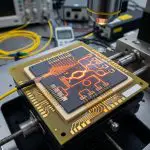
A new set of tools for generating bright, pure, and interference-ready single-photon sources is enabling advances in quantum communication and photonic quantum information processing. Sahil D. Patel and colleagues at University of California highlight that existing solid-state platforms frequently require complex optical setups and post-selection processes to achieve acceptable performance. Their review surveys recent developments integrating electronic and photonic components with single quantum emitters in two-dimensional materials, specifically examining excitonic emitters in transition metal dichalcogenides and defect-based colour centres in hexagonal boron nitride. Stabilised, on-demand quantum light sources efficiently coupled to optical fibres or photonic circuits offer the potential for scalable quantum photonics through co-designed architectures that optimise operation, stabilisation, tunability and optical interfacing.
Strain-induced quantum emitter formation via monolayer transfer onto silicon nitride waveguides
Waveguide integration underpins recent advances, enabling on-chip routing of quantum emission and addressing limitations of earlier systems which often relied on free-space optics and cumbersome alignment procedures. A two-dimensional material, such as a monolayer of tungsten diselenide, is carefully transferred onto a pre-fabricated silicon nitride dielectric waveguide. Silicon nitride is favoured due to its low optical loss in the visible spectrum and compatibility with standard microfabrication techniques. Localized strain gradients, created by the waveguide’s edges and transfer imperfections, arising from the mismatch between the monolayer and the waveguide surface, can generate single quantum emitters directly within the material, positioning them near the light-guiding channel. The formation of these quantum emitters is attributed to the creation of localized defects or modifications of the material’s band structure induced by the strain. Initial demonstrations achieved a unidirectional coupling efficiency of approximately 0.32% for TE00 mode and 0.34% for TM00 mode, offering a scalable and relatively simple method for routing quantum emission on a chip, avoiding the complexities of embedding emitters within the waveguide core. This coupling efficiency represents the proportion of photons emitted by the quantum emitter that are successfully guided into the desired mode of the waveguide, and is a crucial parameter for assessing the performance of integrated quantum photonic circuits. Further optimisation of the transfer process and waveguide design is expected to improve these efficiencies. The ability to fabricate these devices using established nanofabrication techniques is a significant advantage for scalability.
Integrated two-dimensional materials extend single-photon coherence beyond quantum bit dephasing
Single-photon source coherence time, T2, has markedly improved, extending from picoseconds to over 3 nanoseconds in recent demonstrations. This threshold is critical because it surpasses the dephasing rates of many quantum bits, previously hindering long-distance quantum communication and complex quantum circuits. Quantum bit dephasing, the loss of phase information in a qubit, limits the duration of quantum computations and the distance over which quantum information can be reliably transmitted. Progress stems from integrating electronic and photonic components with two-dimensional materials like tungsten diselenide and hexagonal boron nitride, enabling on-demand triggering and noise mitigation. The integration allows for active stabilisation and control of the quantum emitter, reducing the effects of environmental fluctuations.
Electrical injection and fast modulation techniques suppress unwanted blinking and spectral wandering, phenomena that degrade the performance of single-photon sources. Blinking refers to the random on-off switching of the emitter, while spectral wandering describes fluctuations in the emitted photon’s wavelength. Photonic waveguides and resonators efficiently channel emitted photons into optical fibres, minimising losses and maximising collection efficiency. Increasingly sophisticated control over single-photon sources integrated with electronic components is being achieved at various institutions, evidenced by electrically pumped devices now demonstrating stability measurements at biases around 30 Volts. These advancements build upon narrowband tunnel-junction demonstrations and engineered carbon-doped hexagonal boron nitride single-photon emitters, aligning with observations that electrical operation can activate defect populations. The tunnel junctions provide a means of controlling the charge state of the defect, while carbon doping can modify the defect’s energy levels and emission properties. Key device characteristics include electrical triggering to nanoampere levels, maximising emission from zero-phonon lines, and improving single-photon purity; these metrics connect to evaluations of existing sources based on two-dimensional materials. Zero-phonon lines represent transitions where no vibrational energy is exchanged, resulting in highly pure single photons. Optimising electrical switching times and minimising carrier storage are achieving advances towards pulsed operation at gigahertz rates, alongside engineering faster radiative lifetimes. Faster radiative lifetimes allow for higher repetition rates of single-photon emission. However, current results do not fully reflect packaged, room-temperature operation, and a gap remains before these devices become practical components in widespread quantum photonic systems. Maintaining performance under realistic operating conditions, including ambient temperatures and vibrations, remains a significant challenge.
Evaluating the dominance of tungsten diselenide and hexagonal boron nitride for integrated
Creating reliable, compact single-photon sources is vital for the promise of integrated quantum technologies, yet current progress remains largely confined to two-dimensional materials like tungsten diselenide and hexagonal boron nitride. This review acknowledges a deliberate limitation, excluding advances made with alternative emitter materials. A critical question arises: is concentrating solely on these two materials potentially overlooking parallel innovations in other systems that might offer a more immediate path to scalable quantum networks. While other materials, such as diamond with nitrogen-vacancy centres or silicon carbide with silicon vacancies, also exhibit promising single-photon emission properties, tungsten diselenide and hexagonal boron nitride have emerged as frontrunners due to their compatibility with integrated photonic platforms and relatively straightforward fabrication processes.
Understanding progress in these specific materials is vital for near-term development of practical quantum devices, even as broader research continues elsewhere. Electrical and photonic control offers a pathway towards deployable quantum technologies, moving beyond initial demonstrations to engineered, stable devices. This integration directly tackles the challenge of scaling single-photon sources, essential for building practical ‘quantum light engines’ for real-world applications. Electrical control suppresses unwanted noise and enables on-demand operation, while photonic components efficiently channel emitted photons into optical fibres and circuits. Future development hinges on co-designing electronic and photonic architectures, jointly optimising performance metrics like stability and tunability; localized excitons and defect centres are key to this process. Co-design involves considering the interplay between the electronic and photonic components from the outset, rather than treating them as separate entities. This holistic approach is crucial for achieving optimal performance and scalability. The development of these ‘quantum light engines’ will pave the way for applications in secure quantum communication, quantum sensing, and distributed quantum computing.
The research demonstrates progress in integrating single quantum emitters, specifically within tungsten diselenide and hexagonal boron nitride, with both electronic and photonic components. This integration is important because it addresses key challenges in creating stable and controllable single-photon sources for quantum technologies. By combining electrical and photonic control, researchers are working towards ‘quantum light engines’ that can reliably emit single photons on demand and efficiently couple them to optical fibres. The authors suggest future work will focus on co-designing electronic and photonic architectures to further optimise the performance of these sources.
👉 More information
🗞 Electronic and Photonic Integration of Single Quantum Emitters in 2D Materials
🧠 ArXiv: https://arxiv.org/abs/2605.05721



See today’s quantum computing news on Quantum Zeitgeist for the latest breakthroughs in qubits, hardware, algorithms, and industry deals.