A fault-tolerant mapping of surface codes onto a silicon spin-qubit railway architecture has been achieved by Arun John Moncy of Donostia International Physics Centre, and colleagues from University of Navarra and Hitachi Cambridge Laboratory. The approach addresses wiring complexity through electron shuttling. Moncy and colleagues reveal that strategically shuttling check qubits, rather than data qubits, sharply enhances system thresholds for error correction. Their circuit-level noise modelling indicates the non-CSS XZZX surface code surpasses standard CSS variants when subjected to dephasing noise inherent in spin-qubit shuttling, and importantly, they show a distance 7 code with a physical error rate of  can achieve a Megaquop footprint, suggesting a viable route to reducing hardware requirements for near-term fault-tolerant quantum computing.
Reduced error rates and scalable qubit architecture via dynamic check qubit shuttling
Error rates were reduced to  , enabling a Megaquop footprint with a distance 7 code; previously, achieving this level of performance necessitated greater hardware resources and a significantly larger qubit count. Successfully mapping rotated surface codes onto a silicon spin-qubit railway architecture, utilising electron shuttling to bypass wiring complexities, underpinned this breakthrough. Surface codes are a leading candidate for quantum error correction, but their implementation demands substantial qubit overhead. This research demonstrates a pathway to minimise that overhead. The architecture features qubits on parallel lines dynamically linked by electron movement, demonstrating that shuttling check qubits, instead of data qubits, fundamentally improves error correction thresholds, a key advancement for scalable quantum computation. Check qubits are crucial for verifying the integrity of data qubits, and optimising their movement proves critical for overall system performance. The Megaquop footprint refers to the number of physical qubits required to implement a logical qubit with a specified error correction capability; a smaller footprint is highly desirable for practical quantum computers.
Detailed analysis revealed that fluctuations in magnetic field gradients and velocity during electron shuttling contribute to the overall error bias, offering further avenues for noise control and optimisation. These fluctuations introduce uncertainty in the electron’s trajectory and interaction with the qubits, leading to errors. Understanding and mitigating these sources of noise is paramount for improving the fidelity of quantum operations. This tailored approach, combined with a non-CSS XZZX surface code optimised for spin-qubit shuttling noise, unlocks a pathway towards reducing the physical qubit count required for fault-tolerant quantum processors. The XZZX code is a variation of the surface code designed to be more resilient to specific types of noise, such as dephasing. Achieving this footprint utilising a distance 7 code confirms the viability of this silicon spin-qubit architecture, and future work will focus on mitigating the impact of magnetic field fluctuations and velocity changes during electron transport to refine performance. A distance 7 code represents a significant step towards practical error correction, as it provides a higher level of protection against errors than lower-distance codes.
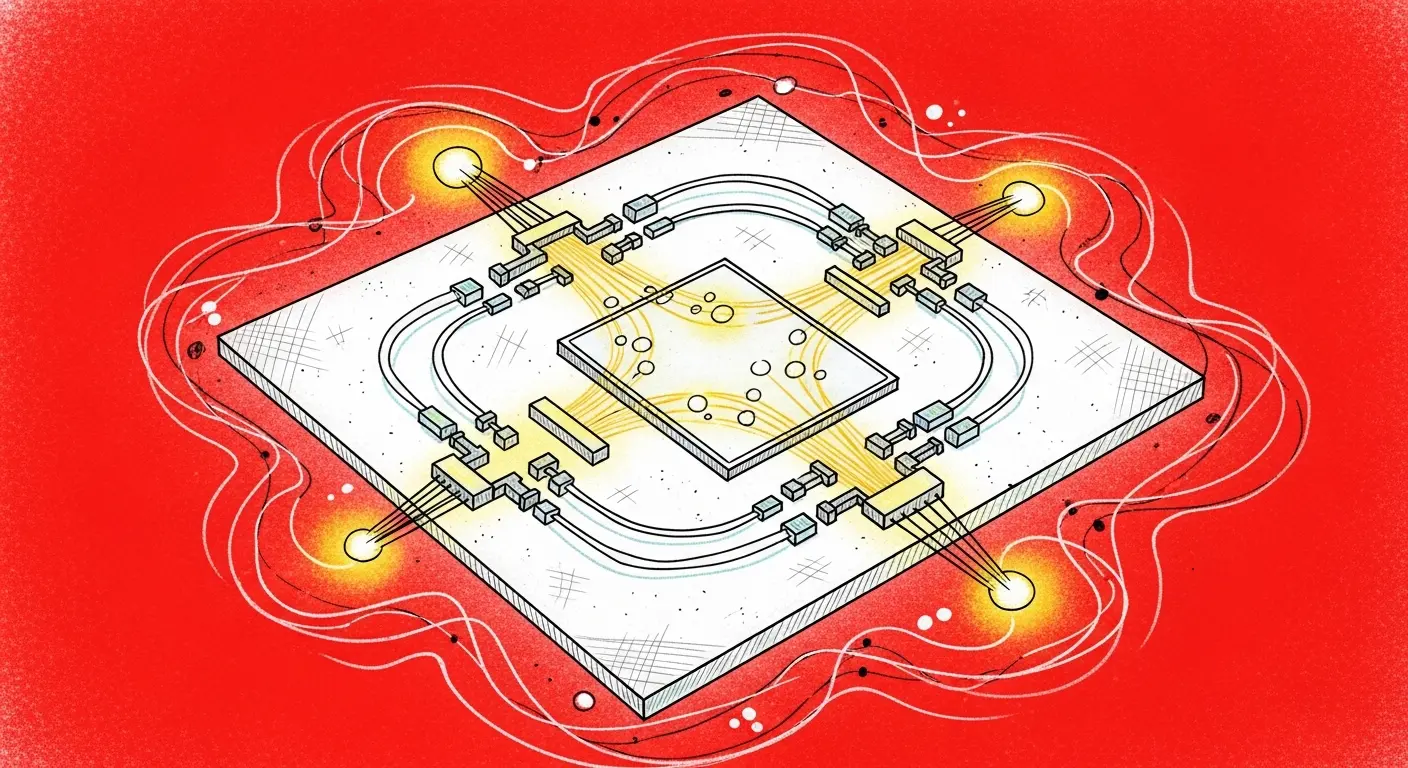
Electron shuttling, a method of moving quantum information between qubits, underpinned the successful mapping of surface codes onto a silicon spin-qubit architecture; the technique resembles a miniature railway system transporting packages. Physically transporting the spin of an electron between interaction zones circumvents the limitations of static, nearest-neighbour qubit connections, allowing qubits to be dynamically linked as needed for operations. Traditional quantum computer architectures often rely on fixed connections between qubits, which limits the types of quantum algorithms that can be efficiently implemented. Electron shuttling offers a solution to this problem by enabling dynamic connectivity. A 2xN grid, termed a ‘railway’ architecture, was implemented, with qubits residing on parallel lines and shuttled along them to enact the necessary connections for quantum error correction. The ‘railway’ analogy highlights the organised and controlled movement of quantum information within the architecture. This architecture allows for a more flexible and efficient use of qubits, reducing the overall hardware requirements.
This dynamic connectivity alleviates wiring complexity and allows for denser qubit arrangements without sacrificing control fidelity. Wiring complexity is a major challenge in building large-scale quantum computers, as it requires a vast network of cables and connectors. Electron shuttling simplifies this process by reducing the need for long-range connections. Silicon spin qubits were utilised within a 2xN grid architecture, a ‘railway’, to map rotated surface codes. Rotated surface codes offer advantages in terms of error correction performance and qubit connectivity. Circuit-level noise modelling, focusing on dephasing caused by micromagnets and spin-orbit coupling during qubit transport, informed the optimisation of the surface code for this specific architecture. Dephasing is a type of noise that causes qubits to lose their quantum coherence, and it is particularly prevalent in spin-qubit systems. Micromagnets and spin-orbit coupling are two sources of dephasing noise in silicon spin qubits. Building quantum computers demands ever-increasing qubit counts, but maintaining the integrity of quantum information remains a formidable challenge. The exponential increase in complexity with qubit number necessitates innovative error correction strategies and architectural designs.
Optimising how error correction is implemented within a specific silicon spin-qubit architecture offers a promising route to scaling; however, the reliance on circuit-level modelling introduces a critical tension. While simulations accurately predict performance under defined conditions, they cannot fully capture the unpredictable subtle aspects of real-world fabrication and operation. Circuit-level noise modelling allows researchers to predict the performance of quantum circuits under various noise conditions, but it is an approximation of reality. The accuracy of these models depends on the fidelity of the underlying assumptions and the completeness of the noise characterisation. Realistic expectations require acknowledging that simulations cannot perfectly replicate a physical device, and future work will focus on validating these findings through physical device fabrication and testing. Experimental validation is crucial for confirming the theoretical predictions and identifying any discrepancies between the simulation and the real world.
Successfully mapping a rotated surface code onto a silicon spin-qubit railway demonstrates a pathway to reduce the physical resources needed for fault-tolerant quantum computation. Prioritising the movement of ‘check qubits’, essential for error detection, rather than ‘data qubits’ fundamentally improves the system’s ability to correct errors. Data qubits store the actual quantum information, while check qubits are used to verify its integrity. The work highlights how tailoring the quantum code to the specific noise characteristics of spin-qubit shuttling, particularly dephasing, unlocks performance gains; the non-CSS XZZX surface code proved superior to standard alternatives, and its implementation details are key for replicating these results. The choice of quantum code and its optimisation for the specific hardware platform are critical for achieving high performance. Further research will focus on refining the shuttling process and exploring alternative qubit architectures to further enhance the scalability and fault tolerance.
Successfully mapping a rotated surface code onto a silicon spin-qubit railway suggests a reduction in the hardware needed for reliable quantum computation. Prioritising the shuttling of check qubits, rather than data qubits, improves the system’s error correction capabilities. Researchers demonstrated that a non-CSS XZZX surface code outperformed standard codes under noise conditions typical of spin-qubit shuttling, achieving a distance 7 code with a physical error rate of 10⁻³. The authors intend to validate these findings through the fabrication and testing of physical devices.
👉 More information
🗞 Surface-Code Thresholds and Qubit Footprints in Shuttling-Based Spin-Qubit Railways
🧠 ArXiv: https://arxiv.org/abs/2605.05881
See today’s quantum computing news on Quantum Zeitgeist for the latest breakthroughs in qubits, hardware, algorithms, and industry deals.