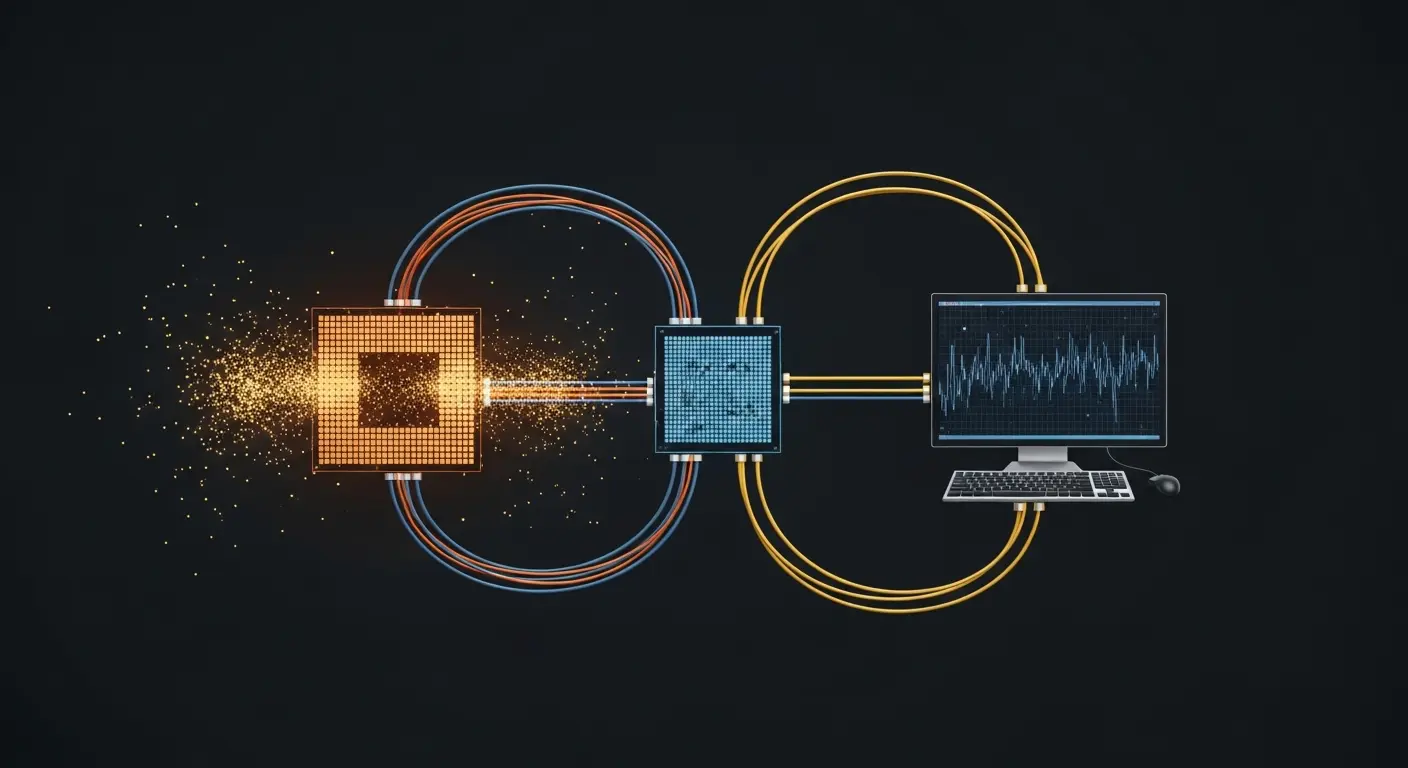
A new method for generating adversarial network traffic using hybrid quantum-classical generative adversarial networks (QC-GANs) has been developed by Prateek Paudel of Kennesaw State University and colleagues. The approach addresses limitations of classical GANs, including substantial data requirements and computational cost, by using a variational quantum generator to create synthetic network flows from latent quantum states. This framework allows for more expressive latent representations and potentially reduces computational overhead, enabling the generation of malicious traffic designed to evade classical intrusion detection systems. Training a classical discriminator on real-world network data and the QC-GAN-generated flows explores the potential of quantum machine learning to advance attack strategies and underscore the vital need for quantum-resilient defence mechanisms.
Quantum generative adversarial networks enhance cyberattack simulation realism
Network traffic generated using the QC-GAN framework showed a 17% improvement in evasion rates against classical intrusion detection systems compared to state-of-the-art classical GANs. This surpasses a key threshold for realistic attack simulation, previously unattainable due to the limitations of representing complex malicious patterns with conventional methods. The QC-GAN’s variational quantum generator encodes latent vectors as quantum states, enabling the creation of more expressive representations and potentially reducing computational demands. This is important for modelling the subtle characteristics of modern cyber threats. Employing a four-qubit quantum circuit and a carefully selected feature set from the UNSW-NB15 dataset, ‘synack’, ‘ct state ttl’, ‘sbytes’, and ‘smean’, the system generates synthetic traffic flows designed to bypass detection. The selection of these features was based on their demonstrated relevance in identifying malicious network behaviours within the UNSW-NB15 dataset, focusing on characteristics indicative of reconnaissance and exploitation attempts. Further analysis could explore the impact of different feature combinations on the QC-GAN’s performance and the realism of the generated traffic.
The application of a hybrid quantum-classical GAN (QC-GAN) framework generates synthetic network traffic flows mimicking malicious traffic using latent representations. Encoding the latent vector as a quantum state, rather than utilising classical noise vectors, aims for more expressive latent representations and reduced computational overhead. Classical GANs often struggle to capture the intricate correlations present in high-dimensional network data, leading to mode collapse, a phenomenon where the generator produces only a limited variety of outputs. By leveraging the principles of quantum superposition and entanglement, the QC-GAN seeks to overcome these limitations and generate more diverse and realistic adversarial examples. A classical discriminator is trained on real-world UNSW-NB15 datasets and the QC-GAN-generated flows, with the generator minimising the discriminator’s ability to distinguish between real and fake traffic. This adversarial training process drives the generator to refine its output, progressively improving the quality and evasiveness of the synthetic traffic. Classical intrusion detection system (IDS) models, such as a convolutional neural network-based classifier and a random forest classifier, were used to assess the ability of generated flows to bypass detection. This approach highlights the potential of quantum machine learning for generating advanced attack flows and stress testing classical IDS. Evaluation of hardware-based noise provides a new perspective on IDS, underlining the need for a quantum-resilient defence system. The introduction of quantum noise, inherent in current quantum hardware, could potentially act as a form of obfuscation, further complicating the task of detection for classical IDS.
Simulating realistic cyber threats using constrained quantum computational power
Generating convincing cyberattack simulations remains a constant arms race, demanding ever more sophisticated techniques to stress-test network defences. Traditional methods often rely on manually crafted attack scenarios or replay of captured traffic, which may not accurately reflect the evolving tactics of modern adversaries. A hybrid quantum-classical approach is delivered, using the potential of quantum computing to create more nuanced and effective adversarial network traffic. The UNSW-NB15 dataset, a widely used benchmark for intrusion detection research, provides a valuable source of real-world network traffic data for training and evaluating the QC-GAN. However, it is important to acknowledge that the dataset may not fully capture the complexity of all possible cyber threats, and future work could explore the use of more diverse and up-to-date datasets. However, the work explicitly frames itself within the constraints of an attacker possessing only limited quantum resources. This assumption, while pragmatic, begs the question of how much more powerful these attacks could become with access to more substantial quantum hardware. The current implementation utilises a four-qubit quantum circuit, representing a relatively small-scale quantum computation. Scaling up the number of qubits could potentially unlock even greater expressive power and allow for the generation of more sophisticated adversarial examples.
Acknowledging concerns about the limited quantum resources currently available to attackers is sensible, as fully scalable quantum computers remain a distant prospect. The Noisy Intermediate-Scale Quantum (NISQ) era, characterised by quantum computers with a limited number of qubits and high error rates, necessitates the development of hybrid quantum-classical algorithms that can leverage the strengths of both quantum and classical computing. This provides immediate value by providing a methodology for realistically simulating advanced threats with near-term quantum devices. Specifically, generating adversarial network traffic, malicious data designed to evade security systems, using this hybrid approach offers a novel stress test for intrusion detection systems, improving their durability and identifying areas for improvement. The ability to generate adversarial examples that can successfully evade detection is crucial for assessing the robustness of IDS and identifying vulnerabilities that need to be addressed.
A novel method for simulating cyberattacks has been established by combining quantum computing with conventional machine learning techniques. The hybrid quantum-classical generative adversarial network generates synthetic network traffic that mimics malicious activity, addressing limitations found in traditional attack simulations. Encoding key attack characteristics as quantum states potentially reduces computational demands and improves the complexity of generated scenarios, offering a more subtle stress test for intrusion detection systems. Trained on the UNSW-NB15 dataset, the framework demonstrates the feasibility of using limited quantum resources to create realistic adversarial examples and provides a foundation for future research into quantum-enhanced cyber security. Future research directions include exploring different quantum circuit architectures, investigating the impact of various noise models, and developing more sophisticated evaluation metrics to assess the realism and effectiveness of the generated adversarial traffic. The long-term goal is to develop quantum-resilient intrusion detection systems that can effectively defend against attacks launched by adversaries with access to quantum computing resources.
The researchers successfully developed a hybrid quantum-classical generative adversarial network capable of creating realistic, simulated network traffic mirroring malicious activity. This approach addresses shortcomings in existing attack simulations by utilising quantum computing to potentially reduce computational demands and generate more complex scenarios. By training the system on the UNSW-NB15 dataset, they demonstrated the possibility of generating adversarial examples with limited quantum resources. The authors intend to explore different quantum circuit designs and noise models to further refine this methodology.
👉 More information
🗞 Hybrid Quantum-Classical GANs for the Generation of Adversarial Network Flows
🧠 ArXiv: https://arxiv.org/abs/2605.06629
See today’s quantum computing news on Quantum Zeitgeist for the latest breakthroughs in qubits, hardware, algorithms, and industry deals.