Networks must evolve from isolated experiments into scalable infrastructures to fully realise their potential, and a team led by Md. Shariful Islam and Joaquin Chung from Argonne National Laboratory, alongside Ely Marcus Eastman from Northwestern University, now demonstrates a significant step towards this goal. The researchers developed a prototype system that automates complex quantum experiments across the Argonne campus using principles similar to those found in modern software-defined networks. This achievement validates a scalable architecture capable of handling networking tasks, synchronising time across distant locations, and verifying entanglement between remote nodes, paving the way for practical quantum networks. Notably, the team successfully distributed stable entanglement between sites for twelve continuous hours, demonstrating a promising path towards building truly scalable quantum communication systems.
Deployed Fiber Entanglement Distribution Testbed
Scientists detailed the design and implementation of a quantum network testbed, focusing on achieving stable entanglement distribution over deployed fiber optic cables. The work describes the hardware and software components, the control framework, and the algorithms used for compensating for polarization drift and maintaining continuous entanglement. The authors emphasize the importance of a software-defined approach to managing the network and ensuring reliable operation, creating a system geared towards researchers and engineers working in the field of quantum networking. The core of this research is a physical network incorporating entangled photon sources, polarization analyzers, and control systems.
The team leveraged software-defined networking principles to create a flexible and programmable control framework, allowing for dynamic configuration and optimization. A critical challenge is maintaining photon polarization as they travel through fiber, and the scientists developed an algorithm to actively compensate for polarization drift, ensuring high-fidelity entanglement. This requires robust control and compensation mechanisms, achieved through a layered control framework similar to classical networking stacks. This work demonstrates a practical approach to building and operating a quantum network testbed, highlighting the importance of robust control software. Active compensation for polarization drift is crucial for maintaining high-fidelity entanglement over long distances, and the use of software-defined networking simplifies the management and optimization of quantum networks.
Automated Calibration and Continuous Entanglement Distribution
Scientists engineered the Argonne Quantum Network (ArQNet) orchestrator to demonstrate continuous entanglement distribution across a multi-node campus-scale testbed, bridging the gap between isolated experiments and operational quantum networks. This involved developing automated routines for the periodic calibration of entangled-photon sources and polarization analyzers, essential for maintaining stable quantum links. The system is capable of executing two-photon interference and quantum state tomography experiments without manual intervention, a crucial step towards autonomous operation. The team implemented a system that continuously monitors fringe visibility during two-photon interference experiments.
When visibility drops below a pre-defined threshold, the orchestrator automatically triggers link recalibration, restoring performance. This automated process ran continuously for 12 hours, demonstrating the system’s ability to maintain stable entanglement distribution over an extended period. The orchestrator leverages software-defined networking principles to automate quantum communication experiments across buildings connected by deployed telecom fiber, validating a scalable architecture. Scientists harnessed software-defined networking to orchestrate the execution of quantum experiments, enabling remote control and automated data analysis.
The system delivers precise timing synchronization across remote nodes, essential for maintaining entanglement fidelity and enabling distributed quantum applications. They developed a scalable architecture supporting service-level abstraction of quantum networking tasks, simplifying the development and deployment of complex quantum applications. The automated system continuously monitors and adjusts link parameters, ensuring stable entanglement distribution over extended periods and paving the way for production-grade quantum networks.
Stable Entanglement Distribution Across Quantum Network Testbed
The research team successfully demonstrated a scalable architecture for a quantum network, achieving continuous and stable entanglement distribution between remote sites for a sustained period of 12 hours. This prototype, implemented on the Argonne Network (ArQNet) testbed, validates a system leveraging software-defined networking (SDN) principles to automate experiments across the Argonne campus, connected by deployed telecom fiber. Experiments revealed a fully functional system integrating entangled-photon distribution, radio-over-fiber clock delivery, and modular device agents, enabling synchronized quantum operations.
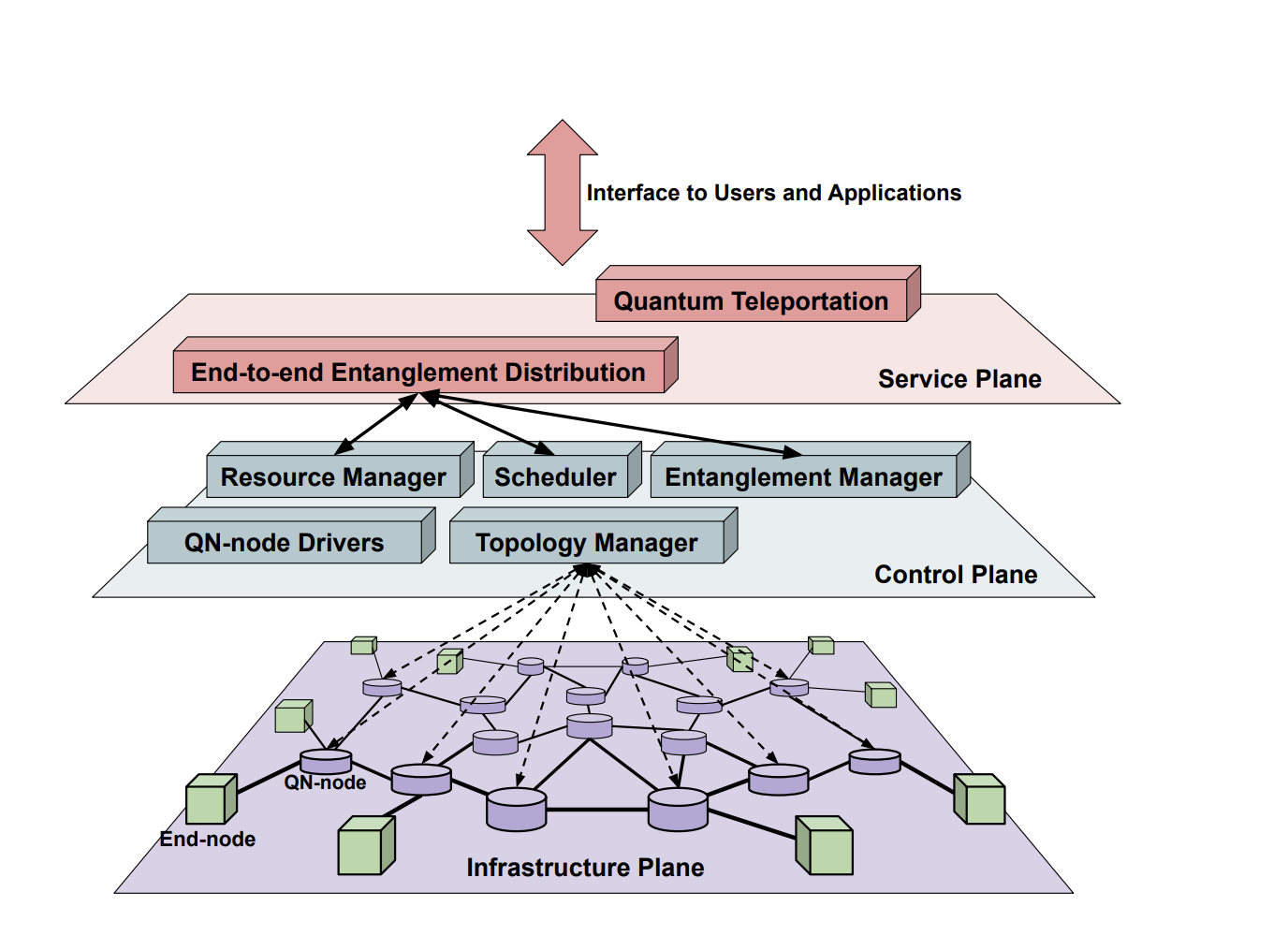
The ArQNet testbed utilizes a three-plane abstraction, infrastructure, control, and service, to manage network functions, resource allocation, and end-to-end service composition. The control plane, implemented with a centralized architecture, coordinates resource management, scheduling, topology management, and crucially, entanglement management. This centralized approach allows for automated calibration and precise timing synchronization, essential for maintaining stable entanglement over extended durations. The successful 12-hour continuous entanglement distribution prototype service demonstrates the feasibility of scalable quantum networks capable of supporting applications like quantum key distribution and distributed quantum computing. The system integrates radio-over-fiber clock delivery and modular device agents to ensure precise synchronization, and the implementation on the ArQNet testbed provides a platform for ongoing research and development of scalable quantum networking technologies. The network’s architecture and automated control mechanisms represent a significant step towards realizing practical, long-distance quantum communication.
ArQNet Demonstrates Quantum Network Control and Performance
The team successfully designed, implemented and evaluated ArQNet, a control plane software for quantum networks that integrates distributed timing, polarization stabilization and modular hardware control into a unified experimental platform. By adopting principles from software-defined networking and a three-plane abstraction, the orchestrator coordinates entangled photon sources, polarization analyzers and time taggers, enabling quantum communication experiments with minimal manual intervention. Experimental results validate this architecture across both colocated and remote configurations, demonstrating improvements in coincidence-to-accidental ratios, clock distribution jitter and maintenance of interference visibility over five kilometers of deployed fiber. Notably, the researchers demonstrated a prototype service capable of continuously distributing stable entanglement between remote sites for 12 hours autonomously, confirming the reliable execution of distributed entanglement generation, two-photon interference and quantum state tomography over a campus-scale testbed. This work establishes a pathway towards programmable, service-oriented photonic quantum networks, bridging the gap between laboratory-scale quantum optics and scalable quantum internet infrastructures.
🗞 Experimental Demonstration of Software-Orchestrated Quantum Network Applications over a Campus-Scale Testbed
🧠 ArXiv: https://arxiv.org/abs/2511.01247
See today’s quantum computing news on Quantum Zeitgeist for the latest breakthroughs in qubits, hardware, algorithms, and industry deals.