

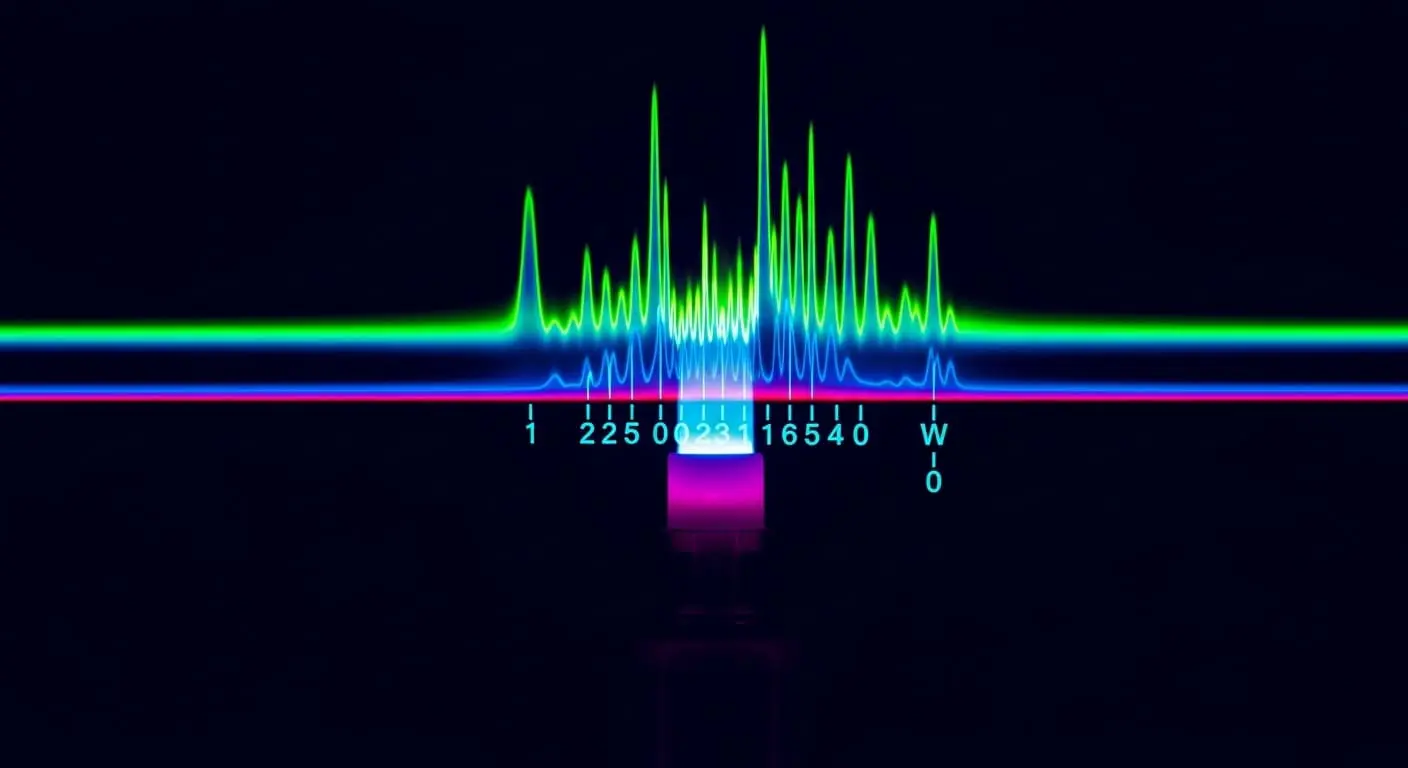
Stephen Wiggins, of the University of Bristol, and colleagues have derived a semiclassical expansion linking Out-of-Time-Order Correlators, key measures of quantum scrambling, to the geometry of phase-space structures, specifically Normally Hyperbolic Invariant Manifolds. The connection between scrambling rates and unstable periodic orbits is revealed, identifying a local instability exponent that governs the initial growth of quantum information scrambling before the Ehrenfest time. By extending periodic-orbit trace methods to scrambling observables, a theoretical pathway for controlling scrambling through manipulation of transverse actions is proposed, potentially advancing quantum information processing
Unstable periodic orbits reveal quantum information scrambling dynamics
Periodic-orbit trace methods, a technique for calculating system properties by summing contributions from all possible repeating paths, underpinned this analysis; it’s akin to determining the total sound in a room by accounting for echoes from every surface. These methods rely on identifying and characterising periodic orbits, trajectories that repeat themselves over time, and then weighting their contributions to the overall observable based on their stability and action. Extending this established approach to analyse quantum information scrambling marked a foray into previously uncharted territory for this mathematical tool, as it traditionally focused on classical observables like energy or momentum. The team first applied the Normal Form theory of the transition state, transforming the complex equations governing the system near a ‘saddle point’ into a simpler, more manageable form, effectively isolating the key dynamics responsible for scrambling. A saddle point represents a region of phase space where the system is unstable in some directions but stable in others, crucial for understanding the transition between different states and the emergence of chaotic behaviour.
Application of established periodic-orbit methods to a new problem yielded a local instability exponent, Λ(J), governing the rate of scrambling. This exponent quantifies how quickly nearby trajectories diverge from each other, reflecting the sensitivity to initial conditions characteristic of chaotic systems. The analysis utilised a semiclassical approach, valid before the Ehrenfest time, to examine quantum information scrambling. The Ehrenfest time represents the timescale beyond which quantum behaviour increasingly resembles classical behaviour, limiting the validity of semiclassical approximations. Building upon the initial framework, the research details how the Normal Form theory simplifies the equations, enabling the application of periodic-orbit techniques. Specifically, it transforms the Hamiltonian, the function describing the total energy of the system, into a form where the unstable directions are clearly separated, facilitating the identification of periodic orbits and the calculation of their contributions to the scrambling rate. The resulting framework provides insight into the relationship between the geometry of the system and the observed scrambling dynamics, offering a potential route to understanding the limitations of the semiclassical approximation, and potentially extending its range of validity.
Quantum scrambling rate linked to unstable manifold geometry
Calculations of quantum information scrambling now demonstrate an effective scaling of 1.5Λ, a sharp improvement over previous methods unable to accurately model the interaction between hyperbolic growth and wavepacket dilution. Wavepacket dilution refers to the spreading of a quantum wavepacket as it evolves in time, reducing the signal and making it difficult to observe scrambling. The previous methods often underestimated the contribution of unstable periodic orbits, leading to inaccurate predictions of the scrambling rate. This simplified scaling emerges when observation times align with the intrinsic periods of contributing orbits, a condition previously unattainable in detailed analysis of scrambling dynamics. The Normally Hyperbolic Invariant Manifold (NHIM) plays a crucial role here; it’s a region of phase space where trajectories remain confined for a limited time before escaping along unstable directions. The team’s derivation of a leading-order semiclassical expansion for the microcanonical Out-of-Time-Order Correlator (OTOC), a measure of scrambling, formally connects quantum information dispersal to the geometry of NHIMs, localized regions of predictable, yet unstable, behaviour. The OTOC quantifies the degree to which information is scrambled by measuring the correlation between two operators at different times, and its connection to the NHIM provides a geometric interpretation of the scrambling process.
Quantum scrambling complexity arises from periodic orbit alignment
Understanding how information scrambles within quantum systems is increasingly the focus of scientists, a process vital for future technologies such as quantum computing and quantum communication. Efficient scrambling is essential for creating and maintaining entanglement, a key resource for these technologies. However, this analysis reveals that the simplified scaling of 1.5Λ, while elegant, is contingent on a specific alignment of observation times with orbital periods; the full semiclassical expansion is demonstrably more complex. This means that the simple scaling law only holds true when the time at which the scrambling is measured coincides with the periods of the dominant unstable periodic orbits on the NHIM. Deviations from this alignment introduce additional terms into the expansion, making the calculation of the scrambling rate more challenging.
Despite relying on specific conditions, the importance of this analysis remains significant. The successful extension of established methods for analysing periodic orbits to the challenging area of quantum scrambling, a key process in understanding how information spreads in quantum systems, provides a strong link between traditionally separate fields, namely, the study of chaotic systems and quantum information theory. This advancement offers a pathway to potentially control scrambling through manipulation of system properties, such as the transverse actions, and further research will focus on exploring the full semiclassical expansion to account for deviations from the simplified scaling. Investigating higher-order terms in the expansion could reveal new insights into the complex interplay between classical and quantum dynamics in scrambling systems.
The rate of quantum information scrambling is formally linked to the geometry of Normally Hyperbolic Invariant Manifolds, predictable regions within chaotic systems. By extending established methods for analysing paths a system repeatedly traces to measure scrambling, researchers have connected a quantum property to classical dynamics. The resulting framework reveals a local instability exponent governing the initial spread of information, offering a potential route to understanding the limitations of the semiclassical approximation and potentially designing systems with enhanced scrambling capabilities.
Researchers successfully linked the rate of quantum information scrambling to the geometry of Normally Hyperbolic Invariant Manifolds within chaotic systems. This connection establishes a relationship between a quantum property and classical dynamics, allowing the calculation of a local instability exponent that governs how quickly information spreads. The findings extend existing methods used to analyse periodic orbits to the more complex area of quantum scrambling, providing a framework for understanding the limits of semiclassical approximations. Further work will explore the full semiclassical expansion to account for deviations from simplified scaling laws observed when observation times do not align with orbital periods.
👉 More information
🗞 A Periodic Orbit Trace Formula for Quantum Scrambling: The Role of the Normally Hyperbolic Invariant Manifold
🧠 ArXiv: https://arxiv.org/abs/2604.12369



See today’s quantum computing news on Quantum Zeitgeist for the latest breakthroughs in qubits, hardware, algorithms, and industry deals.



