

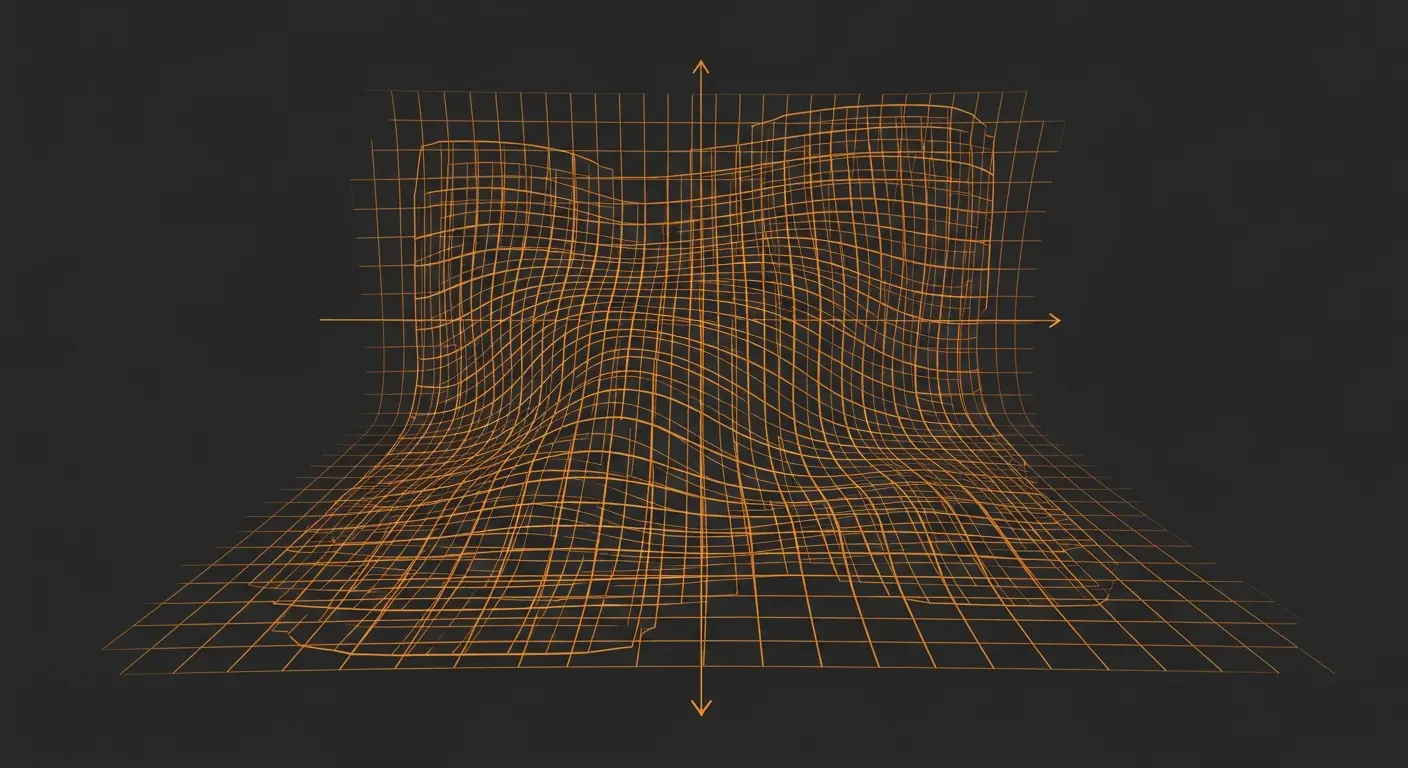
Qing-Wei Wang and colleagues at Zhejiang Ocean University have quantified chirality and revealed a competition between encircling speed and noise strength during dynamic processes in non-Hermitian systems undergoing chiral state conversion near exceptional points. Their research systematically analyses this interplay, identifying distinct “noisy” and “clean” limits governed by a clear scaling law. These findings illuminate the key role of noise in non-Hermitian dynamics and offer insights applicable to both theoretical modelling and future experimental work.
Encircling speed defines a scaling law controlling noise sensitivity in non-Hermitian systems
The non-chirality degree, χc, previously difficult to quantify, now demonstrates sensitivity to noise, with oscillations reduced from extremely sensitive levels to negligible values when encircling speed exceeds a critical threshold. This threshold is determined by a newly discovered scaling law governing the boundary between ‘noisy’ and ‘clean’ limits in non-Hermitian systems, something lacking in prior analysis. Establishing this boundary allows precise determination of when noise overwhelms system behaviour, a feat previously impossible without a quantifiable metric like χc and thorough parameter space exploration. Non-Hermitian systems, unlike their Hermitian counterparts, lack the symmetry that guarantees real eigenvalues, leading to unique behaviours such as exceptional points, points where both eigenvalues and eigenvectors coalesce. This coalescence results in a breakdown of the adiabatic theorem, a cornerstone of quantum mechanics, which dictates that a system will remain in its initial eigenstate if the parameters change slowly enough. Consequently, systems encircling an exceptional point can undergo dramatic changes in their chiral state.
Competition between encircling speed and noise strength fundamentally alters chiral state conversion, revealing new insights into non-Hermitian dynamics. The ability to control the sensitivity of these systems to noise by adjusting the speed at which they encircle exceptional points, unique degeneracies, has been demonstrated. This analysis expands upon initial findings by detailing how a scaling law impacts the conversion of chiral states, states that cannot be superimposed on their mirror images, and provides a deeper understanding of the underlying dynamics. The concept of chirality is crucial in many areas of physics, from particle physics to materials science, and its manipulation in non-Hermitian systems opens up possibilities for novel device functionalities. The researchers’ work highlights that the rate at which a system traverses a loop around an exceptional point is critical; slower loops are more susceptible to noise, while faster loops can suppress its effects. This is because the system spends less time near the exceptional point, reducing the opportunity for noise to induce unwanted transitions.
Detailed analysis revealed that this competition between speed and noise fundamentally alters how chiral states are converted, resulting in two distinct limits: a noisy limit and a clean limit. The boundary separating these limits satisfies a simple scaling law, explained using first-order perturbation theory and the condition number of the transfer matrix; these findings reveal the essential role played by noise in non-Hermitian dynamics and are relevant for both theoretical and experimental investigations. The condition number, a measure of the sensitivity of a matrix to perturbations, provides a quantitative link between the system’s parameters and its susceptibility to noise. First-order perturbation theory allows for an analytical approximation of the system’s behaviour in the presence of small perturbations, providing a theoretical framework for understanding the observed scaling law. The scaling law itself dictates that the critical encircling speed required to enter the ‘clean’ limit is inversely proportional to the noise strength, suggesting a fundamental trade-off between these two parameters. Further work is needed to determine how these principles apply to more complex scenarios and to explore the limitations of this model, particularly in systems with multiple exceptional points or more intricate geometries.
Quantifying noise susceptibility enables control of chiral state transitions in non-Hermitian
A quantifiable measure of how noise impacts chiral state conversion, the flipping of a system’s state, in non-Hermitian systems has been established, revealing a delicate balance between the rate of change and the level of disturbance experienced. This newfound understanding allows for precise control over these systems, potentially leading to improved designs for devices like lasers and optical circuits. However, the current work relies heavily on numerical simulations, a computationally intensive approach that limits exploration of more complex scenarios. The development of a robust metric like χc is essential for moving beyond qualitative descriptions of non-Hermitian dynamics and towards a more predictive and controllable framework. The simulations employed likely involved solving the time-dependent Schrödinger equation with non-Hermitian Hamiltonians, a challenging task that requires significant computational resources.
Establishing a quantifiable measure of chirality, a key property in these unusual materials, is significant despite the reliance on simulations. Understanding how noise disrupts the behaviour of non-Hermitian systems, which do not follow expected rules, is important for building reliable devices. Precisely defining the interaction between disturbance and change allows engineers to design more durable lasers and optical circuits, even with the current modelling limitations. Non-Hermitian systems are increasingly being explored for applications in areas such as sensing, signal processing, and topological photonics. Their unique properties, such as unidirectional propagation and enhanced sensitivity, offer potential advantages over conventional devices. However, the inherent sensitivity to noise poses a significant challenge to their practical implementation. This research provides a pathway towards mitigating these effects through careful control of system parameters.
Defining the boundary between predictable and erratic behaviour in these systems establishes a new framework for understanding non-Hermitian dynamics. A newly developed ‘non-chirality degree’ quantified chirality, a property describing a system’s asymmetry, to track state changes around exceptional points where standard physics breaks down. This careful analysis of how encircling speed and noise compete to influence chiral state conversion revealed a clear scaling law governing the transition between ‘noisy’ and ‘clean’ limits. The ability to accurately predict the system’s response to noise is crucial for designing robust and reliable devices. The researchers’ findings suggest that by carefully tuning the encircling speed, it is possible to suppress the effects of noise and maintain the desired chiral state, even in the presence of significant disturbances. This opens up exciting possibilities for developing novel non-Hermitian devices with enhanced performance and stability.
The researchers quantified chirality using a newly developed ‘non-chirality degree’ and demonstrated its sensitivity to noise in non-Hermitian systems. This is important because these systems, which behave differently from conventional materials, are being explored for potential use in sensing and optical circuits. Their work revealed a scaling law defining how encircling speed and noise interact, establishing a boundary between predictable and erratic behaviour. This understanding allows for better control of system parameters to potentially mitigate the effects of noise and improve device stability.
👉 More information
🗞 Chiral state conversion near an exceptional point: speed-noise competition
🧠 ArXiv: https://arxiv.org/abs/2604.12354



See today’s quantum computing news on Quantum Zeitgeist for the latest breakthroughs in qubits, hardware, algorithms, and industry deals.



