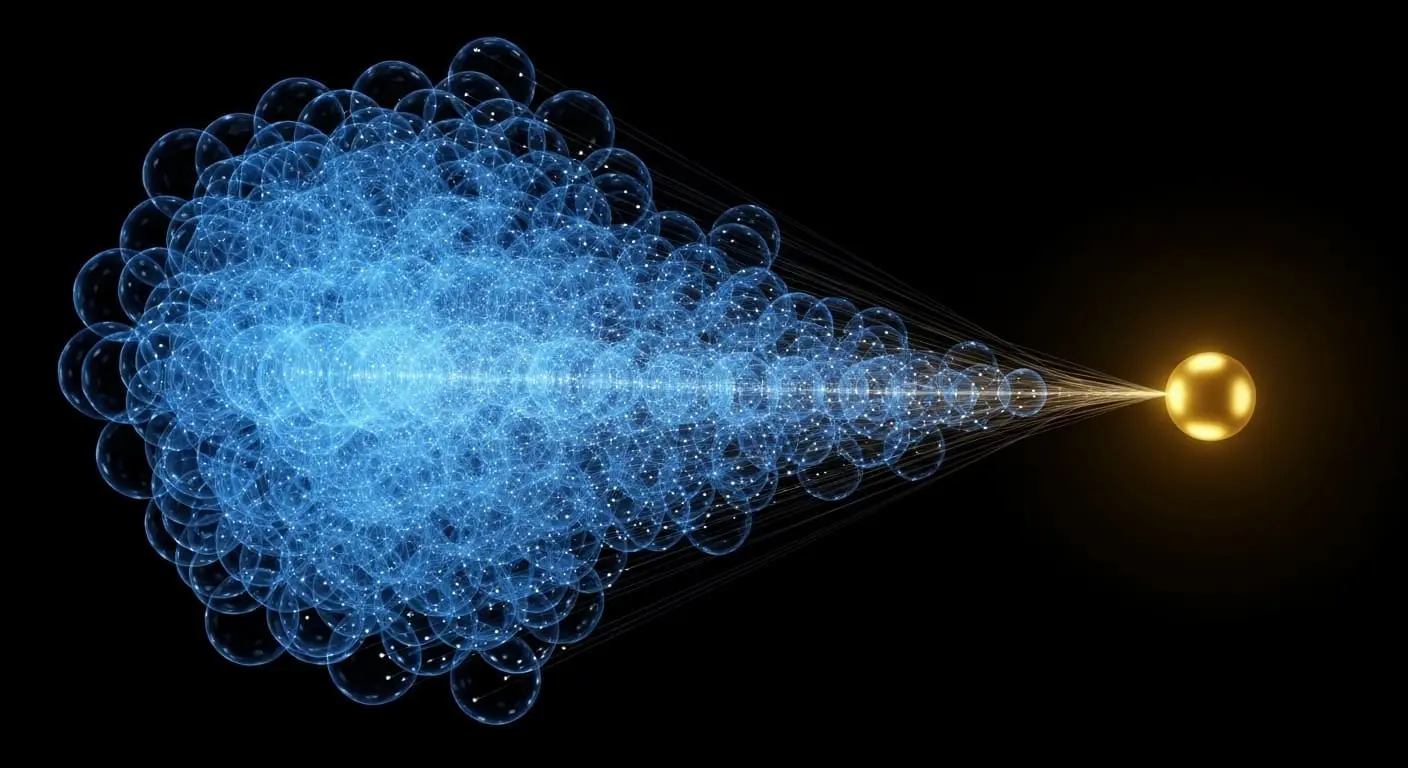
Priyank Singh and colleagues at Centre for Quantum Science and Technology have achieved coherence-gated routing, a technique directing photons based on real-time measurements of a qubit’s coherence. The approach surpasses standard heralded sources by enabling a quantum random number generator, with a min-entropy bounded by Bloch-sphere geometry, and creating a phase-tracked photon source capable of improving matter-matter entanglement fidelity. Real-time estimation provides a security primitive, and thorough benchmarking across numerous trajectories identifies and mitigates potential vulnerabilities related to detector efficiency.
Reduced operational overcertification enables advanced quantum communication applications
A substantial improvement has been achieved in operational overcertification for coherence-gated single-photon routers, now reduced to 3.6% from the previous 4.5% bound attained using Ornstein-Uhlenbeck comparisons. This reduction in overcertification, the degree to which a system’s performance is overstated, is critical for practical applications. Operational overcertification arises from inaccuracies in modelling the behaviour of quantum devices and the detectors used to measure them. Lowering this value allows for more accurate predictions of system performance and unlocks applications previously impossible with conventional heralded sources. Specifically, quantum random number generation exceeding 0.39 bits per accepted photon in min-entropy and phase-tracked photon sources for enhanced matter-matter entanglement fidelity are now possible. The technique directs photons based on real-time assessment of a qubit’s coherence, preserving delicate quantum states rather than relying on energy measurements which inherently destroy the quantum state. Conventional heralded sources rely on post-selection, accepting photons only after a successful measurement, which introduces significant loss and limits functionality. Coherence-gated routing, however, makes a routing decision based on the qubit’s state before the photon is fully emitted, allowing for more efficient and versatile operation.
Detector efficiency was deliberately underestimated to stabilise numerical calculations and simultaneously suppress overcertification, yielding a conservative Direct SME (Statistical Mixture Estimation) configuration requiring approximately 300 operations per step, suitable for FPGA (Field-Programmable Gate Array) deployment. This conservative approach ensures robustness against imperfections in the detection apparatus. The scaling law predicts optimal assumed efficiency with a root-mean-square error of 0.067, indicating the precision with which the efficiency can be estimated. However, achieving η greater than 0.5 on both measurement channels simultaneously, whilst maintaining sufficient qubit coherence for a threshold of 0.7, remains a substantial engineering challenge. Qubit coherence is extremely sensitive to environmental noise, and maintaining it while performing continuous weak measurements is a significant technical hurdle. Validated across over one million trajectories, this establishes a security primitive for quantum networks and offers a pathway towards fully composable security protocols. The ability to verify the security of the routing process is paramount for building trust in quantum communication systems. Its durability to detector inefficiency, a common limitation in quantum systems, makes this technique more robust than existing methods, addressing a key obstacle to building scalable networks and paving the way for future optimisation of detector efficiency for practical deployment. Improving detector efficiency will further enhance the performance and scalability of coherence-gated routing.
Real-time single-photon steering via preservation of quantum coherence
Coherence-gated routing directs single photons by assessing the magnitude of their quantum coherence, a measure of how well-defined a photon’s quantum state remains, in real-time. Quantum coherence is a fundamental property of quantum mechanics, enabling phenomena like superposition and entanglement. Maintaining coherence is crucial for performing quantum computations and communications. Simultaneous, weak measurements of two properties, denoted σx and σz, achieve this, allowing estimation of the coherence without collapsing the quantum state. These Pauli matrices represent rotations around the x and z axes of the Bloch sphere, a geometrical representation of a qubit’s state. By measuring these two components, the researchers can infer the overall coherence of the qubit. Three thousand trajectories were used for benchmarking, deliberately underestimating detector efficiency to improve numerical stability and suppress overcertification. This careful calibration ensures the reliability of the results. The process resembles a delicate balancing act; the longer a top spins without wobbling, the more coherence it possesses. In this analogy, the qubit is the spinning top, and coherence corresponds to the stability of its rotation. The weak measurements are akin to gently observing the top without significantly disturbing its spin.
Real-time coherence assessment enhances quantum network security and random number generation
Quantum communication networks are receiving increasing attention as a field demanding ever more reliable single-photon sources. These networks promise unparalleled security due to the laws of quantum physics, but require robust and efficient components. Current methods often rely on measuring a photon’s energy for routing, unfortunately destroying the delicate quantum information encoded within its coherence. This work introduces an alternative approach, assessing the strength of coherence in real-time, opening possibilities beyond conventional systems and enabling applications like secure quantum random number generation and improved entanglement sources, offering enhanced performance over conventional heralded sources. The min-entropy, a measure of randomness, is directly linked to the coherence of the qubit, ensuring the generated random numbers are truly unpredictable.
This represents a major step forward for quantum security protocols, acknowledging concerns about the complexity of real-world implementation. While perfect fidelity remains a challenge, the demonstrated ability to bound entanglement fidelity and generate truly random numbers offers practical advantages. Entanglement fidelity is a measure of how well two qubits are linked, and maintaining high fidelity is essential for quantum communication and computation. The new routing technique certifies the quality of emitted photons, a vital step towards building more dependable quantum communication networks. By verifying the coherence of each photon, the system can ensure that only high-quality photons are used for communication, reducing errors and improving security. This certification process is crucial for establishing trust in quantum networks and enabling the development of advanced quantum applications.
The research demonstrated coherence-gated routing of single photons, a method where routing decisions depend on the real-time measurement of quantum coherence. This is significant because it avoids destroying coherence, a key limitation of current photon routing techniques. The protocol enables a quantum random number generator with a min-entropy bounded by Bloch-sphere geometry and a phase-tracked photon source for improved entanglement. Researchers benchmarked seven configurations across 3000 trajectories, showing that deliberately underestimating detector efficiency stabilises the process and suppresses overcertification.
👉 More information
🗞 Coherence-gated quantum devices via real-time weak measurement
🧠 ArXiv: https://arxiv.org/abs/2604.18662


See today’s quantum computing news on Quantum Zeitgeist for the latest breakthroughs in qubits, hardware, algorithms, and industry deals.