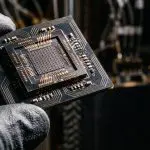
ParityQC has established a new record in quantum computing by implementing the largest Quantum Fourier Transform ever reported, utilizing 52 superconducting qubits on an IBM Quantum Heron processor. This achievement nearly doubles the previous benchmark of 27 qubits attained 24 months prior, signaling an accelerating pace of development within the field. The European company’s demonstration highlights a shift from academic research toward industrial scalability for quantum technologies, with potential applications spanning cryptography, finance, and materials science. Wolfgang Lechner and Magdalena Hauser, Co-CEOs of ParityQC, say this milestone was only possible through the synergy of IBM’s latest quantum hardware and the ParityQC Architecture, which unlocked an improvement in efficiency. This rapid progress suggests quantum computing may be mirroring the early exponential growth observed with Moore’s Law.
Qubit IBM Heron Achieves Record Quantum Fourier Transform
This is not simply an increase in qubit count, but a demonstration of improvement in processing capability, suggesting quantum computing may be mirroring the historical trajectory of Moore’s Law in classical computing. The QFT, a fundamental algorithm with applications spanning cryptography to materials science, is a crucial test for evaluating real-world quantum performance. ParityQC’s success relies on a synergistic approach, combining IBM’s hardware with their proprietary ParityQC Architecture. The team achieved the highest process fidelity ever reported for the unitary QFT at this qubit scale and demonstrated that the performance advantage of their “Parity Twine” application scales exponentially with the number of qubits. This scaling is significant, as it suggests the architecture can maintain its benefits as quantum systems grow in complexity.
Scott Crowder, Vice President, IBM Quantum Adoption, highlighted the broader implications, stating that ParityQC’s demonstration of their Parity Twine application achieving this QFT benchmark, using IBM quantum hardware, is a promising example of how the application could also extend to enabling hardware-aware implementations of algorithms solving complex, industry-useful optimization problems as their hardware improves. The ParityQC Architecture’s ability to reduce gate count and circuit depth, while eliminating the need for error-prone SWAP gates, is central to this progress, allowing for more reliable and efficient quantum computations.
Parity Twine Architecture Reduces Gate Count & Circuit Depth
Recent advancements demonstrate an accelerating pace of development as quantum computing shifts from purely academic exploration toward practical industrial applications. This is not merely about shrinking the size of quantum circuits, but about fundamentally altering how they are constructed, crucially without relying on SWAP gates, a common source of error and overhead in many existing quantum platforms. This reduction in complexity directly impacts performance, allowing algorithms to execute in fewer steps with less accumulated noise and, consequently, at significantly higher fidelity. The performance advantage of Parity Twine scales exponentially, a characteristic that suggests the architecture is well-suited for continued scaling as qubit counts increase. Beyond the QFT benchmark, the implications of this architecture extend to a wide range of applications, from accelerating drug discovery through molecular simulations to optimizing financial portfolios and modeling complex materials.
Exponential Scaling Mirrors Moore’s Law in Quantum Computing
Recent results from ParityQC indicate that the pace of advancement in quantum computing is increasingly reminiscent of the early days of classical computing. This rapid progression suggests a potential mirroring of Moore’s Law, where processing power doubles approximately every two years, a phenomenon that propelled the classical computing revolution. This near doubling of the QFT benchmark is not simply about adding more qubits, but about unlocking improvements in efficiency through architectural innovation. The company’s Parity Twine application, used in this demonstration, achieved a performance advantage that scales exponentially, a critical characteristic for tackling increasingly complex problems. Hermann Hauser, ParityQC investor and co-founder of Acorn and ARM, draws a direct parallel to the integrated circuit era, stating that just as the doubling of transistor density once brought the era of the integrated circuit, the doubling of quantum computing capacity marks quantum computing’s entry into its own era of exponential scaling. The Co-CEOs affirm that progress in quantum technologies begins to follow a predictable path.
Source: https://parityqc.com/



See today’s quantum computing news on Quantum Zeitgeist for the latest breakthroughs in qubits, hardware, algorithms, and industry deals.