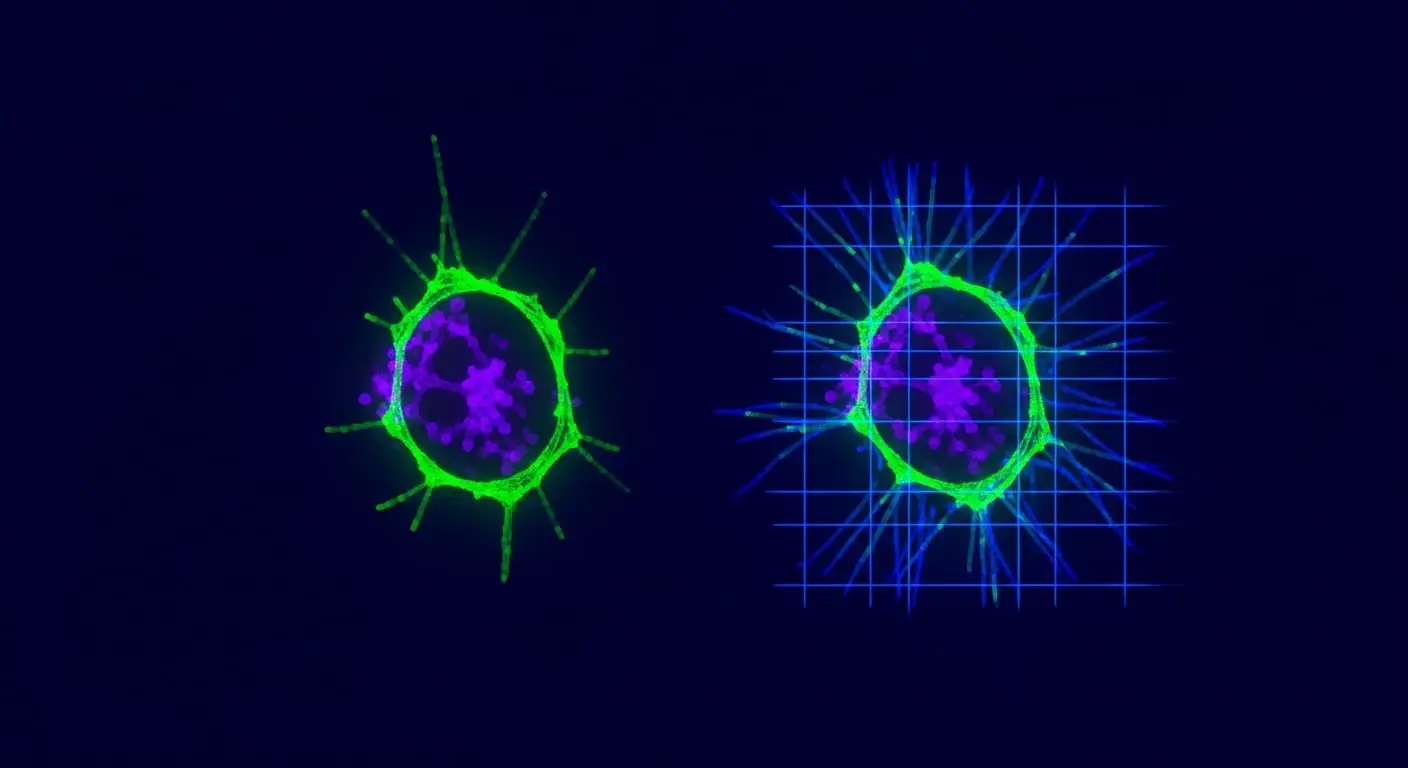
Juan-Diego Urbina and Klaus Richter, from the University Regensburg, have extended semiclassical methods, typically applied to single particles, to describe the behaviour of numerous indistinguishable particles, or quantum fields. A framework based on a many-body version of the van Vleck-Gutzwillers semiclassical propagator offers insights into phenomena such as random-matrix spectral correlations, eigenstate morphology, weak localisation effects, and the scrambling of quantum correlations. This work reveals a unified theory for understanding quantum chaos in systems where many particles interact, potentially advancing our understanding of complex quantum systems.
Extending semiclassical propagation to many-body quantum field chaos
The many-body version of the van Vleck-Gutzwillers propagator serves as a mathematical tool bridging the quantum and classical worlds, akin to creating a simplified map for a complicated territory. It calculates the probability amplitude for a quantum system’s evolution between states, considering all possible classical paths weighted by their likelihood. Originally designed for single particles, this technique has been adapted to account for the collective behaviour of numerous indistinguishable particles, or quantum fields, extending its reach beyond traditional applications. The classical propagator, at its core, relies on the principle of least action, identifying the path a classical particle would take, and the semiclassical approximation then quantises this classical trajectory. However, applying this directly to many-body systems presents significant challenges due to the exponential growth in complexity with particle number.
Semiclassical techniques now investigate quantum chaos in systems containing numerous indistinguishable particles. This approach utilises a modified van Vleck-Gutzwillers propagator, adapting it to account for collective behaviour and many-body quantum interference. The work focuses on a semiclassical limit where the effective Planck’s constant, denoted as ħeff = 1/N, approaches zero, a departure from methods applied to single particles. This scaling is crucial; in standard semiclassical theory, ħ → 0, allowing the classical limit to emerge. However, for many-body systems, scaling ħ with the inverse of the particle number, N, provides a more appropriate route to a meaningful classical limit. This allows exploration of complex quantum phenomena previously inaccessible to standard semiclassical analysis, and provides a foundation for understanding the limitations of mean-field theories in strongly correlated systems. Mean-field theories often fail to capture the intricate correlations that arise when many particles interact strongly, and this new semiclassical approach offers a pathway to address these shortcomings.
Many-body quantum interference modelled using an effective inverse Planck constant
Semiclassical methods have been extended to many-body quantum systems, achieving a previously unattainable level of accuracy in modelling complex quantum phenomena. Prior techniques, limited to single particles, struggled with interference effects arising from numerous indistinguishable particles; this approach overcomes that limitation by utilising an effective Planck constant inversely proportional to the number of particles, denoted as 1/N. Consequently, the study of genuine many-body quantum interference becomes possible, a key element in understanding systems like quantum fields, and opens avenues for investigating random-matrix spectral correlations and the scrambling of quantum correlations. The concept of indistinguishability is fundamental in quantum mechanics, meaning that identical particles cannot be individually labelled. This leads to interference effects that are absent in classical systems, and are particularly pronounced when many particles are involved.
The applicability of this new semiclassical framework has been demonstrated by successfully modelling random-matrix spectral correlations within many-body systems, describing energy level distribution and representing a hallmark of quantum chaos. Random-matrix theory provides a statistical description of the energy levels of complex quantum systems, predicting universal features that are independent of the system’s details. The accurate reproduction of these correlations validates the semiclassical approach. Furthermore, the technique accurately reproduces the universal morphology of many-body eigenstates, revealing patterns in wavefunctions that characterise quantum states, and predicts interference effects akin to weak localization observed in mesoscopic materials. Weak localization arises from the interference of electron waves travelling along different paths in a disordered material, leading to enhanced conductance at low temperatures. These calculations, performed for systems of interacting bosons with large occupations, also provide insights into the scrambling of many-body correlations, measured by out-of-time-order correlators, central to understanding information processing in quantum systems. Out-of-time-order correlators quantify how quickly information about initial conditions is lost due to quantum chaos, and are relevant to the study of black holes and quantum information theory.
Refining semiclassical analysis for chaotic many-body quantum systems
Complex quantum systems, particularly those with many interacting particles, are receiving increasing attention, which is important for advancements in fields ranging from materials science to fundamental physics. Understanding the behaviour of these systems is crucial for designing new materials with tailored properties, and for probing the fundamental laws of nature. Unlike previous methods which struggled with such intricacy, it establishes a consistent framework for analysing chaotic behaviour in systems with numerous interacting particles. This framework offers a unified approach to understanding quantum chaos, encompassing phenomena like spectral correlations and the scrambling of quantum information, and builds upon the established van Vleck-Gutzwillers propagator. The ability to connect microscopic quantum dynamics to macroscopic classical behaviour is a long-standing goal in physics, and this work represents a significant step towards achieving that goal.
These methods, previously limited to single particles, now successfully extend techniques bridging classical and quantum physics to describe many-body quantum systems, collections of numerous interacting particles known as quantum fields. Accounting for interference arising from the indistinguishable nature of these particles allows for a deeper understanding of the interplay between classical and quantum behaviour in complex systems. The resulting framework offers potential for further refinement to incorporate the intricacies of strongly correlated systems like spin-one-half chains. Spin-one-half chains are model systems used to study magnetism and quantum phase transitions, and extending the semiclassical approach to these systems would provide valuable insights into their behaviour. Future research could explore the application of this framework to other complex quantum systems, such as quantum dots and superconducting circuits, further expanding its scope and impact.
The research successfully extended semiclassical methods, previously used for single particles, to analyse many-body quantum systems composed of numerous interacting particles. This is important because it provides a unified framework for understanding chaotic behaviour in these complex systems, linking microscopic quantum dynamics to macroscopic classical behaviour. The framework explains phenomena such as random-matrix spectral correlations and the scrambling of quantum information, building upon the van Vleck-Gutzwillers propagator. Authors suggest future work could refine the approach for systems like spin-one-half chains, offering further insights into their behaviour.
👉 More information
🗞 Quantum chaos in many-body systems of indistinguishable particles
🧠 ArXiv: https://arxiv.org/abs/2604.12745



See today’s quantum computing news on Quantum Zeitgeist for the latest breakthroughs in qubits, hardware, algorithms, and industry deals.