

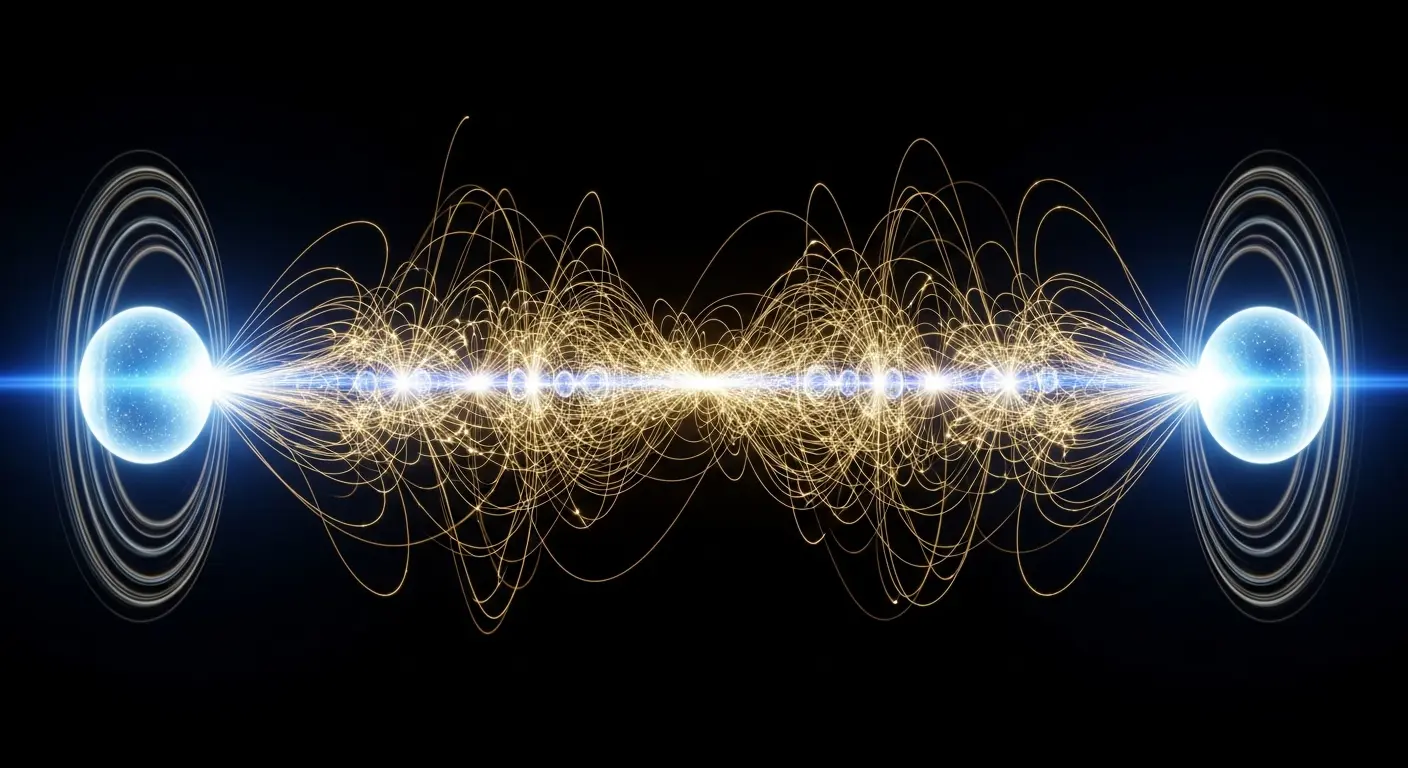
Researchers Daniel Miller and Jens Eisert at the Freie Universität Berlin (Dahlem Center for Complex Quantum Systems), Forschungszentrum Jülich (Institute for Theoretical Nanoelectronics), and Helmholtz-Zentrum Berlin for Materials and Energy, demonstrate that entanglement certification can be significantly simplified by focusing on a limited number of measurement moments. The team’s work reveals that comparing only three partial transpose (PT) moments, rather than requiring calculations for all moments up to a certain order, substantially reduces the experimental demands associated with verifying quantum entanglement. This advancement builds upon the established positive partial transposition (PPT) criterion, offering a more pragmatic approach to confirming entanglement in quantum states. By analysing locally depolarized GHZ states and globally depolarized stabilizer states, they delineate conditions under which limited moment access can fully reproduce the PPT criterion, and introduce a novel concept, quantum weight enumerators, to characterise the decay of these moments under the influence of noise, with potential implications for both quantum error correction and information theory.
Reduced moment calculations fully reproduce entanglement criteria for depolarized quantum states
Entanglement verification, a cornerstone of quantum information processing, traditionally necessitates accessing and analysing a comprehensive set of partial transpose (PT) moments to establish the non-separability of a quantum state. The current research demonstrates that this requirement can be dramatically reduced. Entanglement measures now require accessing only five PT moments, representing a sharp reduction from methods previously demanding calculations for all moments up to a certain order. This breakthrough enables the full reproduction of the positive partial transposition (PPT) criterion for globally depolarized stabilizer states, a feat previously unattainable given limitations in computational resources. The simplification stems from the demonstration that comparing any three PT moments, designated $p_k$, $p_l$, and $p_m$, is sufficient to confirm entanglement, analogous to ensuring the correct combination of ingredients in a complex recipe. The PT moments are calculated as Tr$[(ρ^Γ)^k]$, where $ρ^Γ$ denotes the partially transposed density matrix of a quantum state $ρ$, and ‘Tr’ represents the trace operator. Partial transposition involves transposing the density matrix with respect to one of the subsystems, effectively rearranging the matrix elements.
A quantum state is confirmed as entangled if $ > 1-x$, where x = (m-l)/(m-k). This streamlined approach has significant implications for quantum error correction and information theory, offering a more practical pathway to verifying entanglement in complex quantum systems. The Stieltjes-$m$ criterion, a generalisation of the PPT criterion, matches the power of the PPT criterion when the partially transposed density matrix has no more than $(m+1)/$2 distinct eigenvalues. This condition provides a more efficient pathway for entanglement verification, as it reduces the number of eigenvalues that need to be considered. Consequently, this offers a foundation for further investigation into broader applications of these techniques and opens avenues for more efficient experimentation and analysis, particularly with increasingly complex quantum systems where computational resources are often constrained. The ability to accurately and efficiently determine entanglement is crucial for developing quantum technologies such as quantum computing and quantum communication, as entanglement is a key resource in these fields.
Reduced computational cost confirms entanglement in noisy quantum systems
Verifying that quantum states are entangled is vital for building future technologies, yet this property has traditionally demanded significant computational resources. Eleanor Rieffel and colleagues at Quantum AI have now refined the process, showing that analysing just three ‘partial transpose’ moments, a way of quantifying the shape of a quantum state, can reliably confirm entanglement. This reduction in computational complexity is particularly beneficial for increasingly complex quantum systems, where the number of parameters describing the state grows exponentially with the number of qubits. The partial transpose operation, central to this method, effectively rearranges the elements of the density matrix, providing a means to detect entanglement by examining the eigenvalues of the resulting matrix. The use of only three moments represents a significant departure from traditional methods that require analysing a larger number of moments, thereby reducing the computational burden.
Although restricting this technique to states affected by noise, or ‘global depolarisation’, appears limiting, it represents an important step towards practical quantum technology. Global depolarisation refers to a type of noise that affects all qubits in the system equally, reducing the coherence of the quantum state. While this simplification currently applies to states undergoing global depolarisation, it sharply reduces the computational burden of verifying entanglement, a key feature of quantum systems, which traditionally required extensive processing power. Statistical measures quantifying a quantum state’s shape, specifically three ‘partial transpose’ moments, are sufficient to reliably confirm entanglement. The choice of three moments is not arbitrary; it is based on the mathematical properties of the PPT criterion and the Stieltjes-$m$ criterion, allowing for an efficient and accurate determination of entanglement. Future research will aim to extend the method’s applicability to a wider range of quantum states, addressing its current limitations to states affected by noise. This includes investigating techniques to mitigate the effects of other types of noise, such as local depolarisation and phase damping, which are more prevalent in real-world quantum systems. Furthermore, exploring the use of different sets of moments or combining this approach with other entanglement criteria could further enhance its robustness and versatility.
Researchers demonstrated that analysing just three partial transpose moments of a quantum state is sufficient to confirm entanglement. This represents a reduction in the computational effort typically required for entanglement verification, as previous methods needed to analyse a larger number of these moments. The findings show that for certain states, specifically those undergoing global depolarisation, this simplified approach can reproduce the accuracy of the full positive partial transposition criterion. The authors intend to extend this method to encompass a broader range of quantum states and noise types in future work.
👉 More information
🗞 Detecting entanglement from few partial transpose moments and their decay via weight enumerators
🧠 ArXiv: https://arxiv.org/abs/2604.12576




See today’s quantum computing news on Quantum Zeitgeist for the latest breakthroughs in qubits, hardware, algorithms, and industry deals.



