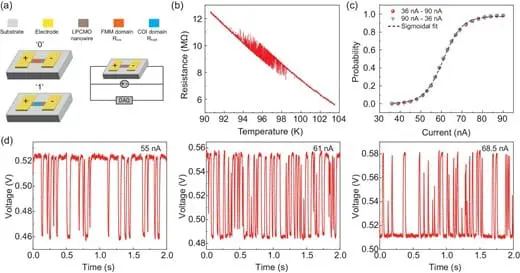
A research team led by Professor Jian Shen and Hangwen Guo at Fudan University has developed a probabilistic bit (p-bit) device using manganite nanowires. This device exploits phase separation domains fluctuating between ferromagnetic metal and antiferromagnetic insulating states. This device, controlled by nanoampere-level currents, demonstrates high operational stability and exceptional computational potential for tasks such as Bayesian inference. The findings, published in the 2025 issue of National Science Review, highlight the device’s ability to generate high-quality random numbers and its role in advancing probabilistic computing toward practical applications.
Probabilistic computing represents a novel paradigm that addresses the limitations of classical computing by incorporating elements of quantum behaviour within a classical framework. Unlike traditional binary logic, which relies on deterministic processing, probabilistic computing utilizes p-bits, probabilistic bits, that can fluctuate between 0 and 1 due to thermal noise. This inherent probabilism allows for the representation of uncertainty and probability distributions, making it particularly suited for solving complex optimization problems that are computationally intensive for classical methods.
Recent advancements in materials science have enabled the development of p-bit devices with high stability and low power consumption. For example, researchers at Fudan University demonstrated a system using manganite nanowires to create p-bits capable of switching between ferromagnetic metal and antiferromagnetic insulating states. These p-bits are controlled by nanoampere-level currents, demonstrating exceptional operational stability with minimal deviation during extensive testing. This level of stability is critical for practical applications, as it ensures reliable performance even under prolonged use.
The ability of p-bits to generate high-quality random
The ability of p-bits to generate high-quality random numbers further enhances their potential applications in cryptography. By leveraging the inherent randomness of thermal noise, these devices can produce robust encryption keys, significantly improving security measures. This capability addresses a critical need in data protection and underscores the versatility of probabilistic computing in addressing diverse computational challenges.
Recent advancements in materials science have enabled the development of p-bit devices with high stability and low power consumption. For example, researchers at Fudan University demonstrated a system using manganite nanowires to create p-bits capable of switching between ferromagnetic metal and antiferromagnetic insulating states. These p-bits are controlled by nanoampere-level currents, demonstrating exceptional operational stability with minimal deviation during extensive testing. This level of stability is critical for practical applications, as it ensures reliable performance even under prolonged use.
The ability of p-bits to generate high-quality random numbers further enhances their potential applications in cryptography. By leveraging the inherent randomness of thermal noise, these devices can produce robust encryption keys, significantly improving security measures. This capability not only addresses a critical need in data protection but also underscores the versatility of probabilistic computing in addressing diverse computational challenges.
Probabilistic computing offers a promising alternative to classical
Probabilistic computing offers a promising alternative to classical computing by incorporating p-bits that mimic quantum behaviours within a classical framework. Recent developments, such as those at Fudan University, demonstrate the potential for highly stable and efficient p-bit devices, capable of solving complex optimization problems and enhancing cryptographic security. These advancements suggest that probabilistic computing could be a practical bridge between classical and quantum computing paradigms, addressing specific computational challenges without requiring full-scale quantum infrastructure.
External Link: Click Here For More




See today’s quantum computing news on Quantum Zeitgeist for the latest breakthroughs in qubits, hardware, algorithms, and industry deals.