During the recent 10-day journey of the Artemis II mission around the Moon, NASA astronauts experienced a new level of connectivity thanks to the first crewed test of laser communications at lunar distance. The Orion Artemis II Optical Communications System, developed by MIT Lincoln Laboratory, successfully transmitted a diverse range of data including high-definition video, flight procedures, photos, engineering data, and voice communications to Earth. The system exchanged 484 gigabytes of data between Orion and Earth, roughly equivalent to 100 high-definition movies, exceeding the capacity of traditional radio frequency systems. Dr. Kelsey Young, Artemis II lunar science lead, said that access to high-resolution imagery and other scientific data during dynamic science mission phases will allow for “faster insights, better science decision-making” during future missions.
Artemis II Mission Leverages O2O Laser Communications System
The Artemis II mission achieved a first in deep-space communication; laser communications successfully supported a crewed mission at lunar distance, fundamentally altering how data is transmitted from space. This increase in bandwidth enabled a new level of real-time insight for mission scientists. Ground stations at NASA’s Jet Propulsion Laboratory and White Sands Complex, chosen for their optimal atmospheric conditions, received a record 26 gigabytes of data in under an hour, surpassing the speed of many home internet connections. Expanding the network, the Australian National University Quantum Optical Ground Station at Mount Stromlo contributed over 15.5 hours of dual-stream video, proving the viability of commercial, off-the-shelf components in building cost-effective optical ground stations; as Greg Heckler, SCaN’s deputy program manager for capability development, noted, “Space communications isn’t just about moving bytes, it’s about delivering the images, the video, and the voices of the crew that bring a mission to life.”
484 Gigabyte Data Transfer Surpasses Radio Frequency Limits
The demand for increased bandwidth in deep-space communication has long been constrained by the limitations of radio frequency systems; current infrastructure, even at lunar distances, typically delivers data rates in the single-digit megabits per second range. The recent Artemis II mission, however, demonstrated a substantial leap forward with the successful implementation of laser communications, transmitting 484 gigabytes of data between the Orion spacecraft and Earth during its approximately 10-day journey. This volume is equivalent to roughly 100 high-definition movies, a figure unattainable with conventional radio frequency technology. According to Dr. Young, this means “faster insights, better science decision-making to support the crew as they’re completing science exploration, and a mission with a more integrated science presence.” The ability to receive data in near real-time, rather than relying on delayed analysis, promises a more responsive and productive scientific process during future missions.
Australian National University’s Quantum Optical Ground Station Support
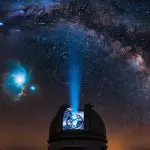
After years of technical support from NASA’s Glenn Research Center and Goddard Space Flight Center, the university constructed a lunar-capable optical telescope utilizing commercially available components, significantly reducing the typical costs and timelines associated with building such facilities. This innovative approach allowed the station to contribute substantially to NASA’s “Live Views from Orion” feed, achieving dual-stream video reception from the Orion spacecraft for over 15.5 hours throughout the mission. The Australian site didn’t merely receive video; it successfully downlinked data at the terminal’s maximum rate of 260 megabits per second, proving the viability of affordable, off-the-shelf parts in establishing effective optical ground stations.
High-Definition Video Enables Real-Time Crew Connection
The Artemis II mission’s ten-day lunar journey marked the first instance of laser communications supporting a crewed spacecraft at that distance, fundamentally altering how mission control receives and interprets data from deep space. This expanded bandwidth allowed for a level of immediacy previously unattainable with traditional radio frequency systems, shifting the focus from delayed analysis to real-time insights. Crisp, clear imagery of Earthset and Earthrise, downlinked via the laser system, provided a visually compelling experience for both the public and the science team. This rapid transfer rate, facilitated by a new ground station at the Australian National University, enabled a more “productive crew science conference the morning after the flyby,” according to Dr. Young, and demonstrated the feasibility of leveraging commercial, off-the-shelf components to reduce the cost and complexity of establishing optical ground stations.

See today’s quantum computing news on Quantum Zeitgeist for the latest breakthroughs in qubits, hardware, algorithms, and industry deals.