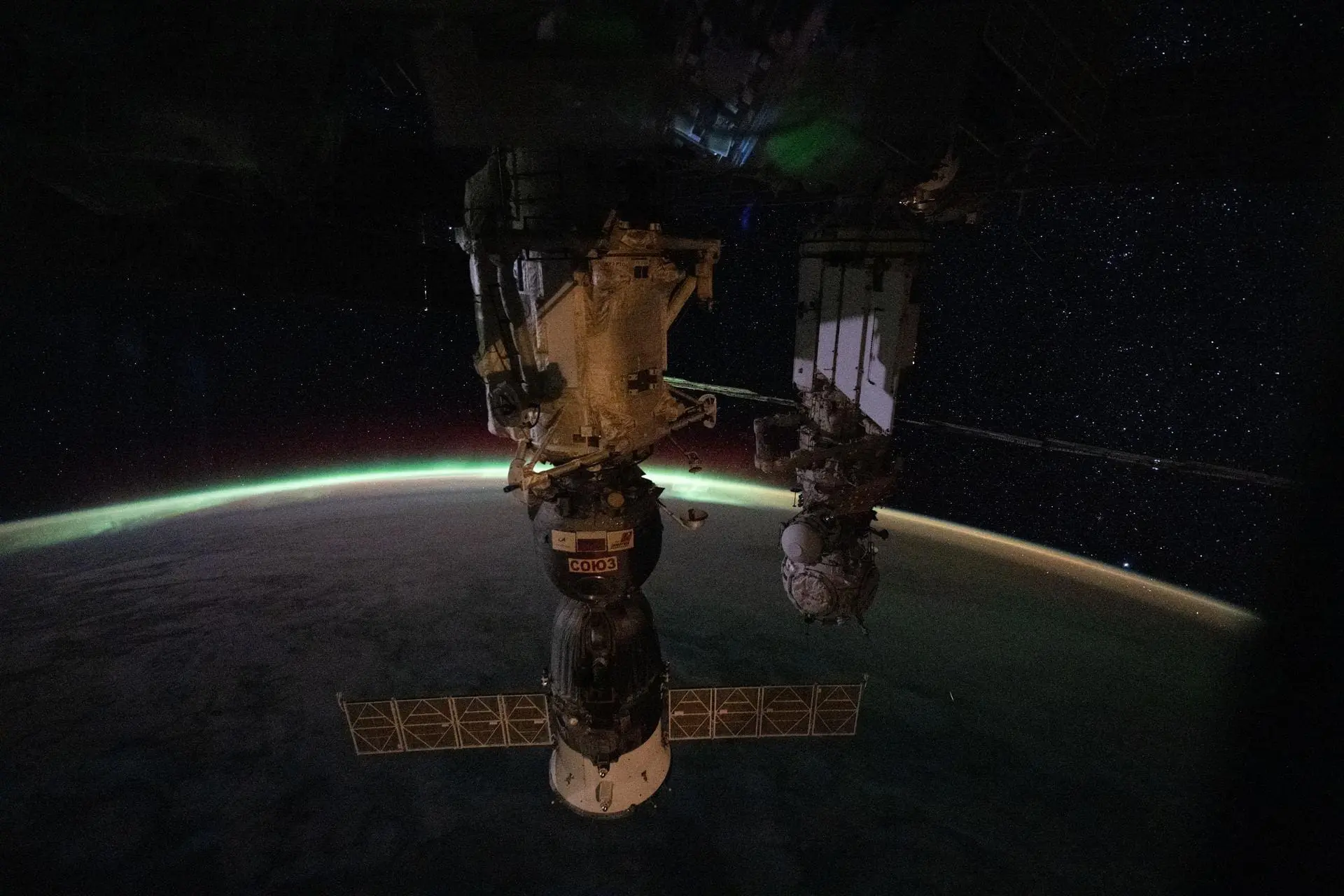
NASA flight engineers Jessica Meir and Jack Hathaway recently upgraded the Cold Atom Lab aboard the International Space Station, installing a new module to chill atoms to near absolute zero, approximately -273.15°C. The advanced hardware expands the lab’s capabilities, allowing researchers to observe atomic wave functions and potentially unlock deeper understandings of general relativity. This research aids the search for dark matter, the mysterious substance comprising roughly 85 percent of the matter in the universe. The upgrade followed the arrival of Progress 95, which delivered approximately three tons of food, fuel, and supplies to the orbiting outpost on Monday, sustaining the crew and their ongoing investigations.
Progress 95 Cargo Delivery and Zvezda Module Integration
Roscosmos cosmonauts Sergey Kud-Sverchkov and Sergei Mikaev meticulously completed leak and pressure validations between the Progress 95 and Zvezda’s rear port, subsequently installing air ducts and commencing the unpacking process, ensuring a seamless integration of the delivered resources. This enhancement allows the CAL to achieve temperatures near absolute zero, approximately -273.15°C, a critical capability for observing atomic wave functions and probing the fundamental laws of physics. Simultaneously, Sophie Adenot of ESA focused on a technology demonstration aimed at generating medical-grade saline solutions from the station’s potable water, potentially reducing reliance on Earth-based resupply for critical medical needs. Investigations into cryogenic fuel behavior, led by Meir with Adenot’s assistance, are underway, with the potential to refine spacecraft propulsion and life support systems; Chris Williams dedicated time to reorganizing cargo within the Kibo laboratory module, optimizing space for upcoming experiments and servicing essential computer equipment supporting ongoing research. These combined efforts demonstrate the ISS’s continued role as a multifaceted platform for both applied technology and fundamental scientific inquiry.
Cold Atom Lab Upgrade Enables Quantum Physics Research
The pursuit of fundamental physics continues aboard the International Space Station, now bolstered by a significant upgrade to the orbital outpost’s Cold Atom Lab. This extreme cooling is essential for observing atomic wave functions, phenomena obscured by thermal motion at warmer temperatures, and gaining insights into the very fabric of reality. Conducting this research in microgravity offers distinct advantages over terrestrial labs, as the absence of convection currents and other gravitational influences allows for more precise control and observation of these delicate quantum states. NASA stated that the CAL’s enhanced capabilities will provide “deeper insights into general relativity,” a cornerstone of modern physics, and potentially unlock clues to one of the universe’s greatest mysteries: dark matter.
Estimates suggest dark matter comprises approximately 85% of the matter in the universe, yet its composition remains largely unknown, making investigations like these crucial for a complete understanding of the cosmos. Beyond relativity and dark matter, the station’s research extends to practical applications; flight engineer Sophie Adenot, with Meir’s assistance, worked with the Microgravity Science Glovebox, stowing physics hardware used to study cryogenic fuels, with the goal of improving spacecraft propulsion and life support systems. This multifaceted approach, combining fundamental research with technological development, highlights the ISS’s unique position as a platform for both expanding our knowledge of the universe and improving life in space.
The advanced hardware expands the CAL’s ability to chill atoms to near absolute zero enabling the observation of atomic wave functions, providing deeper insights into general relativity, and aiding the search for dark matter.
Intravenous Fluid Generation for On-Orbit Medical Support
This investigation, utilizing the Intravenous Fluid Generation, Mini technology demonstration, seeks to lessen reliance on resupply missions like Progress 95, which recently delivered approximately three tons of essential cargo, and mitigate the risk of crucial medical supplies expiring during extended space voyages. The ability to create saline solutions in-situ represents a significant step toward greater crew autonomy and self-sufficiency for long-duration missions, potentially reducing the logistical burden and associated costs of deep space exploration. Adenot’s work builds upon existing research into resource utilization, recognizing that water is a relatively abundant resource on the ISS, though still requiring careful management and recycling. The demonstration aims to prove the feasibility of producing fluids meeting stringent medical standards, a challenge complicated by the unique conditions of microgravity and the need for highly purified water. This approach contrasts with current practices where all medical supplies, including intravenous solutions, must be transported from Earth, a process subject to delays and limitations in quantity. The implications extend beyond simply reducing cargo weight; it addresses a critical vulnerability in long-term space habitation.



See today’s quantum computing news on Quantum Zeitgeist for the latest breakthroughs in qubits, hardware, algorithms, and industry deals.