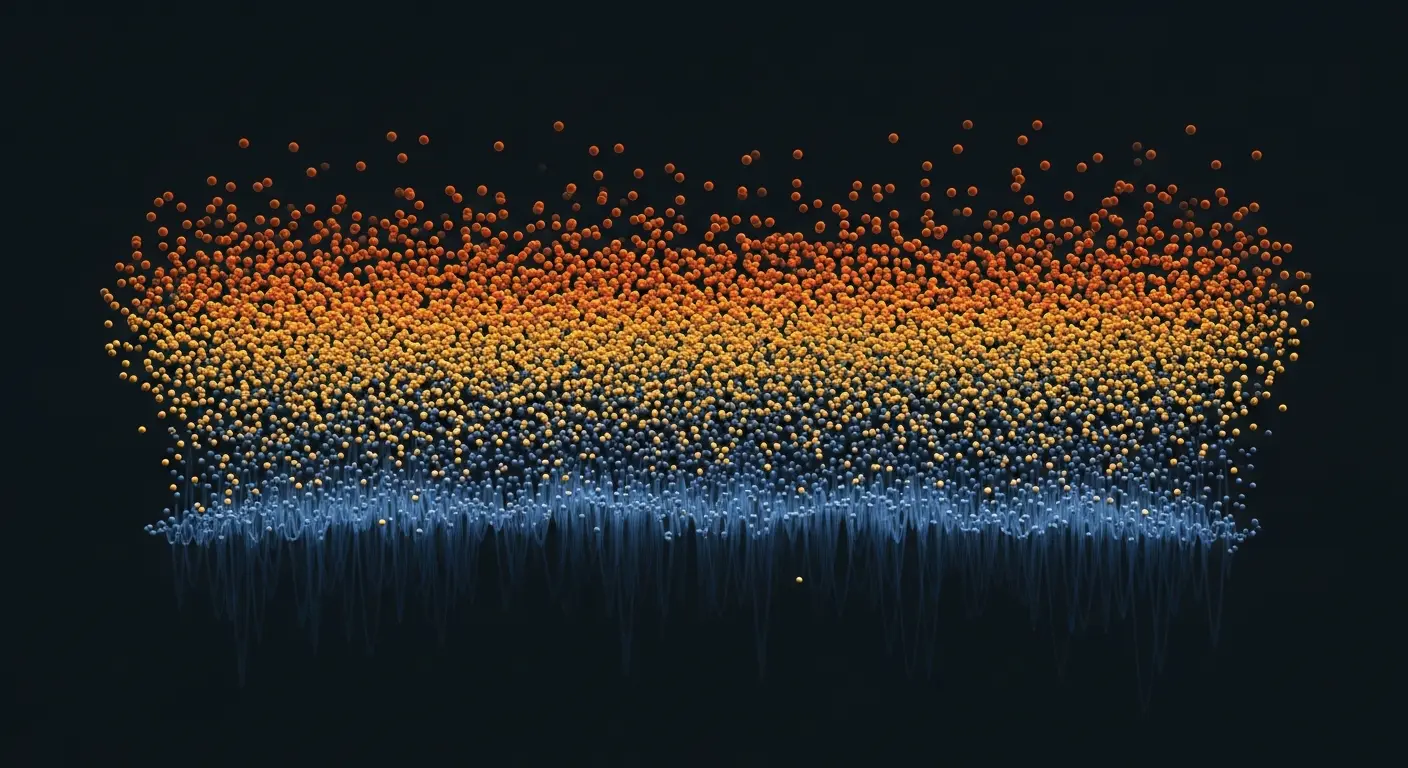
Jakub Zakrzewski and colleagues at Jagiellonian University summarise current understanding of many-body localisation, an intriguing behaviour of complex quantum systems that can defy typical thermalisation. The review details evidence of a transition between normal behaviour and a localised regime, demonstrated using the XXZ model and extended to other systems. It highlights the largely unstudied connection between many-body localisation and the development of quantum computation. The work offers a valuable overview of a field with growing implications for understanding fundamental physics and designing future quantum technologies. Interactions within a quantum system can inhibit energy flow and lead to a non-ergodic state
Eigenstate fluctuations quantify deviations from thermal behaviour in isolated quantum systems
Detailed analysis of eigenstate properties probed the transition to many-body localization, building on the eigenstate thermalization hypothesis (ETH), which describes how isolated quantum systems evolve over time. The ETH posits that in ergodic systems, eigenstates are characterised by random matrix theory statistics, leading to thermal behaviour. However, deviations from this behaviour signal the emergence of non-ergodic phases like many-body localization. Quantifying the matrix elements connecting different energy eigenstates was central to this approach, specifically a random variable termed R mn, representing fluctuations around expected values with unit variance. These matrix elements describe the overlap between eigenstates and provide information about the system’s ability to transport energy. Measuring this variable assessed the extent to which individual quantum states deviate from the predictions of thermalization, effectively revealing whether energy is spreading evenly or becoming trapped. A large R mn indicates significant deviations from the ETH, suggesting localization. The XXZ model served as a primary example throughout this investigation, enabling exploration of the transition between active and localized regimes and facilitating understanding of the behaviour of more complex systems. This model, a spin-1/2 chain with nearest-neighbour interactions, is particularly amenable to numerical studies. Symmetry-resolved entanglement entropy further confirmed this transition, splitting entanglement into configurational and number entropy components. Configurational entanglement reflects spatial correlations, while number entanglement quantifies fluctuations in particle number, revealing how particle fluctuations behave within the system and providing a more nuanced picture of the entanglement structure during the transition.
Disorder-induced transition to many-body localisation observed in the XXZ spin chain
The imbalance, a measure of how much a quantum system remembers its initial state, decreased to approximately 0.1 for the XXZ model at disorder strengths exceeding 10; previously, this metric remained consistently high, indicating a lack of localization. This imbalance is calculated by measuring the overlap between the initial state and the time-evolved state, quantifying the degree to which the system retains memory of its starting configuration. A high imbalance signifies that the system is not thermalizing and is retaining information, a hallmark of a localized phase. This threshold signifies a crossover point where the system transitions from active behaviour, where information is lost through energy exchange, to many-body localization (MBL), a state where interactions trap energy and preserve memory. This finding is key because it expands the scope of MBL studies beyond simplified theoretical models and into more complex, realistic systems. The introduction of disorder, in the form of random on-site energies, is crucial for driving the transition to MBL, as it breaks the symmetries that would otherwise allow for energy transport.
The XXZ model demonstrated a crossover from active behaviour to the many-body localized regime in finite systems, a phenomenon extending to other models to illustrate its generality. Investigations focused on the measures and tools used to characterise many-body localization, alongside the challenges associated with its thermodynamic limit. Understanding the behaviour of MBL in the thermodynamic limit, as the system size approaches infinity, is a significant challenge, as finite-size effects can obscure the true nature of the phase transition. Entanglement entropy indicated system imbalance, with data aligning onto a single curve for system sizes up to 24, although this consistency was limited to short timescales. This scaling behaviour suggests that the observed MBL phase is robust, but the limited timescale raises questions about long-time dynamics and potential slow relaxation processes.
Spectral measures, such as the average gap ratio, showed a transition from Gaussian orthogonal ensemble to Poisson values, indicating a crossover between active and localized regimes. The Gaussian orthogonal ensemble (GOE) describes the statistics of energy levels in ergodic systems, while Poisson statistics are characteristic of localized systems. This change in spectral statistics provides further evidence for the transition to MBL. Establishing a stable many-body localized phase in larger, more complex systems remains an open question. Typically, the dynamics of isolated systems are thermalizing, unless exceptions such as many-body localization, associated with strong disorder, occur. The strength of the disorder is a critical parameter, as weak disorder is insufficient to overcome the interactions that drive thermalization.
Many-body localisation and its implications for disordered quantum systems
This review of many-body localisation (MBL) clarifies the conditions under which interactions between particles can halt energy flow, creating a state where the system ‘remembers’ its initial configuration. Understanding this phenomenon deepens our fundamental knowledge of how matter behaves at the smallest scales, even if immediate technological applications are limited. This insight is valuable as it challenges established theories of energy transfer and thermalisation, which typically assume ergodicity. By examining the XXZ model and extending observations to other systems, scientists demonstrate a definitive transition from predictable, active behaviour to a non-active state where energy becomes trapped, clarifying the conditions under which this localisation occurs and moving beyond simplified theoretical scenarios to encompass more complex quantum fields. The potential implications of MBL extend to the field of quantum computation. A localized system, by virtue of its ability to preserve quantum information, could potentially serve as a robust platform for building quantum bits (qubits). However, realising this potential requires overcoming significant challenges, such as controlling the disorder and scaling up the system size. Further research is needed to explore the largely unexplored relation between MBL and quantum computation, and to determine whether MBL can provide a viable pathway towards building fault-tolerant quantum computers. The study of MBL also has implications for understanding the behaviour of disordered materials, such as glasses and amorphous solids, where localization effects can play a crucial role in determining their properties.
The research clarified the conditions under which interactions between particles can halt energy flow, resulting in many-body localisation. This is significant because it demonstrates how systems can retain memory of their initial state, challenging conventional understandings of energy transfer in quantum mechanics. Using the XXZ model, scientists observed a clear transition to this non-active state with increasing disorder. The authors note that further investigation is needed to explore the connection between this localisation and potential applications in quantum computation.
👉 More information
🗞 Many-body localization
🧠 ArXiv: https://arxiv.org/abs/2604.12464




See today’s quantum computing news on Quantum Zeitgeist for the latest breakthroughs in qubits, hardware, algorithms, and industry deals.