Alfredo Luis and Lorena Ballesteros Ferraz at the Institute of Optics, LPTM, have elucidated the fundamental link between Kirkwood-Dirac distributions and optical coherence. They demonstrate that these distributions represent generalised mutual coherence functions, offering a unified understanding of complex and negative values previously considered anomalous. Their analysis consistently applies to key optical phenomena including polarisation, interference and wave propagation. They propose multiple experimental methods for determining these distributions based on interference principles. This analysis offers a new perspective on optical coherence, potentially advancing the development of new optical technologies and measurement techniques.
Reconstructing light distributions via simplified interferometric measurement
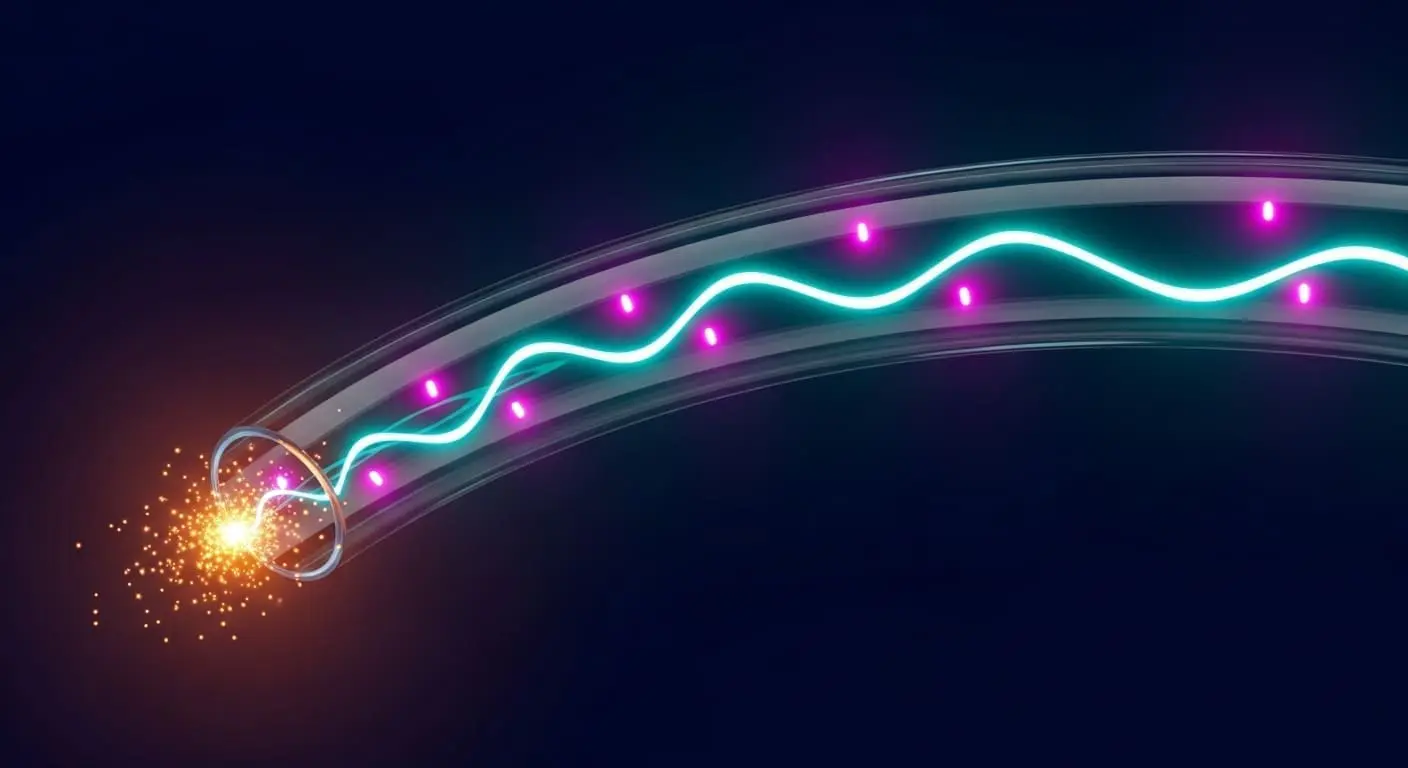
Interferometry became central to accessing Kirkwood-Dirac distributions, a fingerprint of how light waves are distributed in space, by circumventing the need for complex heterodyne detection methods. The technique exploits the principle of wave interference, where two or more light waves combine to create a resultant wave, revealing information about their phase and amplitude relationship. A carefully arranged set of beam splitters and mirrors measured the interference patterns arising from different bases of polarized light and spatial modes. The experimental setup involved precise alignment of optical components to ensure constructive and destructive interference patterns were accurately captured, allowing for the reconstruction of the distributions. This process is analogous to how a hologram records the interference pattern of light, but instead of reconstructing an image, it reconstructs the statistical properties of the light field.
Analysing these patterns reconstructed the distributions without relying on intricate signal processing previously required, offering a more direct and accessible pathway to understanding light’s statistical properties. Kirkwood-Dirac distributions were explored, identifying them as generalised mutual coherence functions relating to two different bases than a single one. This is a significant departure from traditional coherence analysis, which typically focuses on the correlation between two points in a single basis. The use of two bases allows for a more complete description of the light’s statistical state, particularly in scenarios involving complex polarisation or spatial mode structures. This approach offers a unified understanding of complex and negative values as direct indicators of coherence, applicable to polarisation, interference and wave propagation. These ‘anomalous’ values, previously requiring ad-hoc explanations, are now understood as natural consequences of the generalised coherence framework.
Direct interference measurement reveals generalised mutual coherence functions of light
A six-fold improvement in the experimental determination of Kirkwood-Dirac distributions has been achieved, moving from reliance on heterodyne detection to direct measurement via interference. Accurate reconstruction was previously impossible without complex signal processing and calibration, but this advance unlocks access to distributions previously obscured by the limitations of heterodyne methods. Heterodyne detection, while sensitive, introduces its own sources of noise and requires precise frequency stabilisation, making it challenging to accurately measure weak coherence effects. The new interferometric approach significantly reduces these limitations, allowing for more accurate and efficient measurements. These distributions are generalised mutual coherence functions, fundamentally linking them to optical coherence and offering a new interpretation of complex and negative values as indicators of coherence rather than non-classical behaviour.
This unified perspective applies consistently across optical phenomena including polarization, interference and wave propagation, providing a refined descriptor of light’s statistical properties. Furthermore, connections have been established between the distributions and experimentally accessible joint distributions from noisy measurements, and also to the Wigner function in both continuous and discrete variable settings. The Wigner function is a quasi-probability distribution used in quantum mechanics and optics to represent the state of a system in phase space. Establishing a link between the Kirkwood-Dirac distributions and the Wigner function provides a bridge between classical and quantum descriptions of light. This work provides a more comprehensive understanding of light’s behaviour in various optical scenarios, offering a powerful tool for characterising and manipulating light fields. The ability to relate these distributions to noisy measurements is particularly important for real-world applications, where perfect signal quality is rarely achievable.
Kirkwood-Dirac distributions clarify optical coherence and its limitations across field variables
Establishing a clear link between Kirkwood-Dirac distributions and optical coherence offers a powerful new tool for characterising light, potentially simplifying the analysis of complex optical systems. The traditional approach to analysing optical systems often involves decomposing the light field into its constituent components and tracking their evolution. The Kirkwood-Dirac distributions provide a more holistic description of the light field, capturing its statistical properties in a single set of parameters. However, a limitation is acknowledged in fully defining the scope of ‘all field variables’, raising questions about whether this coherence-based interpretation universally applies to every conceivable light property. The term ‘field variables’ encompasses a wide range of parameters that describe the light field, including amplitude, phase, polarization, and spatial mode. Determining the precise boundaries of this set is a challenging task, and further research is needed to fully understand the limits of the coherence-based interpretation.
Acknowledging that fully defining ‘all field variables’ remains an open question does not diminish the significance of this work. Establishing a connection between Kirkwood-Dirac distributions and optical coherence, a measure of how predictable a light wave is, provides a new analytical pathway for researchers. This offers a potentially simpler method for understanding complex light behaviours, even if the framework isn’t yet universally applicable to every light property imaginable. The degree of coherence dictates how well the light wave can be predicted; highly coherent light exhibits a well-defined phase and amplitude, while incoherent light is characterised by random fluctuations. This work provides a new way to quantify and understand coherence in various optical systems.
The work establishes a fundamental connection between Kirkwood-Dirac distributions and optical coherence, revealing the former to be a generalised form of mutual coherence functions; mutual coherence describes the correlation between two points in a light wave. By demonstrating this relationship, a consistent explanation for previously anomalous values, complex or negative readings, is provided as inherent properties of coherence itself, rather than indicators of unusual light behaviour. These anomalous values often arise in situations where the light field is highly structured or exhibits strong correlations. This reframing simplifies the interpretation of optical phenomena like polarization, interference and wave propagation, offering a unified framework for understanding light’s statistical properties. The implications extend to areas such as optical imaging, optical communications, and quantum optics, where a precise understanding of light coherence is crucial for achieving optimal performance.
The research demonstrated a connection between Kirkwood-Dirac distributions and optical coherence, identifying the former as a generalised form of mutual coherence functions. This establishes a unified interpretation for previously unexplained, complex values observed in optical measurements as direct manifestations of coherence. By reframing these values, the work simplifies the understanding of phenomena including polarization, interference and wave propagation. The authors suggest further research is needed to fully define the limits of this coherence-based interpretation across all field variables.
👉 More information
🗞 Kirkwood-Dirac distributions in classical optics
🧠 ArXiv: https://arxiv.org/abs/2604.08325

See today’s quantum computing news on Quantum Zeitgeist for the latest breakthroughs in qubits, hardware, algorithms, and industry deals.