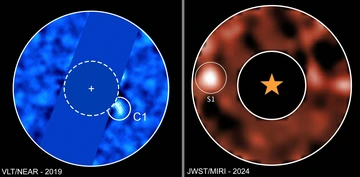
Researchers at the University of Arizona Steward Observatory, led by Kevin Wagner, an assistant research professor, have reported potential evidence for a gas giant planet orbiting within the Alpha Centauri triple star system. Building upon initial indications from a 2021 publication and utilising data acquired in 2024 with the James Webb Space Telescope’s Mid-Infrared Instrument, the team employed a coronagraphic mask to suppress stellar glare from Alpha Centauri A and subsequently identified a candidate planet, designated S1, located on the opposite side of the star. This detection follows an initial planet candidate, labelled C1, identified in 2019 using the Very Large Telescope operated by the European Southern Observatory in Chile. The potential planet is estimated to possess a mass comparable to Saturn. It orbits at approximately twice the Earth-Sun distance, suggesting a possible residence within the habitable zone of the closest star where liquid water could theoretically exist.
Nearby Star System
The Alpha Centauri star system, located approximately 4.37 light-years from Earth, remains a focal point for exoplanetary research. Recent observations from the James Webb Space Telescope (JWST) suggest the potential presence of a gas giant planet. A collaborative study led by researchers at the University of Arizona Steward Observatory, building upon initial findings reported in 2021, has identified a candidate planet, designated S1, orbiting within the system. The research leverages data acquired with JWST’s Mid-Infrared Instrument (MIRI), employing a coronagraphic mask – an essential tool for blocking the intense light emitted by the parent star, Alpha Centauri A – to enhance the detection of faint planetary signals. This technique is crucial, as the star’s overwhelming luminosity would otherwise obscure any potential planetary emissions.
The candidate planet is estimated to possess a mass comparable to Saturn – approximately 95 times the mass of Earth – and orbits at a distance of roughly two astronomical units (AU) from A. This places it within the region around a star where temperatures could, theoretically, permit the existence of liquid water on a planetary surface, a prerequisite for life as we currently understand it. However, it is crucial to note that S1 is a gas giant and therefore unlikely to host surface liquid water directly. Its potential significance lies in the possibility that its gravitational influence may have facilitated the formation, or preservation, of more minor, rocky planets within the same system. The detection methodology relies on discerning subtle infrared emissions from S1, a consequence of its internal heat and reflected starlight. The JWST’s MIRI, sensitive to mid-infrared wavelengths, is uniquely suited to this task, providing significantly enhanced sensitivity and resolution compared to previous instruments.
More information
External Link: Click Here For More
The success of this direct imaging effort hinges critically on the coronagraphic mask, which actively blocks the overwhelming continuum emission from the central stars. By precisely attenuating the starlight across specific wavelengths, the team transforms the detection problem from resolving a faint signal against intense background noise into analyzing subtle angular fluctuations. This level of light suppression is paramount, allowing the MIRI instrument to measure the planet’s faint thermal fingerprint, which arises from the object’s internal heat and interaction with residual stellar flux, rather than simply detecting a transit dip.
Analyzing exoplanets via direct thermal emission, as opposed to transit photometry, presents unique astrophysical challenges. The observed infrared signal is a complex combination of reflected incident light and intrinsic thermal emission from the planet’s atmosphere and solid body. Interpreting this spectrum requires sophisticated atmospheric retrieval models that account for temperature gradients, cloud opacities, and the planet’s orbital geometry, offering clues about its atmospheric composition and evolution within the dynamic environment of a multiple star system.
The Alpha Centauri system itself poses significant dynamical complexities due to its nature as a triple star. The gravitational interactions between Centauri A, B, and the potentially undetected third star significantly affect the stability and orbital evolution of any third-body companion like S1. Modeling the orbital parameters of a planet in such a crowded, perturbed environment demands advanced N-body simulations, necessitating careful consideration of Kozai-Lidov cycles and tidal forces when refining the planet’s orbital history and mass estimates.
Future research utilizing this data will likely pivot toward characterizing the planet’s atmospheric chemistry, specifically searching for biosignatures or indicators of heavy element accretion. The sensitivity of the MIRI instrument to mid-infrared wavelengths allows for molecular fingerprinting, potentially revealing the presence of key molecules such as water vapor (H_2O), methane (CH_4), or carbon dioxide (CO_2). Such spectral measurements are vital steps toward confirming the physical state and atmospheric viability of the distant candidate world.




See today’s quantum computing news on Quantum Zeitgeist for the latest breakthroughs in qubits, hardware, algorithms, and industry deals.