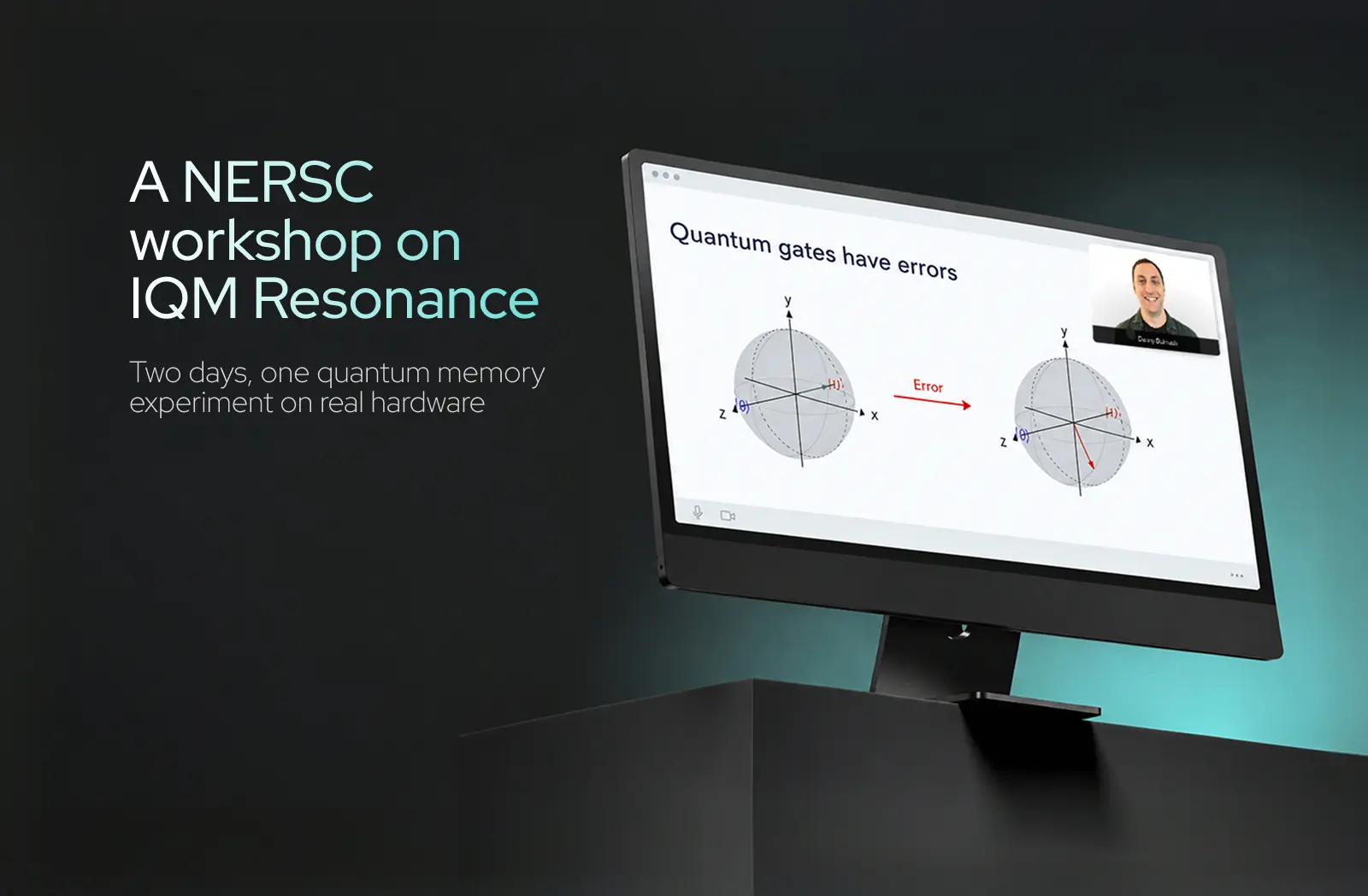
Ermal Rrapaj and Danny Bulmash hosted a two-day virtual workshop organized by the National Energy Research Scientific Computing Center (NERSC) designed to bridge the gap between quantum error correction theory and practical implementation. Participants moved beyond foundational concepts to run a quantum memory experiment using superconducting quantum hardware provided by IQM Resonance.
The workshop connected theoretical knowledge to real-world application, exploring how error correction can be implemented on a quantum computer and addressing the noise inherent in complex quantum algorithms. A key theme emerging from the training was the substantial opportunity for innovation remaining across the entire quantum error correction process.
Workshop Bridges Quantum Error Correction Theory and IQM Resonance Access
The two-day virtual event, hosted by Ermal Rrapaj and led by Danny Bulmash, moved beyond foundational concepts by providing hands-on access to IQM Resonance superconducting quantum hardware. This allowed attendees to run a quantum memory experiment, directly measuring the rate at which stored information degrades due to noise.
Participants first explored the surface code, a prominent approach to error correction, learning the qubit layout, syndrome measurement interpretation, and encoding principles behind its frequent use, IQM Resonance says. This foundational work prepared them to implement the surface code and run the quantum memory experiment, a process that revealed the effects of noise on stored quantum information.
Transitioning from theory to experimentation proved important, as many fundamental ideas within quantum error correction can be investigated on current quantum hardware. “Quantum error correction is often discussed in the context of future fault-tolerant machines, but many of its fundamental ideas can already be investigated experimentally on today’s quantum hardware,” the source material states.
Participants computed the logical error rate themselves, quantifying the speed at which information is lost and gaining firsthand experience with the challenges of maintaining quantum coherence. This hands-on approach distinguished the workshop, emphasizing the practical application of QEC principles and encouraging innovation in the field.
As the community approaches the early fault tolerant era of quantum computing, error correction becomes an important topic not only for providers but also for domain scientists that want to leverage hardware capabilities in the near future term.
Fundamentals of QEC: From Classical Concepts to Quantum Codes
Participants first examined classical error correction principles to establish a foundation for understanding the complexities of quantum approaches, recognizing that quantum error correction presents unique challenges beyond its classical counterpart. The workshop detailed how logical qubits, encoding and decoding operate in classical systems, providing an intuitive context before transitioning to the nuances of quantum codes and the need for real-time decoding during circuit execution.
This approach emphasised that QEC must actively counteract error accumulation while quantum operations are underway, a requirement absent in classical computing. The training then moved to practical implementation, with participants constructing quantum circuits designed to measure syndromes, critical data points used to identify and correct errors within a quantum system, and applying this knowledge to a simple quantum code.
Decoding challenges were addressed, including a survey of classical algorithms employed in the process. The workshop concluded with an overview of potential hardware architectures for realizing QEC in physical machines. This progression from theoretical concepts to circuit construction highlighted a deliberate effort to bridge the gap between abstract ideas and tangible application.
“To turn the deep theoretical literature surrounding these questions into practical implementations, students, researchers, and practitioners in QEC-adjacent topics need a chance to approach QEC at an introductory level, demystify the core concepts, and implement QEC on real quantum computers,” explained the workshop’s organizers.
Surface Code Implementation and Quantum Memory Experiment on Real Hardware
The circuits addressed the physical layout of qubits, the interpretation of syndrome measurements, and the encoding process itself, providing a foundation for the subsequent quantum memory experiment. This hands-on work allowed attendees to move beyond theoretical understanding and directly engage with the practical challenges of implementing a surface code. The quantum memory experiment used IQM Resonance hardware, enabling participants to encode a logical qubit and monitor it for errors in real-time, according to the company.
By actively watching for errors and then decoding them, participants could retrieve the information stored within the logical qubit and directly observe the effects of noise on quantum data. This experiment demonstrated a complete cycle of encoding, error detection, and decoding, bridging the gap between theoretical concepts and practical application.
The workshop’s progression from foundational knowledge to circuit construction and, ultimately, to running an experiment on real hardware, is important for developing a skilled quantum workforce. “Researchers do not have to wait for those systems to begin developing the knowledge and experimental skills that will be needed to use them,” the event organizers stated, emphasizing the importance of proactive training. The ability to test ideas on actual quantum computers, rather than relying solely on simulations, accelerates the learning process and encourages innovation in quantum error correction.
IQM Resonance Enables Hands-on QEC Protocol Analysis and Optimization
IQM Resonance’s open stack architecture enabled workshop participants to build detailed noise models and conduct in-depth analysis of code performance, a level of scrutiny often unavailable with closed-system quantum computers. This granular access extended beyond simulation, allowing attendees to explore how different quantum error correction codes function across the IQM Crystal and IQM Star hardware configurations.
Participants quantified information loss by computing the logical error rate themselves, a key metric for assessing the effectiveness of error correction protocols. This hands-on computation revealed the practical impact of noise on stored quantum information, solidifying understanding beyond abstract concepts.
This level of control is particularly valuable, as it allows for targeted adjustments to mitigate noise and improve the fidelity of quantum operations. “With pulse-level access, researchers can also work on optimizing QEC protocols at a very deep level of the stack,” according to the workshop materials. The NERSC event facilitated a shift from passively learning about quantum error correction to actively refining its implementation on actual hardware, accelerating the development of practical quantum computing solutions.
Source: https://iqm.tech/blog/from-quantum-error-correction-theory-to-experiments-on-real-quantum-hardware/

See today’s quantum computing news on Quantum Zeitgeist for the latest breakthroughs in qubits, hardware, algorithms, and industry deals.