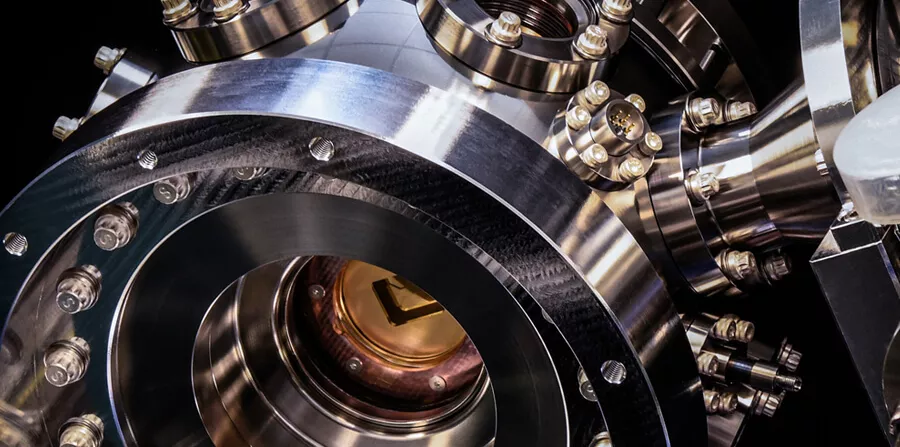
When most people think of Honeywell, they envision thermostats and home heating controls. Yet this industrial conglomerate, founded in 1906 as a heating regulator company, has played a pivotal role in computing history—twice. From challenging IBM’s dominance in the mainframe era to leading today’s quantum revolution, Honeywell’s seven-decade journey represents one of technology’s most remarkable transformations.
This is the story of how a company known for mechanical controls became a computing powerhouse, exited the industry entirely, then returned decades later to pioneer quantum computing—a technology poised to revolutionize computation itself.
The Genesis: Entering the Computer Age (1955-1960)
Honeywell’s entry into computing began with a strategic partnership that would define its trajectory for decades. In April 1955, Minneapolis-Honeywell formed a joint venture with defense contractor Raytheon called Datamatic Corporation, aiming to challenge IBM’s growing dominance in electronic data processing.
Their first product, the DATAmatic 1000, launched in 1957, was a behemoth even by 1950s standards. Weighing 25 tons and occupying 6,000 square feet, this vacuum tube-based machine could perform just 0.006 MIPS (million instructions per second)—roughly the computational power of a 1970s pocket calculator. Despite its enormous cost and size, more than 20 units were sold to large corporations and government agencies, establishing Honeywell as a serious player in the nascent computer industry.
By 1960, Honeywell had bought out Raytheon’s stake and transformed Datamatic into its Electronic Data Processing division. The company quickly transitioned to transistor technology with the Honeywell 800, achieving a 16-fold performance improvement to 0.1 MIPS while maintaining the same basic architecture. This established a pattern that would define Honeywell’s approach: evolutionary improvement through superior engineering rather than revolutionary breakthroughs.
The Liberator Era: Taking on IBM (1963-1970)
Honeywell’s most audacious move came in 1963 with the introduction of the Honeywell 200, marketed under the aggressive “Liberator” campaign. This wasn’t just another computer—it was a direct assault on IBM’s highly successful 1401, which dominated the business computing market.
The H200’s killer feature was compatibility. Through a combination of architectural similarity and clever software translation, it could run IBM 1401 programs without recompilation, while delivering two to three times the performance at a competitive price point. The marketing campaign portrayed the H200 as liberating businesses from IBM’s grip, complete with imagery of broken chains and freed customers.
The strategy worked brilliantly. Hundreds of orders flooded in, seriously threatening IBM’s market position. IBM’s response—pre-announcing its System/360 to freeze the market—demonstrated just how seriously they took the Honeywell threat. While this ultimately blunted the Liberator’s momentum, Honeywell had proven it could compete with “Big Blue” on both technical merit and marketing savvy.
Minicomputers and Diversification (1966-1975)
Recognizing that not every customer needed a mainframe, Honeywell made a prescient acquisition in 1966: Computer Control Corporation (3C), a pioneer in minicomputers. This brought the innovative Series 16 line, including the DDP-116, DDP-516, and eventually the H316.
These machines excelled in real-time applications and industrial control. Most notably, the rugged DDP-516 was selected in 1969 as the Interface Message Processor (IMP) for ARPANET—the Pentagon-funded network that would evolve into the Internet. When weight became an issue, the lighter H316 took over this role, making Honeywell hardware fundamental to the Internet’s birth.
The H316 also spawned one of computing history’s most peculiar footnotes: the Kitchen Computer. In 1969, luxury retailer Neiman Marcus offered an H316 in a pedestal configuration as a recipe storage device for affluent housewives. Despite the absurdity of using binary switches and lights for recipe management, this represented one of the first attempts to market a computer for home use—presaging the personal computer revolution by a decade. Predictably, none were sold.
The Mainframe Years: Acquisition and Growth (1970-1980)
Honeywell’s biggest leap came in 1970 when it acquired General Electric’s computer division, instantly gaining the sophisticated 600-series mainframes and two significant operating systems: GCOS (General Comprehensive Operating System) and Multics (Multiplexed Information and Computing Service).
The GE-600 series, rebranded as the Honeywell 6000 series, represented serious competition for IBM’s System/370. These 36-bit machines achieved around 1 MIPS—comparable to IBM’s offerings—and supported both batch and time-sharing operations. The 6180, specifically modified for Multics support, pioneered virtual memory concepts that would later influence Unix and modern operating systems.
Multics itself was remarkable—a joint project between MIT, GE, and Bell Labs that introduced revolutionary concepts including hierarchical file systems, dynamic linking, and sophisticated security models. While never achieving commercial success, Multics’ influence on computer science was profound. When Bell Labs withdrew from the project, its researchers created Unix as a simplified alternative, inheriting many Multics concepts.
By the mid-1970s, Honeywell had also introduced the Level 6 series (later DPS 6), a line of 16-bit minicomputers that would become its most successful product line. With over 50,000 installations worldwide, these machines found homes in departments, small businesses, and embedded applications where mainframes were overkill.
Peak and Decline (1975-1989)

The late 1970s marked both the peak of Honeywell’s computer operations and the beginning of its end. The company found itself one of the “Seven Dwarfs”—the seven computer companies perpetually chasing IBM’s Snow White. Despite technical excellence, Honeywell struggled to achieve the scale necessary to compete effectively.
The DPS-8 series, introduced in 1979, represented Honeywell’s technological peak. Using current-mode logic (CML) and achieving 1.7 MIPS, these water-cooled giants supported sophisticated virtual memory architectures. The subsequent DPS-88 pushed performance to 4.0 MIPS—a 667-fold improvement from the DATAmatic 1000 just 25 years earlier.
Yet technological excellence wasn’t enough. The minicomputer market was being disrupted by microprocessors, while IBM’s dominance in mainframes seemed unassailable. Honeywell’s computer division, despite generating significant revenue, required enormous capital investments that the parent company was increasingly unwilling to make.
Exit and Transformation (1986-1991)
In 1986, Honeywell made the strategic decision to exit the computer business, merging its computer operations with Groupe Bull of France and NEC of Japan. The joint venture, briefly called Honeywell Bull, saw Honeywell’s stake diminish over time until complete divestiture in 1991.
This exit seemed to mark the end of Honeywell’s computing story. The company refocused on its core businesses: aerospace, building controls, and industrial automation. For nearly three decades, Honeywell appeared to have permanently abandoned the computing frontier.
Table: Honeywell Classical Computing Systems (1957-1990s)
| System | Years | Type | Technology | Performance (MIPS) | Memory | Price (Original) | Key Features | Reference |
|---|---|---|---|---|---|---|---|---|
| DATAmatic 1000 | 1957-1963 | Mainframe | Vacuum tubes, 48-bit words | 0.006 MIPS | 2,000 words (9,600 digits) | $1.5M ($18-24M in 2025) | First computer from joint venture with Raytheon; 20+ sold | Wikipedia |
| Honeywell 800/1800 | 1960-1964 | Mainframe | Transistor-based, 48-bit words | 0.1 MIPS (H-800), 0.15 MIPS (H-1800) | 32K words | $650K | Company’s first fully transistorized computer; 89 H-800s delivered | Wikipedia |
| Honeywell 200 Series | 1963-1970s | Business Computer | Character-oriented, 2-address | 0.2 MIPS (est.), 2-3x faster than IBM 1401 | 4K-32K chars | $37K-250K | “Liberator” – first successful IBM clone with compatibility software | Wikipedia |
| Series 16 (DDP-116) | 1965-1970s | Minicomputer | 16-bit, transistor logic | 0.4 MIPS, 312,500 adds/sec | 4K-32K words | $25K | Original design by Computer Control Corp., acquired by Honeywell | Wikipedia |
| Series 16 (DDP-516) | 1966-1970s | Minicomputer | 16-bit, discrete transistors | 0.5 MIPS, 960 ns cycle time | 4K-32K words | $30K | Rugged version used for early ARPANET IMPs | Wikipedia |
| H8200 | 1968-1970s | Hybrid System | Combination of H-800 and H-4200 | Word + character processing | 8K-262K chars | ~$1M | Combined scientific (word) and business (character) processing | Wikipedia |
| Honeywell 316 | 1969-1980s | Minicomputer | 16-bit, integrated circuits | 0.58 MIPS, 2.5 MHz clock | 4K-32K words | $10,600 | ARPANET IMP; Kitchen Computer variant ($10K, 0 sold) | Wikipedia |
| H416 | 1970-1980s | Minicomputer | Enhanced 316 architecture | 0.55 MIPS | 8K-32K words | $16K | Mid-range Series 16 model | Wikipedia |
| 6000 Series (6040-6080) | 1970-1989 | Mainframe | IC-based, 36-bit words | 1.0 MIPS, EIS option | 32K-262K words | $500K-2M | Acquired from GE; ran GCOS and Multics | Wikipedia |
| H716 | 1970-1980s | Minicomputer | Advanced Series 16 | 0.65 MIPS, microprogrammable | 8K-64K words | $20K | High-end Series 16, used in System 700 | Wikipedia |
| Level 66 | 1973-1982 | Mainframe | MOS memory, cache option | 1.2 MIPS | 128K-1M words | ~$1M | Renamed 6000 series, ran GCOS | Wikipedia |
| H6180 | 1973-1982 | Mainframe | Modified for virtual memory | 1.2 MIPS | 128K-8M words | $1M+ | Multics support with segmentation/paging | Wikipedia |
| Level 68 | 1973-1982 | Mainframe | Enhanced Multics support | 1.2 MIPS | 256K-8M words | $1.5M+ | Dedicated Multics architecture | Wikipedia |
| Level 6/DPS 6 | 1975-1990s | Minicomputer | 16-bit, later 32-bit | 0.3-2 MIPS | 64K-16M words | $50K-500K | Most successful line; 50,000+ installations | Wikipedia |
| H200 Series (higher models) | 1965-1975 | Business Computer | H120: Entry model; H1200/1250: Enhanced; H2200: Mid-range; H4200: High-end | 0.2-0.5 MIPS | Varied by model | $100K-500K | Evolution of the H200 with increasing capabilities | Wikipedia |
| DPS-8 | 1979-1990s | Mainframe | CML technology, water-cooled | 1.7 MIPS, NSA architecture | 512K-16M words | $1M-3M | Virtual memory with domains/segments/pages | Wikipedia |
| DPS-88 | 1982-1990s | Mainframe | Current-mode logic | 4.0 MIPS | 64-128MB | $3M+ | Fastest Honeywell mainframe; water-cooled | Wikipedia |
Classical Computing. Honeywell was a leader in classical computing, although few today will recognise the companies contribution to the computing revolution on our phones. Honeywell gets a second wind and becomes a leader in Ion Trap Quantum Computers.
Return to the Frontier: Quantum Computing (2015-Present)
Honeywell’s return to computing came from an unexpected direction. In the early 2010s, the company’s aerospace division was investigating quantum sensing for navigation systems. This research revealed Honeywell’s unique advantage: decades of expertise in precision control systems—exactly what was needed for quantum computing.
Unlike classical bits that exist as either 0 or 1, quantum bits (qubits) exist in superposition—simultaneously 0 and 1 until measured. Maintaining this delicate quantum state requires extraordinary precision: controlling electromagnetic fields, managing extreme temperatures, and isolating qubits from environmental interference. Honeywell’s experience with atomic clocks, inertial navigation systems, and precision manufacturing provided an ideal foundation for tackling these challenges.
In 2015, Honeywell quietly began developing trapped-ion quantum computers. This approach uses individual charged atoms (ions) suspended in electromagnetic fields as qubits. While other companies pursued superconducting qubits requiring complex cryogenic systems, Honeywell bet on trapped ions’ superior fidelity and full connectivity between qubits.
Understanding Quantum Computing Approaches
Before examining Honeywell’s quantum journey, it’s essential to understand the competing approaches to building quantum computers. Each technology has distinct advantages and challenges, explaining why different companies have made different bets.
Superconducting Qubits are the most common approach, used by IBM, Google, and Rigetti. These systems create artificial atoms from superconducting circuits cooled to near absolute zero. They offer fast gate operations (nanoseconds) and leverage existing semiconductor fabrication techniques. However, they suffer from short coherence times (microseconds), limited qubit connectivity requiring complex routing, and operate at temperatures colder than outer space.
Trapped-ion qubits, Honeywell/Quantinuum’s choice, utilise individual ions confined by electromagnetic fields. This approach provides exceptional fidelity (>99.9%), long coherence times (seconds to minutes), and full connectivity between any qubits. The trade-offs include slower gate operations (microseconds) and challenging scalability beyond hundreds of qubits. The precision control required aligns perfectly with Honeywell’s expertise in aerospace and industrial systems.
Topological Qubits, pursued by Microsoft, remain largely theoretical but promise inherent error protection through exotic quantum states called anyons. If realized, they would provide built-in error correction without the overhead of logical qubits. However, creating the required quantum states has proven extraordinarily difficult, with no working topological qubit demonstrated to date.
Photonic Qubits use particles of light as qubits, offering room-temperature operation and natural compatibility with fibre optic networks. Companies like PsiQuantum and Xanadu pursue this approach for its potential manufacturing scalability. Challenges include probabilistic gate operations and the need for extremely efficient photon detectors.
Neutral Atom Qubits, developed by companies like QuEra and Pasqal, trap neutral atoms in optical lattices created by lasers. This approach enables flexible qubit arrangements and potentially thousands of qubits. Nonetheless, the technology is less mature than superconducting or trapped-ion systems.
Silicon Spin Qubits leverage semiconductor manufacturing to create qubits from electron or nuclear spins in silicon. Intel and others see this as the path to millions of qubits using existing chip fabrication. Current challenges include small qubit sizes requiring precise control and limited demonstrations beyond small prototypes.
Honeywell’s selection of trapped ions reflected a strategic calculation: prioritizing quality over quantity, betting that superior fidelity would matter more than raw qubit count. This decision—rooted in their precision control expertise—has proven prescient as the industry shifts focus from NISQ demonstrations to error-corrected logical qubits.
Quantum Supremacy: The H-Series (2020-Present)
Honeywell’s quantum ambitions became public in March 2020 with a bold promise: to deliver the world’s most powerful quantum computer within three months. They delivered on schedule. The System Model H0, with just 6 qubits, achieved a Quantum Volume (QV) of 64—double IBM’s best system.
Quantum Volume, a metric pioneered by IBM, measures overall quantum computer capability by combining qubit count, error rates, and connectivity. It provides a single number that captures real-world performance better than raw qubit count alone. Honeywell’s achievement demonstrated that quality could trump quantity in quantum computing.
The H1 series, launched later in 2020, began a remarkable progression. Starting at QV 128, the H1-1 and H1-2 systems underwent continuous upgrades, reaching QV 512 in March 2021, QV 1024 in July 2021, and QV 2048 by year’s end. This represented a 32-fold improvement in just over a year—far exceeding Honeywell’s promised 10x annual improvement.
The progression continued exponentially. By 2023, the H1-2 achieved QV 524,288—a thousand times higher than any competitor. This wasn’t through adding more qubits (the system had just 12), but through obsessive focus on fidelity: 99.994% for single-qubit gates and 99.81% for two-qubit operations.
Quantinuum: The New Computing Giant (2021-Present)
In November 2021, Honeywell Quantum Solutions merged with Cambridge Quantum Computing to form Quantinuum, creating the world’s largest standalone quantum computing company. This wasn’t just a financial transaction but a strategic combination of Honeywell’s hardware excellence with Cambridge Quantum’s software expertise.
The merger’s first major achievement was the System Model H2, launched in 2023. Featuring a revolutionary “racetrack” design with 32 qubits (later upgraded to 56), the H2 achieved a staggering QV of 1,048,576. More importantly, it demonstrated the creation and manipulation of non-Abelian anyons—exotic quantum states essential for topologically protected quantum computing.
This achievement opened the path to fault-tolerant quantum computing, where quantum calculations can proceed despite inevitable errors. It’s the quantum equivalent of error-correcting memory in classical computers—essential for practical applications.
The Path to Fault Tolerance: NISQ vs Logical Qubits
To appreciate the magnitude of Quantinuum’s achievements, it’s essential to understand the fundamental challenge they’re solving: the transition from NISQ (Noisy Intermediate-Scale Quantum) qubits to logical qubits.
The NISQ Era: Today’s Fragile Qubits
NISQ, a term coined by physicist John Preskill in 2018, describes our current quantum computing reality. NISQ devices use physical qubits—the raw quantum bits that are extremely fragile and error-prone. These qubits face several critical challenges:
Inherent Fragility: Physical qubits can maintain their quantum states for only microseconds to milliseconds before decoherence destroys the quantum information. Environmental factors like temperature fluctuations, electromagnetic fields, and even cosmic rays can cause errors.
High Error Rates: Current quantum operations have error rates between 0.1% and 1%. While this might seem small, quantum algorithms require thousands or millions of operations. Errors accumulate exponentially, making complex calculations unreliable—like trying to do precise math on a calculator with sticky keys.
Limited Utility: Although current systems boast hundreds or even thousands of physical qubits, their practical usefulness remains severely constrained. NISQ devices can only run short algorithms with perhaps 100-1,000 operations before errors overwhelm the computation.
Logical Qubits: The Error-Corrected Future
Logical qubits represent quantum computing’s holy grail—error-protected qubits that can maintain quantum information indefinitely. Here’s how they transform quantum computing:
Distributed Protection: A logical qubit encodes quantum information across many physical qubits. This number is typically between 10 and 1,000. It is similar to how RAID storage uses multiple hard drives for data protection. These physical qubits work together to detect and correct errors before they accumulate.
Continuous Error Correction: Quantum error correction continuously checks for errors. It does so without destroying the quantum state. This is a delicate process unique to quantum mechanics. When errors are detected, corrective operations restore the logical qubit to its intended state.
Extended Coherence: While a physical qubit might last microseconds, a logical qubit could maintain quantum information for hours or days. It could theoretically do so indefinitely. This enables the long computations needed for practical applications.
Why This Transition Matters
The shift from NISQ to logical qubits represents the difference between quantum computers as laboratory curiosities and quantum computers as practical tools:
Real-World Applications: NISQ devices have demonstrated “quantum supremacy” for artificial problems. But solving real problems—drug discovery, materials design, cryptanalysis—requires millions of error-free operations only possible with logical qubits.
True Scalability: Adding more NISQ qubits often increases noise and crosstalk. Logical qubits can scale while maintaining low error rates, enabling thousands of error-free qubits.
The Threshold Challenge: Creating logical qubits requires physical qubits with error rates below approximately 1%. Above this threshold, error correction introduces more errors than it fixes. Quantinuum’s achievement of 99.994% single-qubit fidelity (0.006% error) and 99.81% two-qubit fidelity clears this threshold by a wide margin—explaining why their systems with fewer qubits achieve higher quantum volumes than competitors with more, noisier qubits.
Table: Honeywell/Quantinuum Quantum Computing Systems (2020-2030)
| System Model H0 | 2020-2021 | Quantum Computer | Trapped ion, QCCD architecture | QV: 64, 6 physical qubits | Cloud-based | Subscription | First commercial trapped-ion quantum computer | QuantumZeitgeist |
| System Model H1 | 2020-2023 | Quantum Computer | Trapped ion, all-to-all connectivity | QV: 128→1024, 10 physical qubits | Cloud-based | Subscription | First to achieve QV 1024; multiple units (H1-1, H1-2) | QV 128 / QV 512 / QV 1024 |
| System Model H1-2 | 2021-2023 | Quantum Computer | Enhanced H1 architecture | QV: 2048→524,288, 12 physical qubits | Cloud-based | Subscription | Record-breaking progression | QV 2048 / QV 4096 / QV 16K+ / QV 524K |
| System Model H2 | 2023-present | Quantum Computer | Racetrack design, 32 qubits | QV: 1,048,576, 32→56 physical qubits | Cloud-based | Subscription | Highest performing quantum computer; demonstrated non-Abelian anyons | QuantumZeitgeist |
| Helios (in development) | 2025+ | Quantum Computer | Advanced trapped ion | 50+ logical qubits | Cloud-based | Subscription | Next-gen fault-tolerant quantum processor | QuantumZeitgeist |
| Apollo (roadmap) | 2030 | Quantum Computer | Universal fault-tolerant | Target: 100+ logical qubits | Cloud-based | Subscription | Goal: fully fault-tolerant quantum computing | Quantinuum |
For those not aware of Honeywell's classical computing past, it may come as a suprise, so too, its Quantum Computing advances.
Connecting Past and Future: Lessons from Seven Decades
Honeywell’s computing journey reveals several profound lessons about technological evolution:
Performance Scaling: From 1957 to 1982, Honeywell achieved a 667x improvement in classical computing (0.006 to 4.0 MIPS over 25 years). In quantum computing, they’ve achieved an 8,192x improvement in just four years (QV 64 to 524,288 from 2020-2024). This acceleration reflects both quantum computing’s early stage and the exponential nature of quantum advantage.
Architecture Matters: In both eras, Honeywell succeeded through architectural innovation rather than brute force. The H200’s compatibility features, Multics’ virtual memory, and trapped-ion qubits’ full connectivity all represent clever design trumping raw power.
Quality Over Quantity: While competitors raced to add more qubits (IBM announced 1,000+ qubit systems), Honeywell focused on fidelity and connectivity. Their 12-qubit system outperformed others with 50+ qubits—echoing their 1960s strategy of building better, not just bigger. This philosophy proves even more critical in the transition from NISQ to logical qubits, where high-fidelity physical qubits are essential for effective error correction.
Ecosystem Importance: Honeywell learned from its classical computing exit that hardware alone isn’t enough. Quantinuum combines hardware, software, algorithms, and applications—creating a complete ecosystem rather than just components.
The Quantum Future: 2025 and Beyond
Quantinuum now stands at a critical inflection point. Reports suggest Honeywell is considering an IPO that would recognize quantum computing’s transition from research to commercial reality.
The roadmap reveals the transition from NISQ to logical qubits in action:
Helios (2025+): Currently under development, Helios targets 50+ logical qubits through quantum error correction. This represents a fundamental shift—while the H2’s 56 physical qubits are impressive, 50 logical qubits would provide error-free quantum computation far beyond any current system. Each logical qubit might require 10-100 physical qubits for error correction, suggesting a system with thousands of physical qubits working in concert.
Apollo (2030): The ultimate goal—universal fault-tolerant quantum computing with 100+ logical qubits. This would enable quantum algorithms requiring millions of operations: drug companies simulating entire proteins, materials scientists designing room-temperature superconductors, and cryptographers developing quantum-secure communications.
These aren’t just incremental improvements but fundamental breakthroughs representing the transition from quantum experiments to quantum engineering. The shift from counting physical qubits to logical qubits marks quantum computing’s maturation—similar to classical computing’s transition from vacuum tubes counted individually to integrated circuits enabling complex systems.
Applications span from drug discovery (simulating complete protein folding requiring millions of error-free operations) to cryptography (implementing Shor’s algorithm to factor large numbers), from financial modeling (optimizing portfolios with thousands of assets) to climate science (simulating complex atmospheric interactions). These applications remain impossible with NISQ devices but become feasible with logical qubits. Honeywell’s industrial customers—from aerospace to chemicals—provide ready markets for quantum advantage once error-corrected systems mature.
Cost Evolution: From Millions to Accessibility
The dramatic reduction in computing costs over time reveals one of technology’s most remarkable transformations. The DATAmatic 1000 in 1957 cost the equivalent of a small office building to purchase and a warehouse to house. By 1969, the H316 brought similar computing power to a desktop-sized unit at a fraction of the cost—representing a 22,400-fold improvement in price/performance in just 12 years.
This transformation enabled entirely new markets. What once required government or Fortune 500 budgets became accessible to universities, departments, and eventually individuals. Today’s quantum computing continues this democratization through subscription models, eliminating the need for massive capital investments while making cutting-edge quantum capabilities accessible to startups and researchers.
The quantum era introduces a fundamentally different economic model. Rather than purchasing hardware, organizations access quantum computing as a service. As the transition from NISQ to logical qubits matures, the value proposition shifts from research experimentation to practical business applications—potentially transforming entire industries just as affordable classical computers did decades earlier.
Performance and Cost Evolution
Performance Evolution
Honeywell’s computing journey spans five technological eras, each bringing dramatic performance improvements. The vacuum tube era (1957-1959) began with the DATAmatic 1000 at just 0.006 MIPS. Early transistors (1960-1968) brought a 17-83x improvement, reaching 0.1-0.5 MIPS. Integrated circuits (1969-1975) achieved 1-2 MIPS, while advanced ICs (1975-1982) pushed performance to 2-4 MIPS—a 667-fold improvement over 25 years.
The quantum era (2020-present) requires entirely different metrics. Quantum Volume, which combines qubit quality, quantity, and connectivity, has grown from 64 to over 1 million—an 8,192x improvement in just four years. This acceleration reflects both quantum computing’s exponential advantages and the rapid maturation of the technology.
Market Impact
Honeywell’s various computing lines achieved different levels of market success. As one of the “Seven Dwarfs” competing with IBM, their mainframes captured respectable but limited market share. The H200 “Liberator” became the first successful IBM-compatible system, seriously threatening IBM’s dominance. The Series 16 achieved historical significance by powering ARPANET, the Internet’s predecessor. The Level 6/DPS 6 became Honeywell’s most successful product with over 50,000 installations worldwide. Today, Quantinuum leads the quantum computing industry in trapped-ion technology and performance metrics.
Computing Type Evolution
Throughout its history, Honeywell developed five distinct categories of computing systems. Mainframes (1957-1990s) served large corporations and government agencies with room-sized installations. Business computers (1963-1970s) brought character-oriented processing to medium-sized companies. Minicomputers (1965-1990s) made computing accessible to departments and universities. Hybrid systems (1968-1970s) uniquely combined word and character processing for specialized applications. Today’s quantum computers (2020-present) operate through cloud access on a subscription model, making quantum computing accessible without massive capital investment.
Conclusion: The Eternal Computing Company
Honeywell’s computing story stands alone in technology history—no other company has exited and successfully re-entered computing at the frontier level. From vacuum tubes achieving 0.006 MIPS to quantum processors exceeding one million quantum volume, this journey spans the entire history of electronic computing.
The company that began by automating heating systems has twice transformed itself into a computing innovator. Their classical computing experience taught valuable lessons: technical excellence alone isn’t sufficient without complete solutions and patient capital. Their current focus on transitioning from NISQ to logical qubits reflects these lessons, prioritizing quality and reliability over marketing metrics.
Whether Honeywell/Quantinuum can maintain leadership in quantum computing remains to be seen. The field is competitive, with major technology companies and startups pursuing different approaches. But their combination of engineering expertise, industrial partnerships, and focus on practical error correction positions them well for the challenges ahead. Seven decades after the DATAmatic 1000, Honeywell’s computing journey continues—measured now in qubits rather than MIPS.