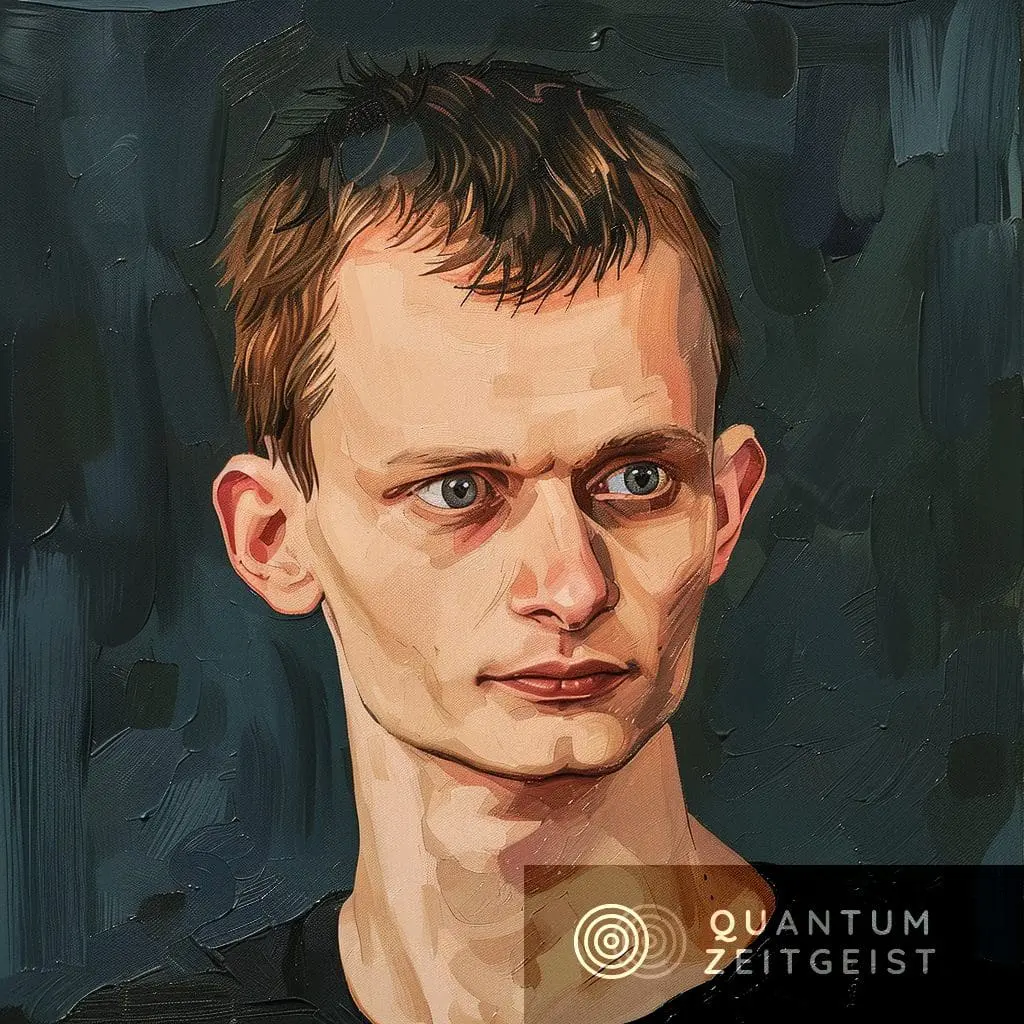
Ethereum co-founder Vitalik Buterin has proposed a strategy to protect user funds in case quantum computers become capable of breaking current cryptographic defenses. The proposal involves a hard fork, a radical change to a network protocol that validates previously invalid blocks/transactions. In a recent post to Ethereum Research, Buterin discussed what would happen if a “quantum emergency” happened as early as tomorrow.
The main concern is that quantum computers could potentially invert elliptic curve multiplications, a key part of Ethereum’s security. Buterin suggests that most users’ private keys, generated through a series of hash calculations, could be protected through a recovery fork. This would require users to download new wallet software but would prevent most from losing their funds.
Quantum Threats to Cryptocurrency and Ethereum’s Response
The advent of quantum computing presents a significant threat to the security of cryptocurrencies, including Ethereum. Quantum computers can break the cryptographic defenses currently in place, potentially leading to large-scale theft of user funds. Ethereum co-founder, Vitalik Buterin, has proposed a strategy to counteract this threat, which involves a hard fork of the Ethereum blockchain.
The Quantum Problem and Ethereum’s Solution
The primary challenge posed by quantum computers lies in their ability to solve problems like the discrete logarithm, which underpins the security of many current cryptographic algorithms, including those used by Ethereum. In simple terms, an Ethereum address is defined by a private key, which is converted into a public key through an elliptic curve multiplication. With quantum computers, this multiplication becomes invertible, potentially revealing the private key and leaving users vulnerable.
Buterin’s proposed solution involves a hard fork of the Ethereum blockchain, which would require users to download new wallet software. However, this would ensure that few users would lose their funds. The key realization is that most users’ private keys are the result of a series of hash calculations. This implies a natural structure for an Ethereum Improvement Proposal (EIP) to hard-fork the chain to recover from a quantum emergency.
The Proposed Hard Fork Strategy
The proposed hard fork strategy involves several steps. First, all blocks after the first block where large-scale theft is happening would be reverted. Traditional transactions would be disabled, and a new transaction type would be added to allow transactions from smart contract wallets. A new transaction type or opcode would be added, which would allow users to provide a STARK proof, proving knowledge of a private preimage, a hash function ID, and a public address. If the proof passes, the user’s account code would be switched over to the new validation code, allowing them to use it as a smart contract wallet from that point forward.
Quantum-Safe Alternatives and Future Developments
Several alternatives and future developments have been suggested in response to Buterin’s proposal. Some users have suggested the use of quantum-secure fallbacks for wallets, hiding a post-quantum key behind the ecdsa key. Others have proposed the use of stateful post-quantum algorithms in hybrid mode with a classical algorithm. However, these would require a significant increase in block sizes due to the large signature and public key sizes of the currently standardized post-quantum dsa scheme.
Another suggestion involves the use of a machine learning monitor system in the node tree to detect large transactions of unsafe or abnormal human transfer, triggering a Stark fail-safe pre-built emergency fork. Some startups are also working on quantum-safe ECDSA based on the pre-image proof, similar to Buterin’s proposal.
Quick Summary
The threat of quantum computing to the security of cryptocurrencies is real and imminent. However, Ethereum’s proposed hard fork strategy, along with other quantum-safe alternatives, offers a promising solution to this problem. As quantum computing continues to develop, it is crucial for the cryptocurrency community to stay ahead of the curve and ensure the security of user funds.
External Link: Click Here For More
Disclaimer. This article is for informational purposes only and does not constitute investment, financial or professional advice. Quantum computing and the cryptography that secures digital assets both evolve rapidly and information may become outdated. Always conduct your own research and consult qualified advisers before making investment decisions. Digital assets are highly volatile and involve significant risk, including the potential loss of your entire investment, and past performance is not indicative of future results.




See today’s quantum computing news on Quantum Zeitgeist for the latest breakthroughs in qubits, hardware, algorithms, and industry deals.