China has a new 71 site Bose–Hubbard quantum simulator for quantum electrodynamics research

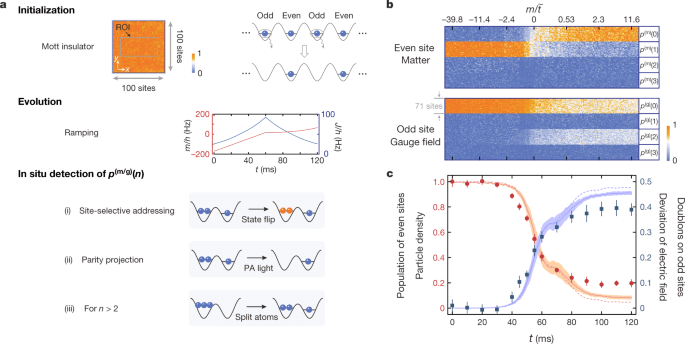
As of late November 2020, The University of Science and Technology of China (USTC) has announced its new breakthrough. Through collaboration with Heidelberg University in Germany and The University of Trento in Italy, they have successfully created a new 71 site Bose–Hubbard quantum simulator. This is groundbreaking for electrodynamics, especially gauge theory.

As classical computers struggle to simulate and calculate the complex problems in gauge theory, scientists decided to create a new quantum computer that can confidently handle these complicated problems. This new computer can construct light lattices to be experimented upon, and the simulation can accurately control the quantum states as well as use a quantum gas microscope to observe these states and understand them.
China has a new 71 site Bose–Hubbard quantum simulator for quantum electrodynamics research
This breakthrough shows the potential of quantum simulations to help better understand fundamental physics

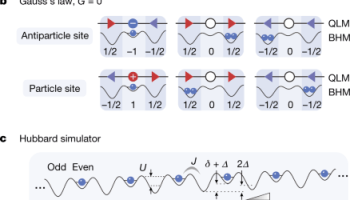
Before this, current research cannot observe the simplest aspect of gauge theory, that is gauge in-variance. Because of this, the researchers behind this new simulation invented their new 71 site Bose–Hubbard quantum simulator. It was used to simulate single-dimension Schwinger models grids, and thus gauge in-variance was observed for the first time. This was also the first time that a multi-grid quantum simulation proved the Gauss’ Law. Important breakthroughs indeed.

This is an important step in simulating light lattices and proves that quantum computing simulations have huge potential.

Read the Original paper

Avatar

Jeremy G

Jeremy G is a prolific writer known for his extensive contributions to the world of technology journalism. With a career spanning over a decade, Jeremy has consistently delivered insightful and factually accurate articles that have educated and informed readers on the latest advancements in the tech industry. Quantum computing emerged as a pivotal subject in Jeremy G's distinguished career as a technology writer. His deep-rooted passion for the field of quantum computing can be traced back to its inception, and he has consistently demonstrated an unwavering commitment to delivering factually accurate and insightful articles on this cutting-edge technology.

Latest Posts by Jeremy G:

OpenAI's DALL-E New Machine Learning Model creates images from text. The AI Art generator

OpenAI’s DALL-E New Machine Learning Model creates images from text. The AI Art generator

September 13, 2021
Canadian government invests in quantum computing to strengthen nation's quantum offering

Canadian government invests in quantum computing to strengthen nation’s quantum offering

March 30, 2021
UKRI appoints Dr. Michael Cuthbert as National Quantum Computing Centre director

UKRI appoints Dr. Michael Cuthbert as National Quantum Computing Centre director

March 13, 2021

Leave a Reply

Your email address will not be published. Required fields are marked *