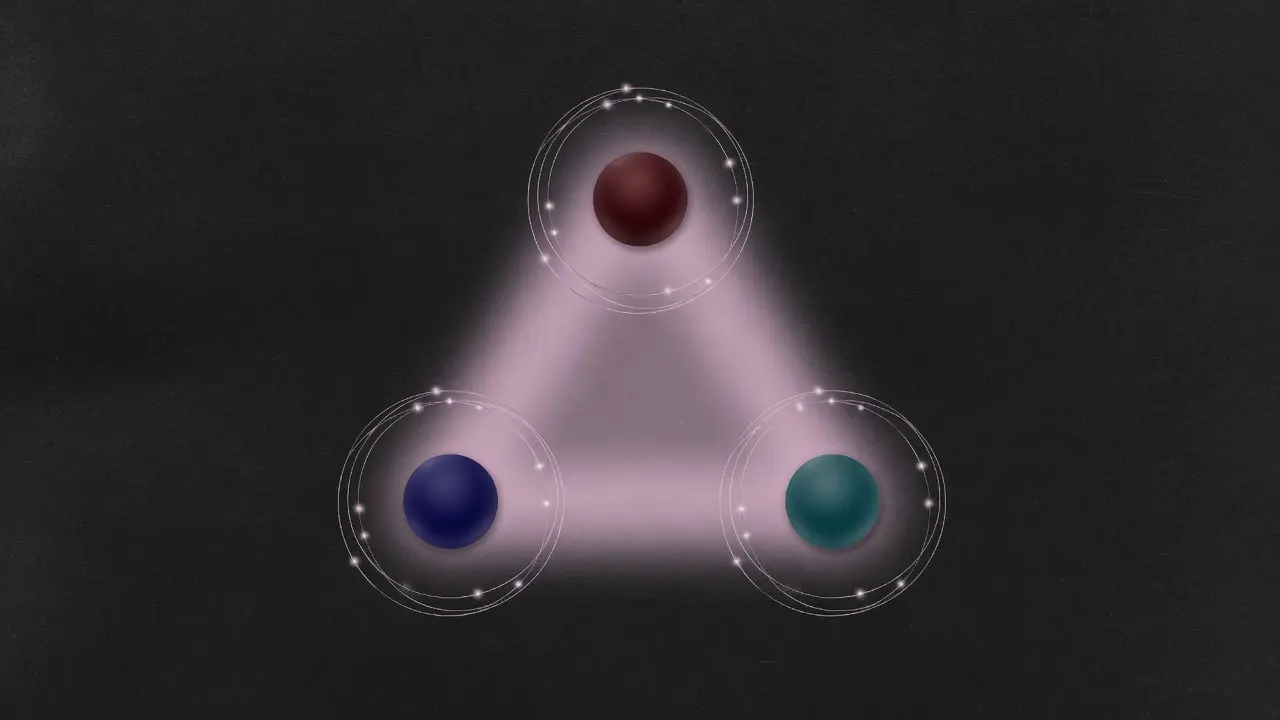
Researchers at Henan University and Capital Normal University have developed new criteria for detecting quantum entanglement without requiring full state tomography, a potentially significant simplification for experimental quantum information science. The work introduces a family of separability criteria based on symmetric measurement correlation matrices, building on existing methods while offering a path to entanglement detection that bypasses complex state reconstruction.
Through illustrative examples, the team demonstrates that their criteria outperform some existing methods, and that they derive a class of lower bounds of concurrence tighter than those previously known. The detection and quantification of quantum entanglement, the authors state, “is a central issue in quantum information science, particularly for unknown quantum states.”
Symmetric Measurement Correlations Detect Entanglement
This approach, detailed in recent work, sidesteps the need to fully characterize a quantum state before confirming its entanglement, a process that can be resource-intensive and prone to error. Instead, the technique focuses on correlations derived from measurements, providing a more direct path to entanglement verification. The new separability criteria not only avoid state tomography but also, according to the authors, outperform some existing methods in identifying entangled states.
The team demonstrated this by constructing correlation matrices from symmetric measurements, a method that also allows for the derivation of a class of lower bounds for concurrence, a measure of entanglement. These lower bounds are reported to be tighter than known counterparts, offering a more precise quantification of the entangled connection between quantum particles. The work builds on earlier research into symmetric informationally complete POVMs (SIC-POVMs) and generalized versions of these measurements, using their inherent symmetry properties.
Illustrative examples presented in the study showcase the improved performance of these new criteria. Specifically, the researchers compared their derived lower bounds of concurrence, obtained using an (8,2)-POVM, against existing benchmarks. The results, visually represented in the paper, show the new bounds consistently provide a more restrictive, and therefore more accurate, assessment of entanglement strength. “Detailed examples show that our criteria detect more entangled states and provide tighter lower bounds of concurrence than the existing benchmarks,” the authors state.
The methodology relies on symmetric (N,M)-POVMs, consisting of N d-dimensional measurement operators, and the associated probability matrices derived from these measurements. By realigning these measurement probabilities, the researchers constructed matrices that is the basis for their separability criteria and concurrence lower bounds.
The team notes that future research could explore the use of generalized equiangular weighted frames (GEWFs) to further refine this approach, potentially leading to even more powerful entanglement detection tools and improved estimates of the Schmidt number, another measure of entanglement. No data were created or analyzed during the study, indicating the work is entirely theoretical and computational.
(N,M)-POVMs and Probability Matrix Foundations
Symmetric (N,M)-POVMs, a framework encompassing both multiplexed measurement (MUMs) and generalized symmetric informationally complete positive-operator-valued measures (GSIC-POVMs), provide a foundation for new separability criteria. These POVMs, defined by measurement operators Eα,k | k=1,2,…,M with α = 1,2,…,N, allow for the construction of probability matrices central to assessing entanglement. The utility of this approach lies in its ability to refine existing entanglement detection methods. Specifically, researchers have demonstrated that for any separable state ρAB on HA⊗HB, certain inequalities hold true when using these (N,M)-POVMs.
These inequalities, built upon matrices constructed from joint outcome probabilities, offer a means of identifying entangled states with greater precision than previously possible. The construction of matrix Q(ρAB) for a bipartite state ρAB, where ‘a’ belongs to Rᵐ and ‘b’ to Rⁿ, is key to this process. The first equality in the derived inequalities follows from Q(sumkpρk⊗ρk) = sumkpQ(ρk⊗ρk), highlighting the mathematical basis for the criterion.
The application of GSIC-POVMs and MUMs yields specific corollaries, enhancing the framework’s versatility. Using MUMs leads to a corresponding condition, demonstrating the adaptability of the (N,M)-POVM framework to different measurement strategies. The resulting matrix G(ρAB), with entries defined as Tr[(MAα⊗MBβ)ρAB], is a critical component in determining separability.
Analysis of a mixture of a bound entangled state proposed by Horodecki and the 9×9 identity matrix, denoted as ρ(τ,q), reveals tighter lower bounds on the concurrence, a measure of entanglement. A comparison of the bounds derived from this work with those presented in a previous study, using (8,2)-POVMs with t = 0.01, shows a clear advantage.
Generalized Correlation Matrices Enhance Separability Criteria
The ability to define the boundaries of quantum entanglement has been advanced through a new approach focusing on the relationships between measurements, rather than requiring complete knowledge of a quantum state. This technique relies on constructing matrices from measurement probabilities obtained through symmetric measurements, offering greater flexibility than previous methods. This framework recovers existing entanglement criteria as specific instances, but introduces a novel element: an auxiliary block within the constructed matrix that can be an arbitrary-ranked matrix.
The technique’s strength lies in its reliance on local measurement statistics, making it particularly well-suited for practical applications where complete state knowledge is unattainable. These advancements, combined with the recent introduction of (N,M)-POVMs, have opened the way to more versatile entanglement detection methods.
The current work integrates these concepts, offering a unified framework for analyzing and quantifying entanglement through measurement-based criteria. The authors state, highlighting the compatibility and expansion of existing techniques. The flexibility of this new criterion is further emphasized by the ability to recover all related earlier criteria simply by setting a parameter to one. This adaptability makes the method broadly applicable to various experimental scenarios and quantum states. The study’s findings represent a step toward more practical and robust methods for characterizing and harnessing entanglement in quantum information science.
This theorem also encompasses previously published lower bounds as special cases, demonstrating its broader applicability and compatibility with established techniques. The researchers demonstrated that their method identifies a wider range of entangled states than earlier criteria.
Rank-One Limitations in Existing Criteria
Existing methods for identifying entangled quantum states often rely on constructions that inadvertently limit their effectiveness, according to new work focused on refining the measurement of quantum correlations. Previous approaches, including those using symmetric informationally complete positive operator-valued measures (SIC-POVMs), frequently employed auxiliary blocks in their entanglement detection matrices that were restricted to rank-one structures. This inherent limitation restricted the amount of probability information these blocks could encode, hindering the ability to discern subtle forms of entanglement.
The research team addressed this constraint by generalizing the construction of these matrices, allowing the upper-left block to possess an arbitrary rank. This extension not only strengthens existing criteria but also unifies them, with previously established methods recoverable by simply setting the rank to one. This shift in approach allows for substantially greater flexibility in identifying entanglement. The ability to achieve these tighter bounds stems from the use of an arbitrary-ranked matrix in the upper-left corner of the constructed matrix, a departure from the scalars or rank-one matrices used in prior studies.
The construction of measurement operators within informationally complete POVMs relies on a specific parameter range to guarantee positivity, a condition dictated by the maximum and minimum eigenvalues of Hermitian operators. Using the constructed correlation matrices, the authors further derive a class of lower bounds of concurrence.
👉 More information
🗞 Separability and lower bounds of concurrence via symmetric measurement correlations
✍️ Yuhang Xie and Yanjun Chu (School of Mathematics and Statistics, Henan University, Kaifeng 475004, China); Shao-Ming Fei (School of Mathematics Sciences, Capital Normal University, Beijing 100048, China)
🧠 ArXiv: https://arxiv.org/abs/2611.07727v1




See today’s quantum computing news on Quantum Zeitgeist for the latest breakthroughs in qubits, hardware, algorithms, and industry deals.