
A project from one Commodore 64 enthusiast has created a program that allows users to run elementary quantum circuit from fundamental gates on the vintage computer which was popular in the 1980s. The computer can handle the following two-qubit gates: Pauli-X, Pauli-Y, Pauli-Z, Hadamard, CNOT and SWAP.
Of course, there is no “quantum” underneath, as the hardware has no quantumness inherent in the hardware. Still, for small circuit sizes, classical computers can easily simulate a quantum circuit constructed of these gates. The source code is available for anyone to use should they wish to implement it on C64 hardware or an emulator.
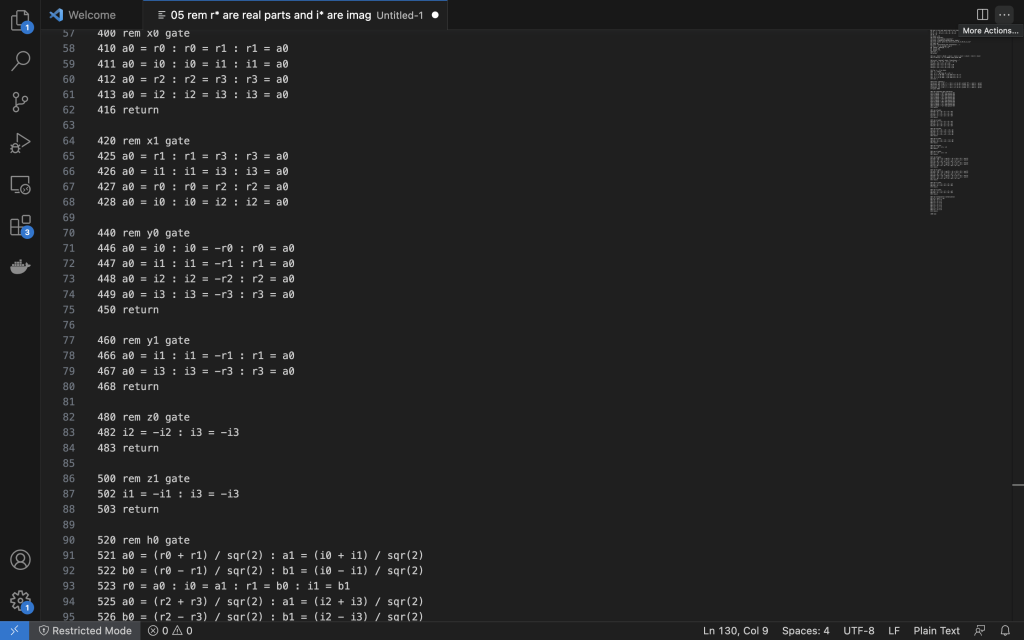
Quantum computing is often associated with highly advanced, cutting-edge technology. However, the key factor in computing, whether it’s classical or quantum, is the speed and accuracy of the system. This concept is illustrated by Davide ‘dakk’ Gessa, who implemented these quantum gates using under 130 lines of BASIC code on a Commodore 64. You can check out the BASIC code here and the wider GitHub project here.
Sure, it’s a bit nerdy, but it does illustrate that fundamental operations of qubits are simply rotations, and once the math is nailed down, it’s just a computation. It doesn’t require a lot of horse-power either, unless you want to run a massive circuit (which is the point of a quantum computer). Also good that two words separated by 40 years are now unified!
There is no limit to the machines that simulators could be extended to, enabling almost all the world’s machines to computer external quantum circuits. Perhaps we’ll see a version for a Sinclair Spectrum ZX or Sinclair Z81 next!? But the Commodore 64 is one of the more popular vintage computers, and there are still quite a few around.



See today’s quantum computing news on Quantum Zeitgeist for the latest breakthroughs in qubits, hardware, algorithms, and industry deals.